

























GET HCM
magazine
Sign up for the FREE digital edition of HCM magazine and also get the HCM ezine and breaking news email alerts.
Not right now, thanksclose this window I've already subscribed!
Follow Health Club Management on Twitter Like Health Club Management on Facebook Join the discussion with Health Club Management on LinkedIn
FITNESS, HEALTH, WELLNESS

features

Retention: It all adds up

Is it worth getting your members to visit more frequently? Dr Melvyn Hillsdon does the sums based on the latest findings of the TRP 10,000 survey

By Dr Melvyn Hillsdon , University of Exeter | Published in Health Club Management 2015 issue 11
New members who attend at least once in a month are 27 per cent less likely to cancel in the next month / PHOTO: SHUTTERSTOCK.COM

There’s considerable variation in how frequently members use their clubs. A fine balance is required to avoid clubs feeling over-crowded, but at the same time ensure members attend often enough to feel they’re getting value for money.

We’ve previously reported that member attendance is linked to membership retention, with non-attendance in any given month increasing the risk of cancellation in the subsequent month. Using data from the updated TRP 10,000 study of membership retention, we’ll use visit frequency and retention data to examine the financial implications of member usage patterns with the aim of informing club strategy and policies on usage levels.

Frequency of use
During the first 12 months of their membership, TRP 10,000 members used their clubs an average of 4.1 times each month. However, this is skewed somewhat by a small number of members who visit a lot, and a higher number of visits in the early months.

Figure 1 shows the proportion of members reporting no visits at all in each month after joining: around 30 per cent of members fail to visit their club in each of the first three months of membership, increasing to more than half by month 12.

However, this is only important if we show that not visiting in a month increases the risk of cancellation – and our data shows that each month a member makes at least one visit to their club, their likelihood of cancellation reduces by 20 per cent compared to members who don’t attend at all.

For members in the first six months of membership, the benefit of attending is even higher: making at least one visit in a month reduces the risk of cancelling in the next month by 27 per cent.

This suggests that failing to attend the club for a month is more likely to lead to cancellation among newer, rather than established, members.

The bottom line
A key question is, of course: do more visits translate into more income?
One way to estimate the impact of retention on income is to model the retention of 1,000 members over the first 24 months of membership. Assuming all members pay a monthly fee of £50, we can then plot the income for each month by multiplying the £50 monthly fee by 1,000 (the original number of members) and then by the proportion of members still paying in any given month.

We can then layer visit frequency on top of this. Table 1 (overleaf) displays the income for each month after joining according to frequency of visit. Each column is a separate scenario, each based on 1,000 original members and assuming all retained members attend the same number of times a week. So in month one, the income from an original 1,000-member sample paying £50 a month and all attending less than once a week would be £48,875 [1,000 x 50 x 0.9775 – the latter being the retention rate in the TRP 10,000 study]. In month 18, the income from an original 1,000-member sample paying £50 a month and all attending twice a week would be £35,610 [1,000 x 50 x 0.7122].

Standardising the number of members in each group and the monthly fee means we can judge the impact of different attendance levels, and the accompanying retention rates, on total income without results being skewed by differences in fee or number of members.

Over 24 months, a difference in total income of 17 per cent is seen between a member base where all members attend less than once a week versus one where all attend at least three times a week.

Monthly incomes are also higher in each month after joining for every increase in visit frequency: any increase in members’ average visit frequency results in increased income from membership dues with immediate effect.

Theory into practice
In Table 2, rather than use a simulated sample of members, we applied the method to the actual members who participated in TRP 10,000.

In our sample: 2,724 members attended their club less than once a week on average; 3,977 less than twice a week; 2,261 less than three times a week; and 1,038 at least three times a week. Assuming they all paid £50 a month for their membership, Table 2 displays the 24-month income from each group based on the attendance and consequent retention rates observed for them. On this basis, an original 10,000 members paying £50 a month according to their visit frequency would yield just over £9m.

The highest income comes from the members who visit once a week simply because they represent the largest group and have a higher retention rate than members who attend less frequently – not because attending once a week is the most effective attendance pattern.

Changing visit frequency
We can repeat this exercise to estimate how a change in visit frequency would alter 24-month income. For the purpose of this article, Table 3 displays revised incomes based on a 10 per cent upward change (same 10,000 total but a revised ‘N’ – number of people in the group – for each of the groups); the new numbers in each group are displayed in the second row. Over 24 months of membership, a 10 per cent increase in average attendances would lead to an increase in revenues of £43,343 from this cohort of 10,000 members.

An alternative strategy would be to work harder to reduce the number of members attending less than once a week. Table 4 shows what would happen to incomes if the number of members in the lowest attending group were reduced by 50 per cent, with half of them moved to a once a week and half to twice a week. The second strategy would yield £141,260 more compared to the income in Table 2.

Summary
It’s clear that increasing the average visit frequency of members yields more income from membership dues because of the higher retention rate. Although any uplift in average visit frequency will increase income, reducing the proportion of members who visit less than once a week – moving them to an average frequency of once a week – yields more income than increasing the visit frequency of members who already visit regularly.

Also, targeting members in their first six months who fail to attend in a given month will have the greatest impact on reducing premature cancellations.

FIGURE 1:

THE NO-SHOWS

The proportion of members reporting no clubs visits (by number of months after joining)
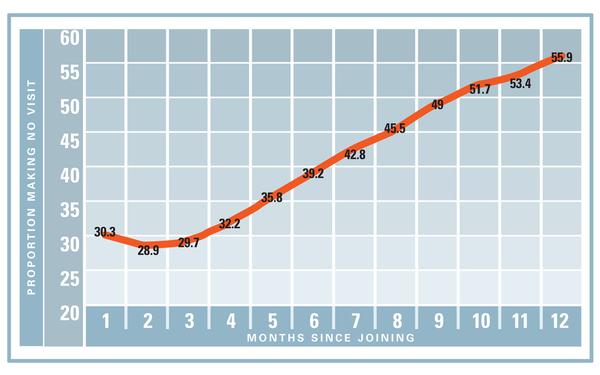
FIGURE 1
FIGURE 1

Ongoing tracking

The TRP 10,000 study initially surveyed 10,000 health and fitness members on their exercise habits and membership behaviour between July and September 2013. In the next development of this project, this same group of members has now been followed for a further two years, tracking cancellation and survival rates up to the end of August 2015.

During the follow-up period, 45 per cent of participating members cancelled their membership. To date, TRP 10,000 members have an average follow-up period (to their cancellation date or the end of August 2015, whichever comes first) of 20 months from the date they completed the questionnaire, and 47 months from their original join date.

TABLE 1:

MORE VISITS = MORE REVENUE?

Estimated income per month for 24 months after joining, for four different scenarios – 1,000 original members all attending:

(a) less than once a week,
(b) once a week,
(c) twice a week, or (d) three or more times a week
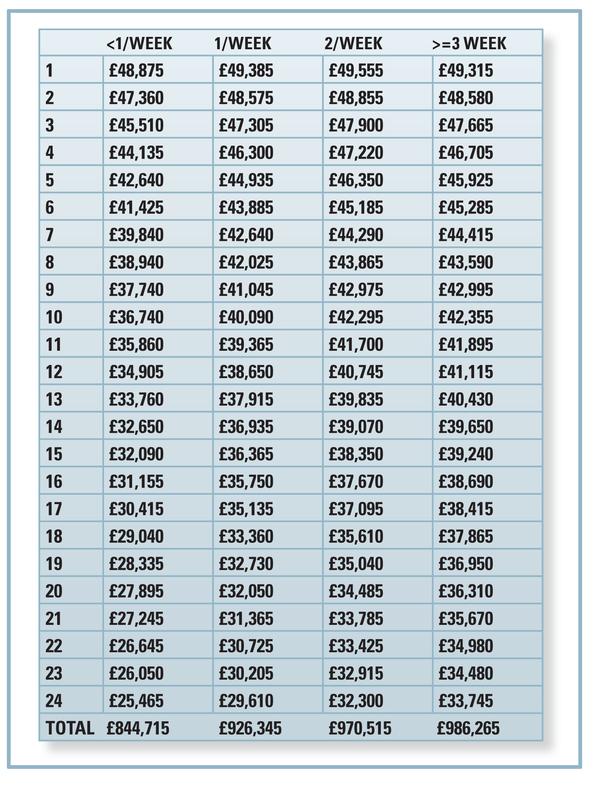
TABLE 1
TABLE 1

TABLE 2:

THEORY INTO PRACTICE

Estimated 24-month income from TRP 10,000 members
based on retention rates for different attendance groups
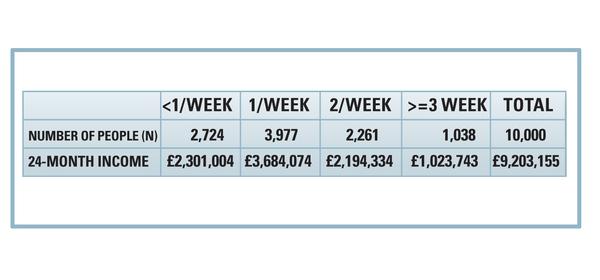
TABLE 2
TABLE 2

TABLE 3:

BOOSTING ATTENDANCE - SCENARIO 1

Estimated 24-month income from TRP 10,000 members based on
retention rates for different attendence groups, if attendance in each group were increased by 10%
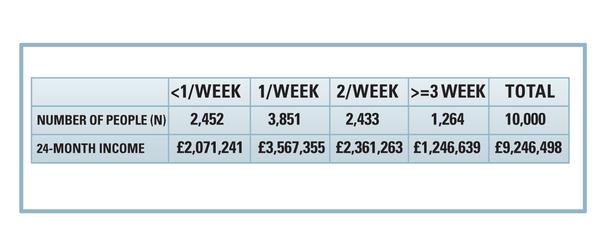
TABLE 3
TABLE 3

TABLE 4:

BOOSTING ATTENDANCE - SCENARIO 2

Estimated 24-month income from TRP 10,000 members based on retention rates for different attendance groups, if the number of members in the bottom group were reduced by 50% and these members equally redistributed between 1/week and 2/week
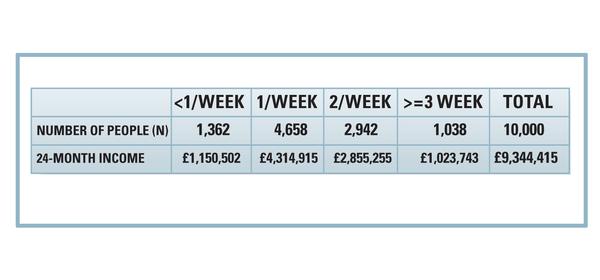
TABLE 4
TABLE 4

Recommendations

• Understand the patterns of attendance and non-attendance, their impact on membership and how this applies to the clubs you run.

• Develop a customer experience strategy to reduce the proportion of members who visit less than once a week.

• Develop a strategy for targeting any members in their first six months of membership who fail to attend for a month – use a range of methods to effectively intervene.

• View all club attendances as an opportunity for all employees to ‘sell’ another visit – that is, provide an experience that members wish to return for, signpost members to activities they may enjoy, discuss attendance with them, and ask members about their next visit.

About the author

Dr Melvyn Hillsdon is associate professor of exercise and health at the University of Exeter, where he researches physical activity and population health. Since his landmark retention report in 2001 (Winning the Retention Battle), he has published numerous reports into the determinants of membership retention.

Sign up here to get HCM's weekly ezine and every issue of HCM magazine free on digital.
Clubs should be working harder to reduce the number of members attending less than once a week / SHUTTERSTOCK.COM
https://www.leisureopportunities.co.uk/images/101619_59465.jpg
Is it worth getting your gym members to visit more frequently? The sums certainly add up...
Dr Melvyn Hillsdon ,Retention, visit frequency, attendance, Melvyn Hillsdon, TRP 10,000
HCM magazine
HCM People

Jamie Clements

The Breath Coach
I experienced a blissful feeling of joy I hadn’t felt since I was a kid
HCM magazine
Strength training is evolving, driven by changing consumer preferences. Julie Cramer talks to innovators about how their products are meeting this demand
HCM magazine
HCM People

Stephen Price

Founder, SP&Co Group
Working in public health over the last few years has lit up parts of my brain again
HCM magazine
As the entrepreneur who started Wexer, Fresh Fitness, Fitness DK and Repeat, as well as being a former elite athlete, Rasmus Ingerslev’s life looked perfect from the outside, but onthe inside it was a different story. He talks to Kath Hudson about healing old wounds
HCM magazine
For every member with a tripod and a big following, there are others irritated at the way equipment is being hogged or wary they’ll be in the background on someone’s Insta feed. Do influencers offer valuable, free marketing or are they just a nuisance? Kath Hudson finds out how operators are responding
HCM promotional features
Sponsored
SnowDome Fitness has added 50 per cent more space with cutting-edge Technogym solutions
HCM promotional features
Sponsored
David Lloyd is stepping up its commitment to women’s health as it continues to explore what fit-for-purpose looks like for the female population
HCM promotional features
Sponsored
Starpool supports Olympic champion Marcell Jacobs, says Riccardo Turri
HCM promotional features
Sponsored
Third Space partnered with IndigoFitness to deliver a bespoke training space for its new club at The Whiteley
HCM promotional features
Sponsored
Find out how your gym can tap into the corporate wellness boom
HCM promotional features
Sponsored
Greg Bradley looks at the shift towards strength training in gyms and advises on how operators can create the ultimate training environment
HCM promotional features
Sponsored
EGYM has opened a new HQ in Paternoster Square, London and revealed a range of new launches
HCM promotional features
Sponsored
The industry is embracing consumer-facing tech. Now it’s time to streamline back-of-house systems with Orbit4, says Daniel Jones
HCM promotional features
Sponsored
Pulse Fitness has created a new health club delivering an elevated wellness experience
HCM promotional features
Latest News
Celebrating its 10th anniversary, Elevate has had its busiest show to date, with almost 200 ...
Latest News
A new report from Your Personal Training (YPT) suggests UK gym operators could be missing ...
Latest News
Eighty-four per cent of consumers now say wellness is a top priority in their lives, ...
Latest News
Elevate Arena is underway at London's Excel and the hot topic of AI was the ...
Latest News
PureGym Group has announced that group chief financial officer, Alex Wood, is taking over the ...
Latest News
Independent operator, Fitness Worx Gyms, is introducing private blood testing as a service to members. ...
Latest News
International industry lobbying associations are calling for physical activity and strength training to be deeply ...
Latest News
Global group exercise specialist, Les Mills, is inviting operators to sign up to its Workout ...
Opinion
promotion
Strength training has moved from the margins to the mainstream.
Opinion: Building smarter strength spaces for today’s operators
Featured supplier news
Featured supplier news: Reaching the people most gyms miss: Bedford Gym & Swim Campaign delivers 410 new members
One of the biggest mistakes the fitness industry still makes is advertising almost exclusively to people who already look and live like gym members.
Featured supplier news
Featured supplier news: CoverMe extends matching service to personal training, rewriting how members and personal trainers connect
CoverMe, the global leader in fitness workforce management, today launches CoverMe PT, an on-demand personal training platform that connects the right personal trainer to the right client in under 10 seconds.
Company profiles
Company profile: Sprung Gym Flooring
Sprung Gym Flooring a trusted brand who specialise in high-performance, durable, non-slip rubber gym flooring, ...
Company profiles
Company profile: Total Vibration Solutions Ltd (TVS Group)
TVS Group includes TVS Sports Surfaces, TVS Gym Flooring, TVS Play Surfaces and TVS Acoustics. ...
Supplier Showcases
Supplier Showcase - Future-proofing
Catalogue Gallery
Click on a catalogue to view it online
Featured press releases
Create PT press release: Create sets a new standard with its new personal training diploma
Create's new Personal Training Diploma is built on the depth, real-client practice and coaching judgement that turn a qualification into genuine readiness - taught as one continuous course so that every skill is reinforced and applied, not cleared once and forgotten.
Featured press releases
Leisure Energy press release: Studley Leisure Centre solar panel installation project begins
Stratford-on-Avon District Council is delighted to announce a new solar panel installation project at Studley Leisure Centre, marking an important step towards improving the sustainability of this valued community facility.
Directory
Industrial washing machines
Miele Company Limited: Industrial washing machines
Fitness tracking platform
SpiviTech: Fitness tracking platform
Hot tubs
MSpa International Ltd: Hot tubs
Water experiences and hydrotherapy solutions
Aquaform s.r.l.: Water experiences and hydrotherapy solutions
Spa and beauty equipment
Oakworks Inc: Spa and beauty equipment
Lockers
Crown Sports Lockers: Lockers
Property & Tenders
Stratford, East London.
Lee Valley Regional Park Authority
Property & Tenders
Y Felinheli, LL56 4QN
Newmark
Property & Tenders
Diary dates
22-23 Jun 2026
WX Wakefield , Wakefield, United Kingdom
Diary dates
21-24 Sep 2026
The Langham Huntington Pasadena , Pasadena, United States
Diary dates
06-08 Oct 2026
Messe Stuttgart, Stuttgart, Germany
Diary dates
22-22 Oct 2026
QEII Conference Centre, London,
Diary dates
26-29 Oct 2027
Koelnmesse Exhibition Centre, Cologne, Germany
Diary dates

features

Retention: It all adds up

Is it worth getting your members to visit more frequently? Dr Melvyn Hillsdon does the sums based on the latest findings of the TRP 10,000 survey

By Dr Melvyn Hillsdon , University of Exeter | Published in Health Club Management 2015 issue 11
New members who attend at least once in a month are 27 per cent less likely to cancel in the next month / PHOTO: SHUTTERSTOCK.COM

There’s considerable variation in how frequently members use their clubs. A fine balance is required to avoid clubs feeling over-crowded, but at the same time ensure members attend often enough to feel they’re getting value for money.

We’ve previously reported that member attendance is linked to membership retention, with non-attendance in any given month increasing the risk of cancellation in the subsequent month. Using data from the updated TRP 10,000 study of membership retention, we’ll use visit frequency and retention data to examine the financial implications of member usage patterns with the aim of informing club strategy and policies on usage levels.

Frequency of use
During the first 12 months of their membership, TRP 10,000 members used their clubs an average of 4.1 times each month. However, this is skewed somewhat by a small number of members who visit a lot, and a higher number of visits in the early months.

Figure 1 shows the proportion of members reporting no visits at all in each month after joining: around 30 per cent of members fail to visit their club in each of the first three months of membership, increasing to more than half by month 12.

However, this is only important if we show that not visiting in a month increases the risk of cancellation – and our data shows that each month a member makes at least one visit to their club, their likelihood of cancellation reduces by 20 per cent compared to members who don’t attend at all.

For members in the first six months of membership, the benefit of attending is even higher: making at least one visit in a month reduces the risk of cancelling in the next month by 27 per cent.

This suggests that failing to attend the club for a month is more likely to lead to cancellation among newer, rather than established, members.

The bottom line
A key question is, of course: do more visits translate into more income?
One way to estimate the impact of retention on income is to model the retention of 1,000 members over the first 24 months of membership. Assuming all members pay a monthly fee of £50, we can then plot the income for each month by multiplying the £50 monthly fee by 1,000 (the original number of members) and then by the proportion of members still paying in any given month.

We can then layer visit frequency on top of this. Table 1 (overleaf) displays the income for each month after joining according to frequency of visit. Each column is a separate scenario, each based on 1,000 original members and assuming all retained members attend the same number of times a week. So in month one, the income from an original 1,000-member sample paying £50 a month and all attending less than once a week would be £48,875 [1,000 x 50 x 0.9775 – the latter being the retention rate in the TRP 10,000 study]. In month 18, the income from an original 1,000-member sample paying £50 a month and all attending twice a week would be £35,610 [1,000 x 50 x 0.7122].

Standardising the number of members in each group and the monthly fee means we can judge the impact of different attendance levels, and the accompanying retention rates, on total income without results being skewed by differences in fee or number of members.

Over 24 months, a difference in total income of 17 per cent is seen between a member base where all members attend less than once a week versus one where all attend at least three times a week.

Monthly incomes are also higher in each month after joining for every increase in visit frequency: any increase in members’ average visit frequency results in increased income from membership dues with immediate effect.

Theory into practice
In Table 2, rather than use a simulated sample of members, we applied the method to the actual members who participated in TRP 10,000.

In our sample: 2,724 members attended their club less than once a week on average; 3,977 less than twice a week; 2,261 less than three times a week; and 1,038 at least three times a week. Assuming they all paid £50 a month for their membership, Table 2 displays the 24-month income from each group based on the attendance and consequent retention rates observed for them. On this basis, an original 10,000 members paying £50 a month according to their visit frequency would yield just over £9m.

The highest income comes from the members who visit once a week simply because they represent the largest group and have a higher retention rate than members who attend less frequently – not because attending once a week is the most effective attendance pattern.

Changing visit frequency
We can repeat this exercise to estimate how a change in visit frequency would alter 24-month income. For the purpose of this article, Table 3 displays revised incomes based on a 10 per cent upward change (same 10,000 total but a revised ‘N’ – number of people in the group – for each of the groups); the new numbers in each group are displayed in the second row. Over 24 months of membership, a 10 per cent increase in average attendances would lead to an increase in revenues of £43,343 from this cohort of 10,000 members.

An alternative strategy would be to work harder to reduce the number of members attending less than once a week. Table 4 shows what would happen to incomes if the number of members in the lowest attending group were reduced by 50 per cent, with half of them moved to a once a week and half to twice a week. The second strategy would yield £141,260 more compared to the income in Table 2.

Summary
It’s clear that increasing the average visit frequency of members yields more income from membership dues because of the higher retention rate. Although any uplift in average visit frequency will increase income, reducing the proportion of members who visit less than once a week – moving them to an average frequency of once a week – yields more income than increasing the visit frequency of members who already visit regularly.

Also, targeting members in their first six months who fail to attend in a given month will have the greatest impact on reducing premature cancellations.

FIGURE 1:

THE NO-SHOWS

The proportion of members reporting no clubs visits (by number of months after joining)

FIGURE 1
FIGURE 1

Ongoing tracking

The TRP 10,000 study initially surveyed 10,000 health and fitness members on their exercise habits and membership behaviour between July and September 2013. In the next development of this project, this same group of members has now been followed for a further two years, tracking cancellation and survival rates up to the end of August 2015.

During the follow-up period, 45 per cent of participating members cancelled their membership. To date, TRP 10,000 members have an average follow-up period (to their cancellation date or the end of August 2015, whichever comes first) of 20 months from the date they completed the questionnaire, and 47 months from their original join date.

TABLE 1:

MORE VISITS = MORE REVENUE?

Estimated income per month for 24 months after joining, for four different scenarios – 1,000 original members all attending:

(a) less than once a week,
(b) once a week,
(c) twice a week, or (d) three or more times a week

TABLE 1
TABLE 1

TABLE 2:

THEORY INTO PRACTICE

Estimated 24-month income from TRP 10,000 members
based on retention rates for different attendance groups

TABLE 2
TABLE 2

TABLE 3:

BOOSTING ATTENDANCE - SCENARIO 1

Estimated 24-month income from TRP 10,000 members based on
retention rates for different attendence groups, if attendance in each group were increased by 10%

TABLE 3
TABLE 3

TABLE 4:

BOOSTING ATTENDANCE - SCENARIO 2

Estimated 24-month income from TRP 10,000 members based on retention rates for different attendance groups, if the number of members in the bottom group were reduced by 50% and these members equally redistributed between 1/week and 2/week

TABLE 4
TABLE 4

Recommendations

• Understand the patterns of attendance and non-attendance, their impact on membership and how this applies to the clubs you run.

• Develop a customer experience strategy to reduce the proportion of members who visit less than once a week.

• Develop a strategy for targeting any members in their first six months of membership who fail to attend for a month – use a range of methods to effectively intervene.

• View all club attendances as an opportunity for all employees to ‘sell’ another visit – that is, provide an experience that members wish to return for, signpost members to activities they may enjoy, discuss attendance with them, and ask members about their next visit.

About the author

Dr Melvyn Hillsdon is associate professor of exercise and health at the University of Exeter, where he researches physical activity and population health. Since his landmark retention report in 2001 (Winning the Retention Battle), he has published numerous reports into the determinants of membership retention.

Sign up here to get HCM's weekly ezine and every issue of HCM magazine free on digital.
Clubs should be working harder to reduce the number of members attending less than once a week / SHUTTERSTOCK.COM
https://www.leisureopportunities.co.uk/images/101619_59465.jpg
Is it worth getting your gym members to visit more frequently? The sums certainly add up...
Dr Melvyn Hillsdon ,Retention, visit frequency, attendance, Melvyn Hillsdon, TRP 10,000
Latest News
Celebrating its 10th anniversary, Elevate has had its busiest show to date, with almost 200 ...
Latest News
A new report from Your Personal Training (YPT) suggests UK gym operators could be missing ...
Latest News
Eighty-four per cent of consumers now say wellness is a top priority in their lives, ...
Latest News
Elevate Arena is underway at London's Excel and the hot topic of AI was the ...
Latest News
PureGym Group has announced that group chief financial officer, Alex Wood, is taking over the ...
Latest News
Independent operator, Fitness Worx Gyms, is introducing private blood testing as a service to members. ...
Latest News
International industry lobbying associations are calling for physical activity and strength training to be deeply ...
Latest News
Global group exercise specialist, Les Mills, is inviting operators to sign up to its Workout ...
Latest News
Global luxury hospitality brand, Six Senses, has partnered with longevity healthcare provider, HUM2N, to launch ...
Latest News
Premium London health club, KX Chelsea, is gearing up to unveil its most significant redevelopment ...
Latest News
Researchers in the US have identified an antibody which could greatly reduce the loss of ...
Opinion
promotion
Strength training has moved from the margins to the mainstream.
Opinion: Building smarter strength spaces for today’s operators
Featured supplier news
Featured supplier news: Reaching the people most gyms miss: Bedford Gym & Swim Campaign delivers 410 new members
One of the biggest mistakes the fitness industry still makes is advertising almost exclusively to people who already look and live like gym members.
Featured supplier news
Featured supplier news: CoverMe extends matching service to personal training, rewriting how members and personal trainers connect
CoverMe, the global leader in fitness workforce management, today launches CoverMe PT, an on-demand personal training platform that connects the right personal trainer to the right client in under 10 seconds.
Company profiles
Company profile: Sprung Gym Flooring
Sprung Gym Flooring a trusted brand who specialise in high-performance, durable, non-slip rubber gym flooring, ...
Company profiles
Company profile: Total Vibration Solutions Ltd (TVS Group)
TVS Group includes TVS Sports Surfaces, TVS Gym Flooring, TVS Play Surfaces and TVS Acoustics. ...
Supplier Showcases
Supplier Showcase - Future-proofing
Catalogue Gallery
Click on a catalogue to view it online
Featured press releases
Create PT press release: Create sets a new standard with its new personal training diploma
Create's new Personal Training Diploma is built on the depth, real-client practice and coaching judgement that turn a qualification into genuine readiness - taught as one continuous course so that every skill is reinforced and applied, not cleared once and forgotten.
Featured press releases
Leisure Energy press release: Studley Leisure Centre solar panel installation project begins
Stratford-on-Avon District Council is delighted to announce a new solar panel installation project at Studley Leisure Centre, marking an important step towards improving the sustainability of this valued community facility.
Directory
Industrial washing machines
Miele Company Limited: Industrial washing machines
Fitness tracking platform
SpiviTech: Fitness tracking platform
Hot tubs
MSpa International Ltd: Hot tubs
Water experiences and hydrotherapy solutions
Aquaform s.r.l.: Water experiences and hydrotherapy solutions
Spa and beauty equipment
Oakworks Inc: Spa and beauty equipment
Lockers
Crown Sports Lockers: Lockers
Property & Tenders
Stratford, East London.

Lee Valley Regional Park Authority
Property & Tenders
Y Felinheli, LL56 4QN
Newmark
Property & Tenders
Diary dates
22-23 Jun 2026
WX Wakefield , Wakefield, United Kingdom
Diary dates
21-24 Sep 2026
The Langham Huntington Pasadena , Pasadena, United States
Diary dates
06-08 Oct 2026
Messe Stuttgart, Stuttgart, Germany
Diary dates
22-22 Oct 2026
QEII Conference Centre, London,
Diary dates
26-29 Oct 2027
Koelnmesse Exhibition Centre, Cologne, Germany
Diary dates
Search news, features & products:
Find a supplier:
Partner sites