




















features
Expansion plans
Franchising is now a significant part of the sector, as this market grows and corporate health club operators also use the model to drive expansion. Kath Hudson takes a look at recent activity


Back at pre-pandemic figures, with membership and same-store sales up 15.5 per cent, Lift Brands CEO, Ty Menzies, recently confirmed to HCM that the company – which owns Snap Fitness and Fitness On Demand – is looking for new backers. Current owner, TZP, had intended to back the business for five years before exiting, but has been locked in for 10 years due to COVID.
Menzies has been getting the business in shape with a brand repositioning, refreshing the strategy and management team and laying out expansion plans. “We have a very clear plan, a strong management team and a few possible areas of acquisition, so it’s about finding an investor that wants to buy into this,” he told HCM in an interview.
“There are ambitions to increase the number of units from 1,000 to 1,350 by 2028. The expansion will be predominantly in the US, Australia and the UK, with additional growth in Ireland, elsewhere in Europe and APAC.”
Expansion will be focused on the 19 markets the brand currently operates in, with existing franchisees expected to take on additional units. “We sold 77 licences last year, the most since 2012 – 70 per cent to existing franchisees,” said Menzies.
Based on customer feedback, with people saying they want to feel stronger, the configuration of clubs has changed to include more weights, with 20 to 30 per cent less cardio. Wellness and recovery spaces may be added if it can be done within the model of affordable convenience.
Empowered Brands
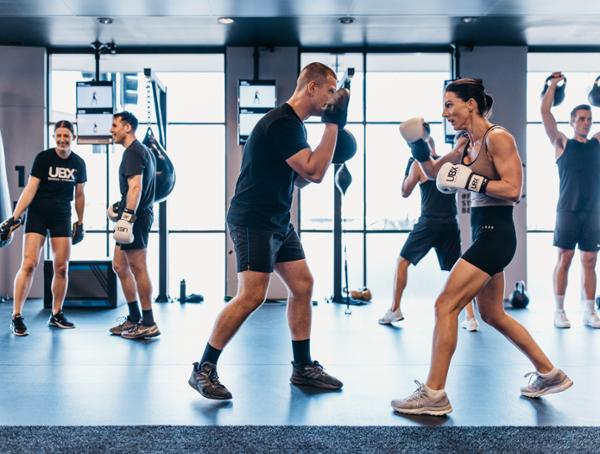
Empowered Brands, owner of énergie Fitness and master franchisor in the UK and Ireland for Australian brand, UBX Boxing + Strength, has recently added staffless concept, Fit+, to its portfolio.
Mark Pinner, CEO, says Empowered Brands will be rolling Fit+ out across the UK and Ireland: “As a digitally-operated and staffless gym brand, Fit+ has lower investment levels than traditional gym franchises and provides a more accessible route for people to own a fitness franchise and open their own gym,” he says.
Another advantage of the model is that it has been designed to serve smaller towns, which means clubs can be opened in rural areas. Pinner says technology to allow unstaffed hours offers flexibility and accessibility for members and frees up the franchisee to focus on expanding the business.
TRIB3
HIIT specialist, TRIB3, continues to expand, with more studios recently launched in Helsinki, Finland, when an existing franchisee took on two more sites after a robust performance from an existing studio in the iconic Adlon Theater.
TRIB3 executive chair, Jonathan Fisher, says: “As TRIB3 transitions from franchise start-up to early growth phase, reaching between 30 to 40 studios this year [there are currently 17 sites open], it’s pleasing to see franchise partners electing to open second and third studios in their chosen markets.”
The company launched a second concept, PILAT3S, in February that aims to take Reformer Pilates to a mainstream audience, offering three 50-minute classes – Tone, Align and Power. Urban Gym Group announced in May that it would be the first operator to debut the brand, at ClubSportive in Amsterdam.
Crunch Fitness
Franchising heavyweight, John Kersh, recently left Xponential Fitness and joined Crunch Fitness to head up international development. In his new role, Kersh is responsible for identifying global franchise partners to drive expansion.
President of Crunch Fitness, Chequan Lewis, says: “Having John join our team is another step in the right direction. We’re keeping a foot on the gas pedal as we look to drive new openings, both domestically and internationally.”
Crunch already has gyms in a number of countries, including Canada, Spain, Portugal and Australia and is looking to expand into new territories. As it celebrates its 35th anniversary, there are 460 gyms and 2.5 million members, with ambitions to reach three million members and 500 clubs by the end of the year.
Self Esteem Brands
Having announced a merger with Orangetheory Fitness, to create a US$3.5 billion, 7,000-site business, Self Esteem Brands has said it’s aiming for 10,000 sites worldwide within five years.
The company owns a number of franchise IPs, including Basecamp Fitness, SUMHIIT Fitness, The Bar Method, Waxing the City and Stronger U Nutrition, with Anytime Fitness being its flagship brand.
In recent months, Anytime Fitness has expanded into the UAE with a master franchise deal, backed by emerging-market specialist, Mark Mobius, which will see the launch of the first club in Dubai.
“When we look at the places where our presence and brands can make a meaningful difference and capture strong growth, UAE is top of the list,” says Sander van den Born, executive VP international.
Fast Fitness Japan, which runs 1,100 Anytime Fitness clubs in Japan – and has plans for 1,400 by end of 2027 – acquired the master franchise for the brand in Germany in May. CEO, Kiyoaki Yamabe, is ambitious about launching more sites in Japan and Germany, as well as further afield, saying: “We’ll continue to work closely with Self Esteem Brands’ head office in the US to further accelerate the opening of new clubs in Germany and other countries.”
PureGym
PureGym, is the second largest European operator, with more than 600 corporate-owned sites in the UK, Denmark and Switzerland and has just surpassed two million members. The company is rolling out a franchise model with partners who operate 20 sites in the Middle East and also partners in the US.
In the next three to four years, PureGym has plans to develop 200 more clubs and after a refinancing deal in the fourth quarter of 2023, is in the financial position to do so. There are plans for 60-70 new sites in 2024, with 15-20 being in the Middle East.
“With our franchise concept now firmly proven, we’re actively exploring partnership opportunities to take our affordable, accessible gym proposition to other territories, such as Japan and India” says CEO, Humphrey Cobbold.
Xponential fitness
Xponential Fitness has made a few changes to its estate during the last six months: offloading Stride and Row House and acquiring Kinrgy – Julianne Hough’s on-line dance concept, which is being made into a bricks and mortar brand – as well as metabolic health company, Lindora.
Its Reformer Pilates brand, Club Pilates, which accounts for one-third of the revenue, is the main focus. The brand came to the UK this year and the third studio, in London, has just been announced. There are plans for 50 to 75.
Planet Fitness
Planet Fitness, the biggest chain in the US, is aiming for 140 to 150 more sites this year and thinks the US can support 5,000. At the end of 2023, the company had 2,575 stores open in the US, having launched 165 more last year. There are also plans to enter the Spanish market with an end goal of 300 locations.
When announcing its Q1 results in May, interim CEO, Craig Benson, said the company was pushing its new franchisee growth model, which reduces the capital requirements for opening and gives franchisees additional flexibility to build their portfolios – for example by relaxing remodel requirements from 10 to 12 years and adjusting re-equips from 5-7 to 6-7 years.
Basic-Fit
Rene Moos, CEO of Basic-Fit has signalled the company is considering growth by franchising. With more than 1,400 locations currently and a record of 202 openings/acquisitions last year, the low-cost operator is targeting 3,000-3,500 clubs in its existing markets – the Netherlands, France, Germany, Spain and Benelux – by 2030. There are plans to have at least 1,575 sites by the end of 2024.
The company acquired 47 clubs from RSG Group earlier this year, in a €50 million deal. The 42 McFit sites are being rebranded to Basic-Fit, but Moos has hinted the five Holmes Place sites might be sold. “We’re currently exploring the options,” he said in a trading update.
Franchising is being considered as a way of growing into new territories, outside Europe. “We’ve initiated a process to determine which approach to franchising would be most suitable to further enhance our company’s growth,” says Moos. “The franchise initiative will cover markets that are not geographically adjacent to our current operations and could enable us to expand into other continents.”


Urban Gym Group has entered the Irish market with the acquisition of Iconic ...
Total Fitness has released new research revealing how the expectations and motivations of ...