Konami’s Dance Dance Revolution (DDR) – a video game played on a dance pad – has shown success in improving children’s health, and attitudes to fitness and self esteem, according to a 24-week clinical study led by West Virginia University (WVU) and West Virginia Public Employees Insurance Agency (PEIA).
The home-based study involved 85 children, who were required to play the game for at least 30 minutes a day, five times a week, and record their activity.
WVU Researchers monitored several health indicators over the course of the study, such as weight, body mass index, blood pressure, arterial function, fitness levels and attitudes towards exercise.
The research was conducted by Dr Linda Carson and Emily Murphy of WVU. They found that, although not all the subjects – all of whom were overweight or obese at the start – lost weight, they did not gain weight and experienced improvements in their aerobic capacity, blood vessel function and overall fitness level.
Carson says: “DDR combines the appeal of ‘screen time’ within a physical activity format.
We are excited we can now demonstrate it as a valuable health tool and something kids enjoy.”
Konami teamed up with PEIA and WVU last January with the aim of placing DDR in all public schools across the state by the end of 2008.
Konami’s Dance Dance Revolution (DDR) – a video game played on a dance pad – has shown success in improving children’s health, and attitudes to fitness and self esteem, according to a 24-week clinical study led by West Virginia University (WVU) and West Virginia Public Employees Insurance Agency (PEIA).
Strength training is evolving,
driven by changing consumer
preferences. Julie Cramer talks
to innovators about how their
products are meeting this demand
For every member with a tripod and a big following, there are others irritated at the way equipment is being hogged or wary they’ll be in the background on someone’s Insta feed. Do influencers offer valuable, free marketing or are they just a nuisance? Kath Hudson finds out how operators are responding
Collaborations with the medical profession and greater aspirations around wellbeing are creating a need for more experts in our sector. It’s time to reboot our thinking around the workforce
Active Blackpool is deploying Cornerstone Connect, a new digital interface allowing
disparate information from multiple systems to be aggregated into one dataset, to support
its focus on reducing health inequalities and improving healthy life expectancy.
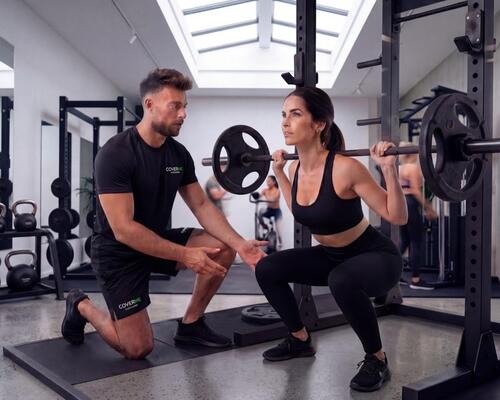
CoverMe, the global leader in fitness workforce management, today launches CoverMe PT, an
on-demand personal training platform that connects the right personal trainer to the right
client in under 10 seconds.
STA is pleased to announce that its Safeguarding Children and Adults at Risk CPD has been
endorsed by the Chartered Institute for the Management of Sport and Physical Activity
(CIMSPA) against both the Safeguarding and Protecting Children and Safeguarding Adults
technical specialism professional standards.
CoverMe, the UK’s leading fitness workforce management and recruitment platform, has
partnered with Jobs In. Fitness, the specialist executive search and advisory firm for the
fitness and wellbeing sector, to give operators a single route to talent at every level –
from frontline staffing to C-suite.
Konami’s Dance Dance Revolution (DDR) – a video game played on a dance pad – has shown success in improving children’s health, and attitudes to fitness and self esteem, according to a 24-week clinical study led by West Virginia University (WVU) and West Virginia Public Employees Insurance Agency (PEIA).
The home-based study involved 85 children, who were required to play the game for at least 30 minutes a day, five times a week, and record their activity.
WVU Researchers monitored several health indicators over the course of the study, such as weight, body mass index, blood pressure, arterial function, fitness levels and attitudes towards exercise.
The research was conducted by Dr Linda Carson and Emily Murphy of WVU. They found that, although not all the subjects – all of whom were overweight or obese at the start – lost weight, they did not gain weight and experienced improvements in their aerobic capacity, blood vessel function and overall fitness level.
Carson says: “DDR combines the appeal of ‘screen time’ within a physical activity format.
We are excited we can now demonstrate it as a valuable health tool and something kids enjoy.”
Konami teamed up with PEIA and WVU last January with the aim of placing DDR in all public schools across the state by the end of 2008.
Konami’s Dance Dance Revolution (DDR) – a video game played on a dance pad – has shown success in improving children’s health, and attitudes to fitness and self esteem, according to a 24-week clinical study led by West Virginia University (WVU) and West Virginia Public Employees Insurance Agency (PEIA).
Strength training is evolving,
driven by changing consumer
preferences. Julie Cramer talks
to innovators about how their
products are meeting this demand
For every member with a tripod and a big following, there are others irritated at the way equipment is being hogged or wary they’ll be in the background on someone’s Insta feed. Do influencers offer valuable, free marketing or are they just a nuisance? Kath Hudson finds out how operators are responding
Collaborations with the medical profession and greater aspirations around wellbeing are creating a need for more experts in our sector. It’s time to reboot our thinking around the workforce
As the entrepreneur who started Wexer, Fresh Fitness, Fitness DK and Repeat, as well as being a former elite athlete, Rasmus Ingerslev’s life looked perfect from the outside, but onthe inside it was a different story. He talks to Kath Hudson about healing old wounds
If the health service is to
survive, we must recognise
that it is a disease service
– and that wellbeing rests with
us, says the activity advocate
and healthy ageing champion.
He talks to Kate Cracknell
Active Blackpool is deploying Cornerstone Connect, a new digital interface allowing
disparate information from multiple systems to be aggregated into one dataset, to support
its focus on reducing health inequalities and improving healthy life expectancy.
CoverMe, the global leader in fitness workforce management, today launches CoverMe PT, an
on-demand personal training platform that connects the right personal trainer to the right
client in under 10 seconds.
STA is pleased to announce that its Safeguarding Children and Adults at Risk CPD has been
endorsed by the Chartered Institute for the Management of Sport and Physical Activity
(CIMSPA) against both the Safeguarding and Protecting Children and Safeguarding Adults
technical specialism professional standards.
CoverMe, the UK’s leading fitness workforce management and recruitment platform, has
partnered with Jobs In. Fitness, the specialist executive search and advisory firm for the
fitness and wellbeing sector, to give operators a single route to talent at every level –
from frontline staffing to C-suite.