

















GET HCM
magazine
Sign up for the FREE digital edition of HCM magazine and also get the HCM ezine and breaking news email alerts.
Not right now, thanksclose this window I've already subscribed!
Elevate Arena
Elevate Arena
Elevate Arena
Follow Health Club Management on Twitter Like Health Club Management on Facebook Join the discussion with Health Club Management on LinkedIn
FITNESS, HEALTH, WELLNESS

features

Retention series: The human touch

What forms of communication do your members value? In the second part of his series based on the findings of the TRP10,000™ study, Dr Melvyn Hillsdon looks at the a of communication

By Dr Melvyn Hillsdon , University of Exeter | Published in Health Club Management 2014 issue 5

Clubs interact with their members in a variety of ways. When members visit their clubs, face-to-face communication channels are via both reception and fitness staff. Away from the club, they receive communication via phone calls, SMS, email and social media. But what level of communication are they receiving, what specific channels of communication do they value, and what quantity and/or types of communication are associated with improved membership retention?

What communication occurs?
Members surveyed were asked whether reception and/or fitness staff spoke to them during their last visit. In addition, they were asked whether they had received a courtesy phone call or email, SMS text or message/information via social media. Finally, members were asked to indicate how much they agreed or disagreed with a series of statements about how much they valued each channel of communication.

Figure 1 shows the proportion of members who reported receiving each type of communication. Less than half of members reported that fitness staff and reception staff spoke to them during their last visit. The most common form of communication away from the club was email, with just under half of members reporting receiving a courtesy email within the last month.

Does communication vary according to gender, age or length of membership? Table 1 shows that females are more likely to receive face-to-face and telephone communication than males, but a little less likely to receive a courtesy email. Face-to-face and telephone communication also increases by age group, but older members are less likely to receive messages via social media.

Longer-standing members are much more likely to report being spoken to by reception staff at their last visit compared to newer members. This is also true for fitness staff communication, albeit the difference is smaller. Although longer-standing members are less likely to receive a SMS text than newer members, there are no clear trends in external club communications by length of membership.

Members who use their club more frequently report receiving more communication from reception and fitness staff, via phone and social media.

What communication is welcome?
Fitness and reception staff communication are the most valued, with nearly nine in 10 members saying they value fitness staff communication (see Figure 2). Of the external methods of communication, email is easily the most valued – this is consistent across age groups, length of membership and usage patterns – with phone calls the least valued. Within this, however, males report valuing any communication form less than females (data not shown).

Older members value reception and fitness staff communication more than younger members, and are more receptive to courtesy telephone calls. They value SMS texts and social media communications less, with these being more valued by younger members.

A similar pattern is observed by length of membership: long-standing members value face-to-face communication above external communication. Members who attend their club regularly value all forms of communication more than members who attend irregularly.

The grey columns in Figure 3 show the percentage of members who report both receiving and valuing each type of communication. The purple columns show the percentage of members who report receiving each type of communication, but who say they do not value them. For example, 56 per cent of members who value being spoken to by reception staff say they were spoken to by these staff at their last visit, while 12 per cent who do not value being spoken to by reception staff were spoken to.

The grey columns highlight that there’s considerable scope for increasing all types of communication to members who would value it. This is especially true in the most valued communication types: fitness and reception staff interactions and courtesy emails.

As noted above, the purple bars in Figure 3 represent members who did not value each of the communication methods – and one stands out. Nearly a third of members who said they did not value email communication reported they had nevertheless received emails. As 32 per cent of members do not value email communication, the potential is there to irritate quite a number of members with unsolicited emails. Perhaps surprisingly, just a quarter of the members who value communication via social media actually report receiving any.

Is communication associated with retention?
Retention rates were calculated based on the time from questionnaire completion (when all members were live) to either the cancellation date (for cancelled members) or 31 January 2014 for live members. Communication methods were separated into two groups. Face-to-face communications were scored ‘0’ if members reported no reception or fitness staff communication at their last visit, ‘1’ if either the reception or fitness staff spoke to them, and ‘2’ if both spoke to them. Too few records were available to examine each of the other methods separately, so external communications were assigned ‘1’ if any were reported (phone calls, emails, texts and social media) or ‘0’ if none were reported.

Figure 4 shows that, compared to not being spoken to at their last visit, members who report being spoken to by either the reception staff or fitness staff have higher retention rates. Further, members who are spoken to by both sets of staff have even higher rates. These findings are true for members at any membership stage (data not shown).

However, Figure 5 shows that receiving external communications in the previous month is unrelated to retention at any period after joining. Although numbers are a little small to formally report, there’s a general trend in the data that indicates that members who receive the communication style they value have the highest retention rates, while those who do not receive what they value have the lowest rates.

Only one exception to this trend was observed: members who received emails they did not value had lower retention rates than members who valued them and did not receive them, suggesting that unsolicited emails may be detrimental.

A plan of action
Members primarily value face-to-face communication from both reception and fitness staff; members receiving such communication have significantly higher retention rates. However, despite this impact on retention, fewer than half of members say that reception and fitness staff spoke to them at their last visit.

Emails are also valued by around two-thirds of members, but again 45 per cent of members do not receive them. On the other hand, 32 per cent of members who do not value emails received them, and there’s some evidence that this may increase the risk of cancelling.

Other forms of communication – such as courtesy phone calls, texts and social media interactions – are less popular overall, but in some groups are still valued. However, external communications generally appear not to be targeted to specific demographic groups, or to really take account of the fact that individual members will prefer certain forms of communication to others, and often seem to be unrelated to length of membership or visit frequency. The low overall level of external communication, along with this lack of targeted and tailored messages, may explain why such communication is not associated with membership retention.

Based on these findings, our recommendations are as follows:
Develop a targeted communications strategy designed to maximise opportunities to interact with members, both within and outside of the club.

Create a conversation culture within the club – implement methods to maximise face-to-face communications.

Identify preferences – consult with members to understand how and when they want to be communicated with. If nothing else, work in line with the preferences identified in this article.

Target emails – ensure emails are only sent to those members who value them.

Restrict unsolicited phone calls – only call those who want to receive them.

Table 1: Communication type received by gender, age group, length of membership and visit frequency
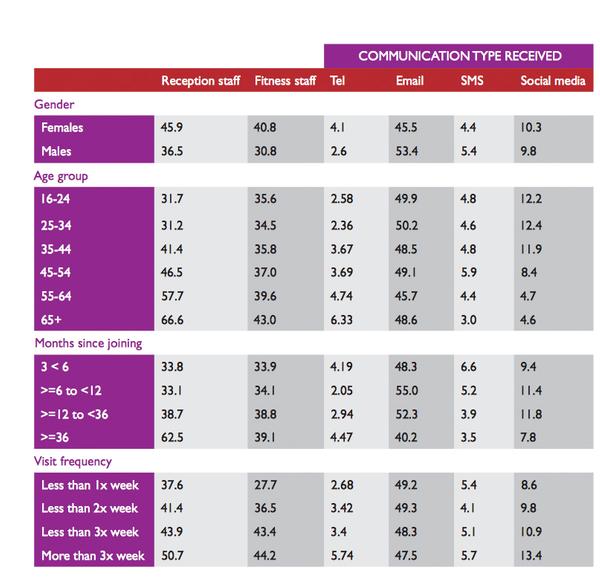
Table 1
Table 1

Fig 1: Proportion of members reporting different communication methods
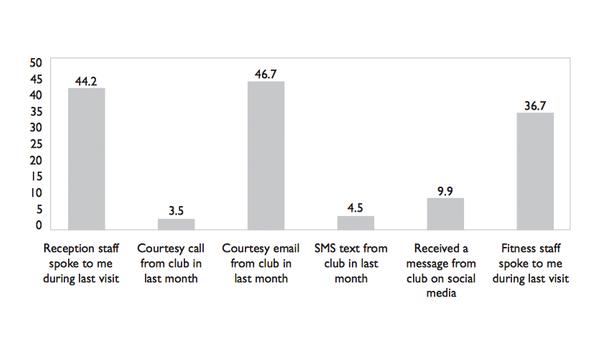
Fig 1
Fig 1

Fig 2: Proportion of members who say they value different types of communication
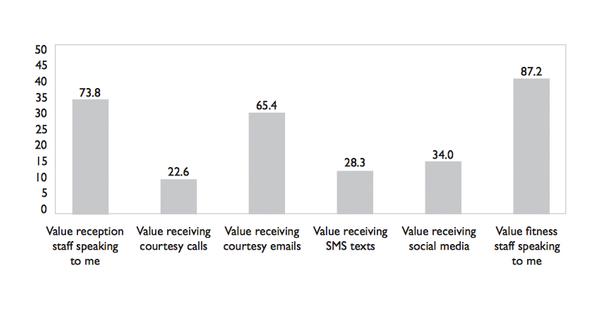
Fig 2
Fig 2

Fig 3: Proportion of members receiving
communications according to whether they value them
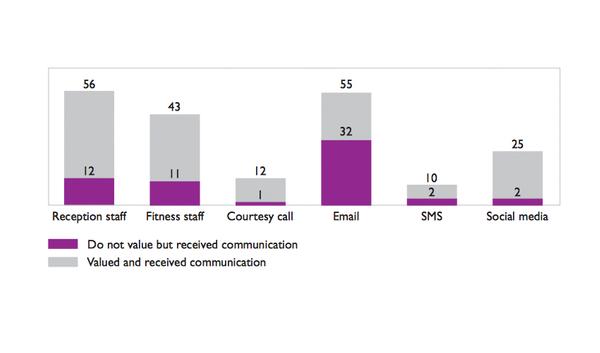
Fig 3
Fig 3

Fig 4: Retention rate by level of face-to-face communication
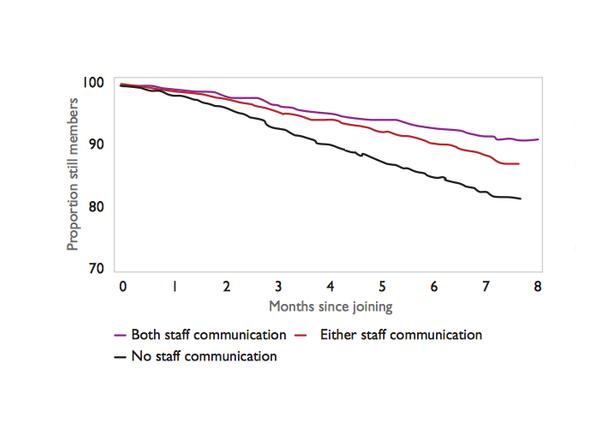
Fig 4
Fig 4

Fig 5: Retention rate by external communication
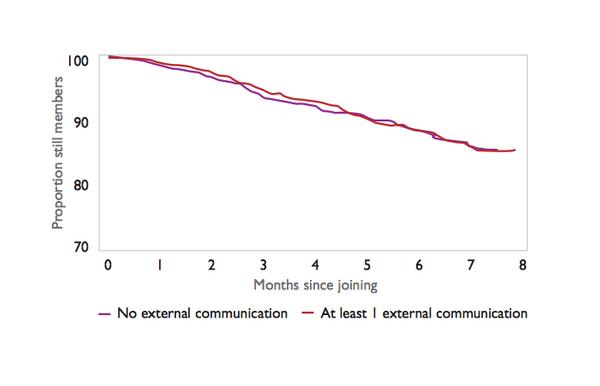
Fig 5
Fig 5

About TRP 10,000™

Conducted in partnership with The Retention People, TRP 10,000™ is the biggest and most comprehensive survey of member behaviour ever carried out in the health and fitness industry: 10,000 health and fitness members completed a baseline survey of their exercise habits and membership behaviour between July and September 2013. During regular intervals over the coming years, they will be followed up to measure changes to their habits and membership behaviour.

The results reported in this article are for members who completed the survey between July and September 2013 and who were followed up until the end of January 2014. During the follow-up period, 1,526 of participating members cancelled their membership.

For more details of the methodology, see part one of the series – HCM April 14, p38.

Melvyn is associate professor of exercise and health at the University of Exeter, where he researches physical activity and population health. Since his landmark retention report in 2001 (Winning the Retention Battle), his research into retention and attrition has led to the development of appropriate measures of retention, attrition and longevity that provide data for operators that can directly inform business decisions. In partnership with TRP, he has published numerous reports into the determinants of membership retention.


Sign up here to get HCM's weekly ezine and every issue of HCM magazine free on digital.
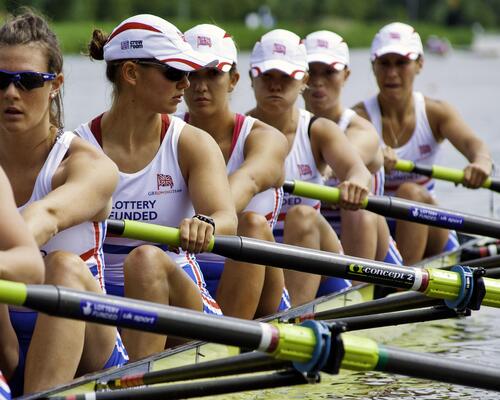
Almost half of members had received a courtesy email in the past month / all Photos: shutterstock.com
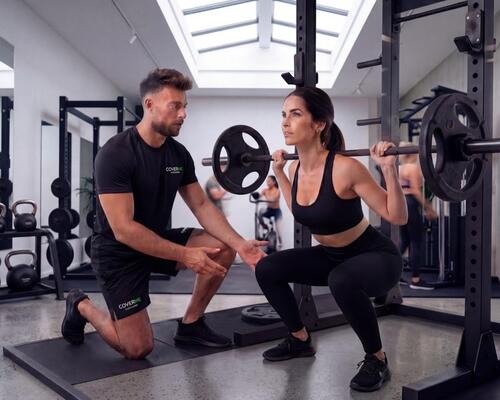
The data shows females are more likely to receive face-to-face communication than males / all Photos: shutterstock.com
SMS texts and social media communication are valued more by younger members / all Photos: shutterstock.com
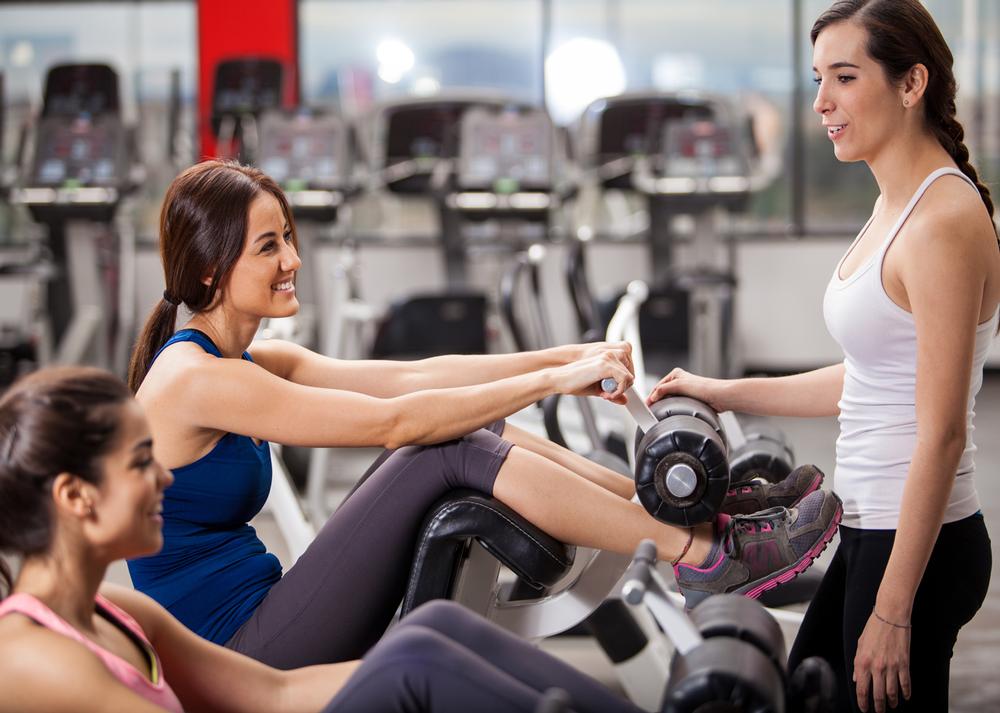
Clubs should create a ‘conversation culture’, maximising opportunities for face-to-face communication with members / all Photos: shutterstock.com
https://www.leisureopportunities.co.uk/images/HCM2014_5rention.jpg
What forms of communication do your members value? In the second part of his TRP 10,000 series, Dr Melvyn Hillsdon looks at the art of communication
Dr Melvyn Hillsdon Associate Professor of exercise and health at the University of Exeter, ,Communication, interaction, email, TRP 10,000, Melvyn Hillsdon, retention
HCM magazine
HCM People

Jamie Clements

The Breath Coach
I experienced a blissful feeling of joy I hadn’t felt since I was a kid
HCM magazine
If the health service is to survive, we must recognise that it is a disease service – and that wellbeing rests with us, says the activity advocate and healthy ageing champion. He talks to Kate Cracknell
HCM magazine
For every member with a tripod and a big following, there are others irritated at the way equipment is being hogged or wary they’ll be in the background on someone’s Insta feed. Do influencers offer valuable, free marketing or are they just a nuisance? Kath Hudson finds out how operators are responding
HCM magazine
HCM People

Stephen Price

Founder, SP&Co Group
Working in public health over the last few years has lit up parts of my brain again
HCM magazine
Collaborations with the medical profession and greater aspirations around wellbeing are creating a need for more experts in our sector. It’s time to reboot our thinking around the workforce
HCM promotional features
Sponsored
David Lloyd is stepping up its commitment to women’s health as it continues to explore what fit-for-purpose looks like for the female population
HCM promotional features
Sponsored
Starpool supports Olympic champion Marcell Jacobs, says Riccardo Turri
HCM promotional features
Sponsored
Find out how your gym can tap into the corporate wellness boom
HCM promotional features
Sponsored
Third Space partnered with IndigoFitness to deliver a bespoke training space for its new club at The Whiteley
HCM promotional features
Sponsored
SnowDome Fitness has added 50 per cent more space with cutting-edge Technogym solutions
HCM promotional features
Sponsored
Greg Bradley looks at the shift towards strength training in gyms and advises on how operators can create the ultimate training environment
HCM promotional features
Sponsored
EGYM has opened a new HQ in Paternoster Square, London and revealed a range of new launches
HCM promotional features
Sponsored
The industry is embracing consumer-facing tech. Now it’s time to streamline back-of-house systems with Orbit4, says Daniel Jones
HCM promotional features
Sponsored
New launch, Salus House, elevates boutique wellness with high service levels and a partnership with Technogym
HCM promotional features
Latest News
Global group exercise specialist, Les Mills, is inviting operators to sign up to its Workout ...
Latest News
Global luxury hospitality brand, Six Senses, has partnered with longevity healthcare provider, HUM2N, to launch ...
Latest News
Premium London health club, KX Chelsea, is gearing up to unveil its most significant redevelopment ...
Latest News
Researchers in the US have identified an antibody which could greatly reduce the loss of ...
Latest News
Peloton has made the strategic acquisition of Pilates start-up, Skōp, to support the expansion of ...
Latest News
Crunch Fitness has announced the launch of Crunch Reform Pilates – its own reformer concept ...
Latest News
The 20th State of the Industry Report from LeisureDB has revealed a resilient, expanding and ...
Latest News
Purpose Brands has announced its entry into the Italian market, having sold the franchise rights ...
Opinion
promotion
Strength training has moved from the margins to the mainstream.
Opinion: Building smarter strength spaces for today’s operators
Featured supplier news
Featured supplier news: CoverMe extends matching service to personal training, rewriting how members and personal trainers connect
CoverMe, the global leader in fitness workforce management, today launches CoverMe PT, an on-demand personal training platform that connects the right personal trainer to the right client in under 10 seconds.
Featured supplier news
Featured supplier news: Elevate 2026 to mark 10-year anniversary with biggest ever waterfront drinks reception
Elevate is set to celebrate its 10th anniversary in style this June, with organisers confirming the event’s largest-ever drinks reception as registrations continue to run more than 10% ahead of last year.
Company profiles
Company profile: GymNation
Ranging from 25,000 to 60,000 square feet, GymNation is open 24/7, 365 days a year ...
Company profiles
Company profile: Les Mills UK
Every week, millions of people get fit in 21,000 clubs, across 100 countries with the ...
Supplier Showcases
Supplier Showcase - Future-proofing
Catalogue Gallery
Click on a catalogue to view it online
Featured press releases
ukactive press release: UK Active launches next phase of Digital Futures to support digital maturity across the physical activity sector
UK Active has announced the next phase of its Digital Futures programme, supporting organisations across the physical activity sector to develop their digital capability.
Featured press releases
The Fitness Group press release: The Fitness Group partners with Serco Leisure to deliver education and career pathways across UK leisure facilities
The Fitness Group, the UK's leading fitness education training provider, has announced a strategic partnership with Serco Leisure, one of the UK's leading national operators of leisure centres, destination venues and elite sporting facilities.
Directory
Industrial washing machines
Miele Company Limited: Industrial washing machines
Spa and beauty equipment
Oakworks Inc: Spa and beauty equipment
Lockers
Crown Sports Lockers: Lockers
Water experiences and hydrotherapy solutions
Aquaform s.r.l.: Water experiences and hydrotherapy solutions
Hot tubs
MSpa International Ltd: Hot tubs
Fitness tracking platform
SpiviTech: Fitness tracking platform
Property & Tenders
Stratford, East London.
Lee Valley Regional Park Authority
Property & Tenders
Y Felinheli, LL56 4QN
Newmark
Property & Tenders
Diary dates
13-13 Jun 2026
Worldwide, Various,
Diary dates
21-24 Sep 2026
The Langham Huntington Pasadena , Pasadena, United States
Diary dates
06-08 Oct 2026
Messe Stuttgart, Stuttgart, Germany
Diary dates
22-22 Oct 2026
QEII Conference Centre, London,
Diary dates
26-29 Oct 2027
Koelnmesse Exhibition Centre, Cologne, Germany
Diary dates

features

Retention series: The human touch

What forms of communication do your members value? In the second part of his series based on the findings of the TRP10,000™ study, Dr Melvyn Hillsdon looks at the a of communication

By Dr Melvyn Hillsdon , University of Exeter | Published in Health Club Management 2014 issue 5

Clubs interact with their members in a variety of ways. When members visit their clubs, face-to-face communication channels are via both reception and fitness staff. Away from the club, they receive communication via phone calls, SMS, email and social media. But what level of communication are they receiving, what specific channels of communication do they value, and what quantity and/or types of communication are associated with improved membership retention?

What communication occurs?
Members surveyed were asked whether reception and/or fitness staff spoke to them during their last visit. In addition, they were asked whether they had received a courtesy phone call or email, SMS text or message/information via social media. Finally, members were asked to indicate how much they agreed or disagreed with a series of statements about how much they valued each channel of communication.

Figure 1 shows the proportion of members who reported receiving each type of communication. Less than half of members reported that fitness staff and reception staff spoke to them during their last visit. The most common form of communication away from the club was email, with just under half of members reporting receiving a courtesy email within the last month.

Does communication vary according to gender, age or length of membership? Table 1 shows that females are more likely to receive face-to-face and telephone communication than males, but a little less likely to receive a courtesy email. Face-to-face and telephone communication also increases by age group, but older members are less likely to receive messages via social media.

Longer-standing members are much more likely to report being spoken to by reception staff at their last visit compared to newer members. This is also true for fitness staff communication, albeit the difference is smaller. Although longer-standing members are less likely to receive a SMS text than newer members, there are no clear trends in external club communications by length of membership.

Members who use their club more frequently report receiving more communication from reception and fitness staff, via phone and social media.

What communication is welcome?
Fitness and reception staff communication are the most valued, with nearly nine in 10 members saying they value fitness staff communication (see Figure 2). Of the external methods of communication, email is easily the most valued – this is consistent across age groups, length of membership and usage patterns – with phone calls the least valued. Within this, however, males report valuing any communication form less than females (data not shown).

Older members value reception and fitness staff communication more than younger members, and are more receptive to courtesy telephone calls. They value SMS texts and social media communications less, with these being more valued by younger members.

A similar pattern is observed by length of membership: long-standing members value face-to-face communication above external communication. Members who attend their club regularly value all forms of communication more than members who attend irregularly.

The grey columns in Figure 3 show the percentage of members who report both receiving and valuing each type of communication. The purple columns show the percentage of members who report receiving each type of communication, but who say they do not value them. For example, 56 per cent of members who value being spoken to by reception staff say they were spoken to by these staff at their last visit, while 12 per cent who do not value being spoken to by reception staff were spoken to.

The grey columns highlight that there’s considerable scope for increasing all types of communication to members who would value it. This is especially true in the most valued communication types: fitness and reception staff interactions and courtesy emails.

As noted above, the purple bars in Figure 3 represent members who did not value each of the communication methods – and one stands out. Nearly a third of members who said they did not value email communication reported they had nevertheless received emails. As 32 per cent of members do not value email communication, the potential is there to irritate quite a number of members with unsolicited emails. Perhaps surprisingly, just a quarter of the members who value communication via social media actually report receiving any.

Is communication associated with retention?
Retention rates were calculated based on the time from questionnaire completion (when all members were live) to either the cancellation date (for cancelled members) or 31 January 2014 for live members. Communication methods were separated into two groups. Face-to-face communications were scored ‘0’ if members reported no reception or fitness staff communication at their last visit, ‘1’ if either the reception or fitness staff spoke to them, and ‘2’ if both spoke to them. Too few records were available to examine each of the other methods separately, so external communications were assigned ‘1’ if any were reported (phone calls, emails, texts and social media) or ‘0’ if none were reported.

Figure 4 shows that, compared to not being spoken to at their last visit, members who report being spoken to by either the reception staff or fitness staff have higher retention rates. Further, members who are spoken to by both sets of staff have even higher rates. These findings are true for members at any membership stage (data not shown).

However, Figure 5 shows that receiving external communications in the previous month is unrelated to retention at any period after joining. Although numbers are a little small to formally report, there’s a general trend in the data that indicates that members who receive the communication style they value have the highest retention rates, while those who do not receive what they value have the lowest rates.

Only one exception to this trend was observed: members who received emails they did not value had lower retention rates than members who valued them and did not receive them, suggesting that unsolicited emails may be detrimental.

A plan of action
Members primarily value face-to-face communication from both reception and fitness staff; members receiving such communication have significantly higher retention rates. However, despite this impact on retention, fewer than half of members say that reception and fitness staff spoke to them at their last visit.

Emails are also valued by around two-thirds of members, but again 45 per cent of members do not receive them. On the other hand, 32 per cent of members who do not value emails received them, and there’s some evidence that this may increase the risk of cancelling.

Other forms of communication – such as courtesy phone calls, texts and social media interactions – are less popular overall, but in some groups are still valued. However, external communications generally appear not to be targeted to specific demographic groups, or to really take account of the fact that individual members will prefer certain forms of communication to others, and often seem to be unrelated to length of membership or visit frequency. The low overall level of external communication, along with this lack of targeted and tailored messages, may explain why such communication is not associated with membership retention.

Based on these findings, our recommendations are as follows:
Develop a targeted communications strategy designed to maximise opportunities to interact with members, both within and outside of the club.

Create a conversation culture within the club – implement methods to maximise face-to-face communications.

Identify preferences – consult with members to understand how and when they want to be communicated with. If nothing else, work in line with the preferences identified in this article.

Target emails – ensure emails are only sent to those members who value them.

Restrict unsolicited phone calls – only call those who want to receive them.

Table 1: Communication type received by gender, age group, length of membership and visit frequency

Table 1
Table 1

Fig 1: Proportion of members reporting different communication methods

Fig 1
Fig 1

Fig 2: Proportion of members who say they value different types of communication

Fig 2
Fig 2

Fig 3: Proportion of members receiving
communications according to whether they value them

Fig 3
Fig 3

Fig 4: Retention rate by level of face-to-face communication

Fig 4
Fig 4

Fig 5: Retention rate by external communication

Fig 5
Fig 5

About TRP 10,000™

Conducted in partnership with The Retention People, TRP 10,000™ is the biggest and most comprehensive survey of member behaviour ever carried out in the health and fitness industry: 10,000 health and fitness members completed a baseline survey of their exercise habits and membership behaviour between July and September 2013. During regular intervals over the coming years, they will be followed up to measure changes to their habits and membership behaviour.

The results reported in this article are for members who completed the survey between July and September 2013 and who were followed up until the end of January 2014. During the follow-up period, 1,526 of participating members cancelled their membership.

For more details of the methodology, see part one of the series – HCM April 14, p38.

Melvyn is associate professor of exercise and health at the University of Exeter, where he researches physical activity and population health. Since his landmark retention report in 2001 (Winning the Retention Battle), his research into retention and attrition has led to the development of appropriate measures of retention, attrition and longevity that provide data for operators that can directly inform business decisions. In partnership with TRP, he has published numerous reports into the determinants of membership retention.
Sign up here to get HCM's weekly ezine and every issue of HCM magazine free on digital.
Almost half of members had received a courtesy email in the past month / all Photos: shutterstock.com
The data shows females are more likely to receive face-to-face communication than males / all Photos: shutterstock.com
SMS texts and social media communication are valued more by younger members / all Photos: shutterstock.com
Clubs should create a ‘conversation culture’, maximising opportunities for face-to-face communication with members / all Photos: shutterstock.com
https://www.leisureopportunities.co.uk/images/HCM2014_5rention.jpg
What forms of communication do your members value? In the second part of his TRP 10,000 series, Dr Melvyn Hillsdon looks at the art of communication
Dr Melvyn Hillsdon Associate Professor of exercise and health at the University of Exeter, ,Communication, interaction, email, TRP 10,000, Melvyn Hillsdon, retention
Latest News
Global group exercise specialist, Les Mills, is inviting operators to sign up to its Workout ...
Latest News
Global luxury hospitality brand, Six Senses, has partnered with longevity healthcare provider, HUM2N, to launch ...
Latest News
Premium London health club, KX Chelsea, is gearing up to unveil its most significant redevelopment ...
Latest News
Researchers in the US have identified an antibody which could greatly reduce the loss of ...
Latest News
Peloton has made the strategic acquisition of Pilates start-up, Skōp, to support the expansion of ...
Latest News
Crunch Fitness has announced the launch of Crunch Reform Pilates – its own reformer concept ...
Latest News
The 20th State of the Industry Report from LeisureDB has revealed a resilient, expanding and ...
Latest News
Purpose Brands has announced its entry into the Italian market, having sold the franchise rights ...
Latest News
Fitness First UK is integrating red light therapy into its yoga and Pilates classes through ...
Latest News
Nuffield Health has told HCM that it takes its responsibilities towards its colleagues seriously and ...
Latest News
Technogym has announced the launch of the Run X World Treadmill Championship, the first world ...
Opinion
promotion
Strength training has moved from the margins to the mainstream.
Opinion: Building smarter strength spaces for today’s operators
Featured supplier news
Featured supplier news: CoverMe extends matching service to personal training, rewriting how members and personal trainers connect
CoverMe, the global leader in fitness workforce management, today launches CoverMe PT, an on-demand personal training platform that connects the right personal trainer to the right client in under 10 seconds.
Featured supplier news
Featured supplier news: Elevate 2026 to mark 10-year anniversary with biggest ever waterfront drinks reception
Elevate is set to celebrate its 10th anniversary in style this June, with organisers confirming the event’s largest-ever drinks reception as registrations continue to run more than 10% ahead of last year.
Company profiles
Company profile: GymNation
Ranging from 25,000 to 60,000 square feet, GymNation is open 24/7, 365 days a year ...
Company profiles
Company profile: Les Mills UK
Every week, millions of people get fit in 21,000 clubs, across 100 countries with the ...
Supplier Showcases
Supplier Showcase - Future-proofing
Catalogue Gallery
Click on a catalogue to view it online
Featured press releases
ukactive press release: UK Active launches next phase of Digital Futures to support digital maturity across the physical activity sector
UK Active has announced the next phase of its Digital Futures programme, supporting organisations across the physical activity sector to develop their digital capability.
Featured press releases
The Fitness Group press release: The Fitness Group partners with Serco Leisure to deliver education and career pathways across UK leisure facilities
The Fitness Group, the UK's leading fitness education training provider, has announced a strategic partnership with Serco Leisure, one of the UK's leading national operators of leisure centres, destination venues and elite sporting facilities.
Directory
Industrial washing machines
Miele Company Limited: Industrial washing machines
Spa and beauty equipment
Oakworks Inc: Spa and beauty equipment
Lockers
Crown Sports Lockers: Lockers
Water experiences and hydrotherapy solutions
Aquaform s.r.l.: Water experiences and hydrotherapy solutions
Hot tubs
MSpa International Ltd: Hot tubs
Fitness tracking platform
SpiviTech: Fitness tracking platform
Property & Tenders
Stratford, East London.

Lee Valley Regional Park Authority
Property & Tenders
Y Felinheli, LL56 4QN
Newmark
Property & Tenders
Diary dates
13-13 Jun 2026
Worldwide, Various,
Diary dates
21-24 Sep 2026
The Langham Huntington Pasadena , Pasadena, United States
Diary dates
06-08 Oct 2026
Messe Stuttgart, Stuttgart, Germany
Diary dates
22-22 Oct 2026
QEII Conference Centre, London,
Diary dates
26-29 Oct 2027
Koelnmesse Exhibition Centre, Cologne, Germany
Diary dates
Search news, features & products:
Find a supplier:
Elevate Arena
Elevate Arena
Partner sites