




















EGYM
EGYM
EGYM
Follow Health Club Management on Twitter Like Health Club Management on Facebook Join the discussion with Health Club Management on LinkedIn
FITNESS, HEALTH, WELLNESS

features

Retention series: Hassles & uplifts

What kind of experiences do members have when they visit their club, and how are these experiences related to retention? Dr Melvyn Hillsdon reports

By Dr Melvyn Hillsdon , University of Exeter | Published in Health Club Management 2014 issue 9
Two-thirds of members are annoyed if they can’t find a locker / photo: www.shutterstock.com

When members make a visit to their club, there are a whole range of experiences they may encounter – good and bad. Could they park easily? Did the receptionist speak to them? Was there a towel available? Were the changing rooms clean? Did the fitness staff speak to them? Did they have to queue to use the equipment? Did they enjoy their workout? These and many other factors contribute to the overall experience of the visit.

In the fourth part of our series based on the TRP 10,000 report, we look at what people say when asked about their experience, and examine whether this is associated with the likelihood of them cancelling their membership.

That’s annoying
Members were asked how frequently they experienced hassles as well as more positive uplifts, and how much they found these hassles annoying and uplifts enjoyable.

Figure 1 shows the proportion of members who reported hassles that happen to them frequently (red bars). The blue bars represent the proportion of members who say hassles happen at least occasionally and also say the hassles are annoying. So just 2 per cent of members say they frequently can’t get a locker, but 69 per cent of members say if they can’t get a locker it’s annoying.

Overall, 55 per cent of members say they don’t often experience the hassles, with the remaining 45 per cent typically reporting an average of two hassles that occur frequently.

The two most frequent hassles reported are either fitness staff or reception staff not talking to them. However, only 16 per cent and 14 per cent of members who say this happens to them find it annoying. On the other hand, only 10 per cent of members report frequently queuing for equipment, but 69 per cent find queuing annoying.

So some things are common but not necessarily that annoying, while others are less common but very annoying when they happen. The most annoying hassles are cancelled classes (not very common) and dirty changing rooms.

By combining the frequency with which hassles are reported, and how many members say they find them annoying, we can rank the club hassles by order of burden.

The top five are:
* Equipment broken down
* Changing facilities not clean
* Queuing for equipment
* No parking space
* Fitness staff not speaking to you

Equipment breakdown and dirty changing facilities are mostly reported as frequently annoying hassles by long-standing members, whereas queuing for equipment is primarily an annoying hassle for younger males. Not being able to park and fitness staff not speaking to you is a hassle that isn’t unique to any particular member group.

Uplifting experience
So what in-club ‘uplifts’ do members report, and which do they enjoy? Figure 2 shows the proportion of members who reported uplifts that happen to them frequently (red bars). The blue bars represent the proportion of members who say an uplift happened at least occasionally and also say they enjoyed it. Just 7 per cent of members say they frequently learn a new piece of equipment, but 72 per cent of members say it’s enjoyable when they do.

Fifty two per cent of members report they frequently experience at least one of the club uplifts.

The most frequently occurring uplifts are completing a challenging workout, achieving fitness goals, and being spoken to by fitness and reception staff. Achieving fitness goals and completing a challenging workout were nearly always reported as enjoyable. Other enjoyable uplifts that were reported were attending a new class, learning a new piece of equipment and meeting friends.

As with hassles, we can rank uplifts in order of magnitude of benefit by combining their reported frequency with enjoyment level.

The top five are:
* Completing a challenging workout
* Achieving fitness goals
* Fitness staff speaking to you
* Encouragement from fitness staff
* Reception staff speaking to you

Future intent
But do hassles and uplifts predict future cancellations? Figure 3 shows the cancellation rate (cancellations per 1,000 members per month) according to whether members say a particular hassle never happens to them, or if it happens frequently and is annoying.

The highest cancellation rates are seen among members who say they have to frequently queue for equipment and find it annoying, and members who say fitness staff frequently ignore them and they find it annoying. Compared to members who say these two hassles never happen to them, the risk of cancelling increases by 80 per cent and 72 per cent respectively.

Interestingly, members who say they frequently have to queue for equipment, but who don’t say it’s annoying, do not have an increased risk of cancelling – queuing for equipment only increases the risk of cancelling if members say it happens frequently and it annoys them (7 per cent of members).

However, the risk of cancelling is increased if people report that fitness staff don’t speak to them (28 per cent of members) irrespective of whether or not they find this annoying. This suggests that fitness staff frequently ignoring members has a bigger overall impact on retention than having to queue.

The smaller number of members reporting frequently being annoyed by queuing for equipment is primarily due to this hassle being restricted to younger males: just 6 per cent of middle-aged women report queuing for equipment as a hassle, compared to 47 per cent of 16- to 24-year-old males who state their usual reason for a visit to their club is for a workout in the gym. Increased cancellations are also seen for frequently not being able to park and no towels being available.

Three hassles in Figure 3 (cancelled class, broken equipment and unclean facilities) appear at first glance to suggest that the more they happen and the more annoying they are, the less people cancel. However, a bit of further investigation reveals that this is because these three hassles are really only reported by long-standing members who attend their clubs regularly – in other words, members at the lowest risk of cancelling compared to the newer, low-attending, high-risk members who don’t report these hassles. Some statistical adjustment of these factors results in there being very little difference in cancellation rates according to how often these hassles occur.

Figure 4 shows the cancellation rate according to whether members say a particular uplift never happens to them or if it happens frequently and is enjoyable. Four key uplifts are associated with the lowest cancellation rates: receiving encouragement from fitness staff, conversation with staff, reception staff communication and meeting friends are all associated with much lower cancellation rates compared to members who say these uplifts never happen to them. Other uplifts shown in Figure 4 are not significantly associated with reduced cancellation rates.

Predictors of cancellation
There is some overlap between the detrimental effect of some hassles and the beneficial effect of some uplifts. In figures 3 and 4, reception and fitness staff communication are important. If members report being frequently ignored by staff, they cancel more frequently; if they report frequently being spoken to, they cancel less.

Members who report one hassle or uplift are likely to also report others; these members may also differ according to other important factors that affect membership retention, such as age, length of membership and visit frequency. It’s therefore necessary to do some additional statistical work to try and identify which of the hassles and uplifts are the strongest predictors of membership cancellations. When we take account of all hassles and uplifts, as well as age, length of membership and visit frequency, four member experiences are significant predictors of the risk of cancelling.

Members who report that staff frequently fail to speak to them, and who find this annoying, are 50 per cent more likely to have cancelled in the seven months after completion of the questionnaire compared to members who say fitness staff never ignore them.

Members who frequently have to queue for equipment and find it annoying are 28 per cent more likely to cancel compared to members who never have to queue.

Members who frequently can’t find a parking space at their club and find it annoying are 33 per cent more likely to cancel than those who can always park.

Members who report they are frequently spoken to by reception staff, irrespective of whether they say it’s enjoyable, are 50 per cent less likely to cancel than members who say they are never spoken to by reception staff.

It’s unlikely that most clubs are in a position to suddenly buy lots of new equipment or build more parking spaces – doing so would be a longer-term strategic decision. So what could be done in the short term to offset the increased cancellation rate caused by customers annoyed by lack of parking or the need to queue for equipment? Of course, all clubs must ensure their facilities and schedules are designed to maximise the space and equipment they do have. However, Figure 5 shows the interaction between fitness staff communication and the hassle of queuing for equipment. It can be seen that, for each level of the queuing hassle, cancellation rates are lower if fitness staff regularly communicate with members. Although not shown, the same is true for the parking hassle.

Summary
Operational matters such as broken-down equipment, dirty changing facilities and having to queue for equipment are the hassles members most frequently report annoy them. The first two are mostly reported by regular, long-standing members who by definition are most inconvenienced by them.

The problem of queuing for equipment is an important predictor of cancelling, but is a hassle primarily restricted to young males. In previous reports, we’ve shown that young males are also least likely to be spoken to by fitness staff, compounding the problem.

Apart from queuing for equipment, it seems operational hassles are less important predictors of cancellation rates than interpersonal hassles. While club cleanliness and maintenance must not be ignored and must clearly meet satisfactory standards, face-to-face communication should also be a priority.

A similar pattern is seen with club uplifts. While members frequently enjoy challenging workouts and meeting their fitness goals, not doing so has little impact on their risk of cancelling compared to the failure of reception and fitness staff to talk to them regularly.

A compelling story is emerging about the power of reception and fitness staff to increase the longevity of memberships, even when other aspects of the club are less than perfect. In an era of fancy technological solutions to everything, this may not be perceived as a very fashionable, or even welcome, finding – it’s perhaps much easier and more tangible to install a ‘hardware’ or ‘software’ solution to the problem than it is to train staff to skillfully and consistently interact with members each visit. But while technology solutions will form a piece of the member experience puzzle, clubs can’t ignore the value of staff conversing with members.

But it may require a culture shift for all levels of management and staff to fully realise the retention benefits of always communicating with members: research results, however compelling, have thus far not led to a noticeable difference in the number of members reporting frequent communication with staff.

Recommendations
* Ensure excellent levels of maintenance and cleanliness.
* Develop an equipment purchasing strategy, facility design and equipment layout that satisfies the needs of young males who like to work out.
* Develop a strategy to ensure all staff understand the value of communication.
* Encourage staff to be aware of hassles noted above, and understand they can compound the problem by ignoring people or alleviate it by talking to them.
* Encourage staff to be aware of the uplifts noted above and understand that the power to delight a customer lies in their willingness to hold a conversation.

Fig 1 Percentage of members reporting frequent
hassles, and hassles they find annoying
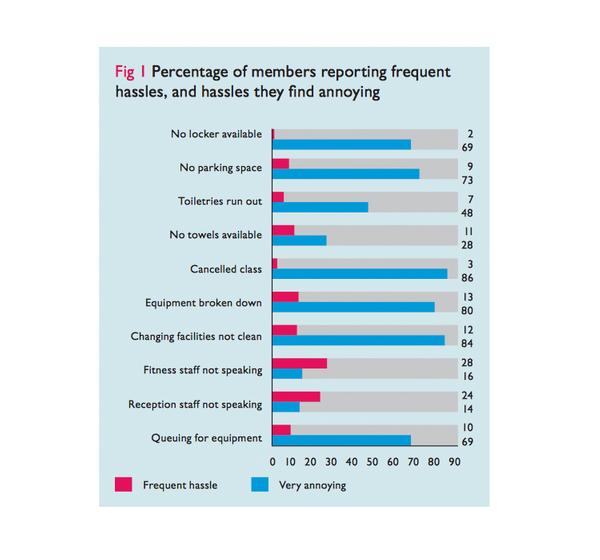
Fig 1
Fig 1

Fig 2 Percentage of members reporting frequent
uplifts, and uplifts they find enjoyable
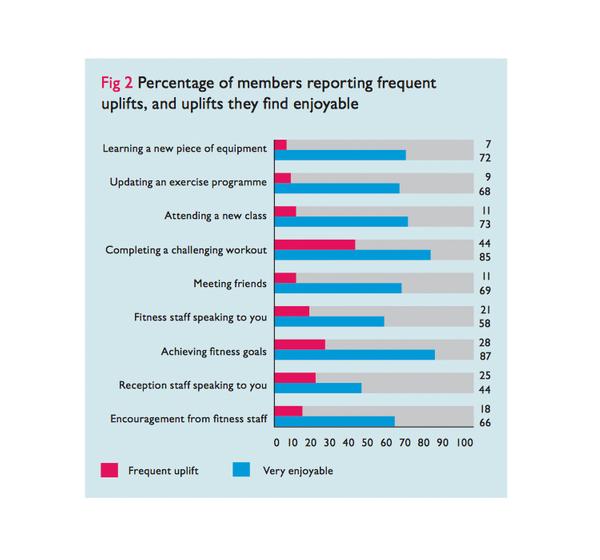
Fig 2
Fig 2

Fig 3 Cancellation rate by hassle frequency and annoyance
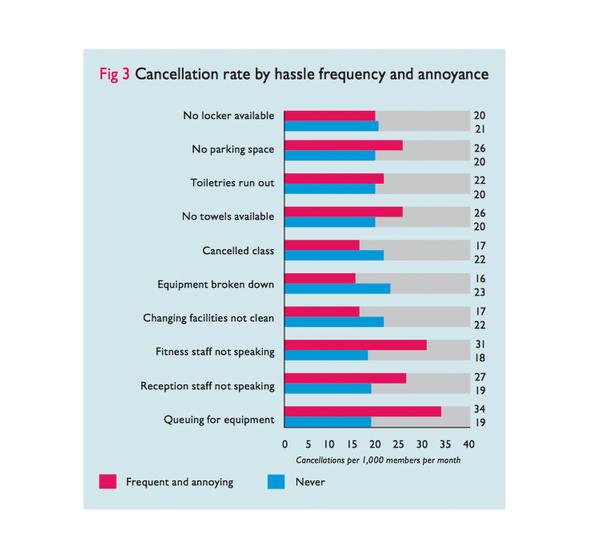
Fig 3
Fig 3

Fig 4 Cancellation rate by uplift frequency and enjoyment
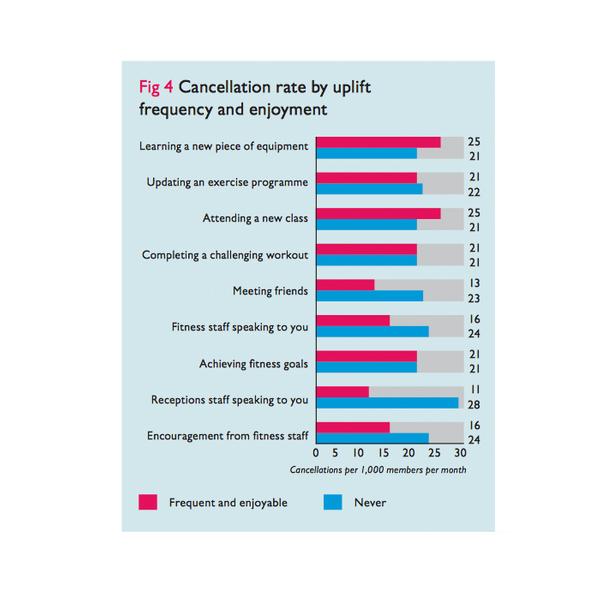
Fig 4
Fig 4

Fig 5 Interaction between hassle of queuing for equipment and fitness staff communication on the risk of cancelling
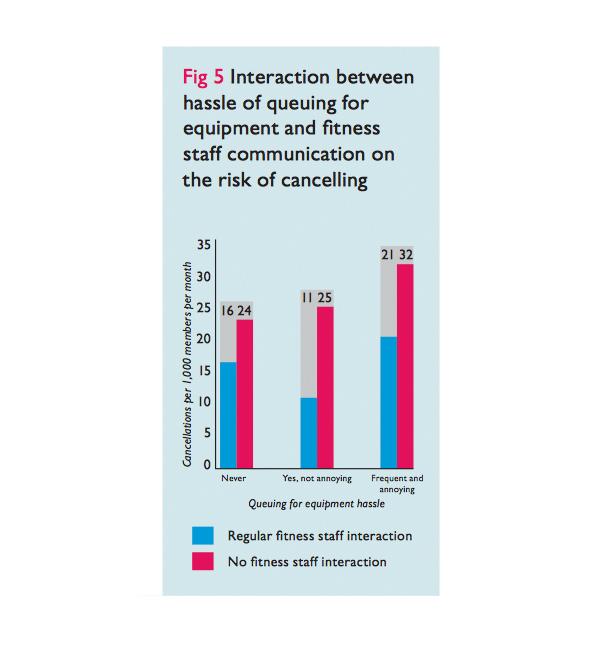
Fig 5
Fig 5

About TRP 10,000™

Conducted in partnership with The Retention People, TRP 10,000™ is the biggest and most comprehensive survey of member behaviour ever carried out in the health and fitness industry: 10,000 health and fitness members completed a baseline survey of their exercise habits and membership behaviour between July and September 2013. During regular intervals over the coming years, they will be followed up to measure changes to their habits and membership behaviour.

The results reported in this article are for members who completed the survey between July and September 2013 and who were followed up until the end of January 2014. During the follow-up period, 1,526 of participating members cancelled their membership.

For more details of the methodology, see part one of the series – HCM April 14, p38.

Melvyn Hillsdon is associate professor of exercise and health at the University of Exeter, where he researches physical activity and population health. Since his landmark retention report in 2001 (Winning the Retention Battle), his research into retention and attrition has led to the development of appropriate measures of retention, attrition and longevity that provide data for operators that can directly inform business decisions. In partnership with TRP, he has published numerous reports into membership retention.


Sign up here to get HCM's weekly ezine and every issue of HCM magazine free on digital.
Interaction with both reception and fitness staff is highly valued by most health club members / photo: www.shutterstock.com
Not being able to park can be a strong contributing factor to cancellation rates / photo: www.shutterstock.com
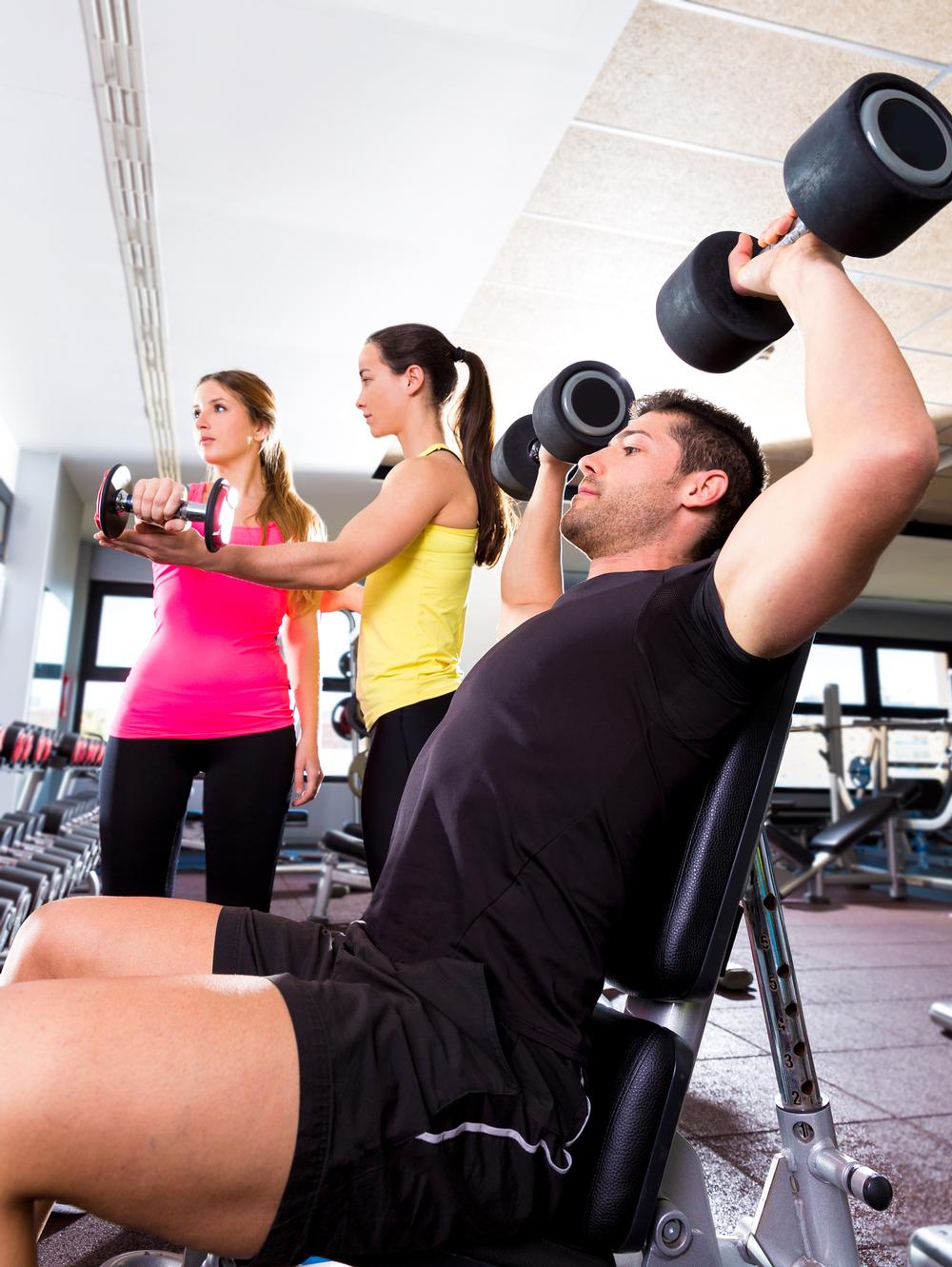
Young male gym-goers aren’t talked to by fitness staff as often as female members / photo: www.shutterstock.com
https://www.leisureopportunities.co.uk/images/521601_602257.jpg
Which elements of the member journey are most linked to retention levels? Dr Melvyn Hillsdon outlines the findings of the TRP 10,000 report
Dr Melvyn Hillsdon, ,Retention, Dr Melvyn Hillsdon, TRP 10,000, interaction, queueing, parking
HCM magazine
If the health service is to survive, we must recognise that it is a disease service – and that wellbeing rests with us, says the activity advocate and healthy ageing champion. He talks to Kate Cracknell
HCM magazine
As the entrepreneur who started Wexer, Fresh Fitness, Fitness DK and Repeat, as well as being a former elite athlete, Rasmus Ingerslev’s life looked perfect from the outside, but onthe inside it was a different story. He talks to Kath Hudson about healing old wounds
HCM magazine
Collaborations with the medical profession and greater aspirations around wellbeing are creating a need for more experts in our sector. It’s time to reboot our thinking around the workforce
HCM magazine
HCM People

Stephen Price

Founder, SP&Co Group
Working in public health over the last few years has lit up parts of my brain again
HCM magazine
For every member with a tripod and a big following, there are others irritated at the way equipment is being hogged or wary they’ll be in the background on someone’s Insta feed. Do influencers offer valuable, free marketing or are they just a nuisance? Kath Hudson finds out how operators are responding
HCM promotional features
Sponsored
SnowDome Fitness has added 50 per cent more space with cutting-edge Technogym solutions
HCM promotional features
Sponsored
Starpool supports Olympic champion Marcell Jacobs, says Riccardo Turri
HCM promotional features
Sponsored
Greg Bradley looks at the shift towards strength training in gyms and advises on how operators can create the ultimate training environment
HCM promotional features
Sponsored
David Lloyd is stepping up its commitment to women’s health as it continues to explore what fit-for-purpose looks like for the female population
HCM promotional features
Sponsored
Find out how your gym can tap into the corporate wellness boom
HCM promotional features
Sponsored
Third Space partnered with IndigoFitness to deliver a bespoke training space for its new club at The Whiteley
HCM promotional features
Sponsored
EGYM has opened a new HQ in Paternoster Square, London and revealed a range of new launches
HCM promotional features
Sponsored
New launch, Salus House, elevates boutique wellness with high service levels and a partnership with Technogym
HCM promotional features
Sponsored
Pulse Fitness has created a new health club delivering an elevated wellness experience
HCM promotional features
Latest News
Portugal’s leading operator, SC Fitness, is celebrating a milestone by reaching 100 gyms.  The company ...
Latest News
Australia’s fast-growing fitness network, Viva Leisure, is adding a low-cost gym brand to its already ...
Latest News
Speedflex has launched a strength training programme for 10 to 16-year-olds, to make it safer, ...
Latest News
Tewinbury Farm Hotel in Hertfordshire, UK is expanding its premium leisure proposition with the launch ...
Latest News

Work is underway in Madrid on one of Europe’s most significant multi-functional complexes, ...

Latest News
PureGym is encouraging people to step away from their screens and go for a walk, ...
Latest News
Small improvements to sleep, diet quality, and physical activity, made in combination lead to a ...
Latest News
Therme Manchester’s 28-acre development, which will include interconnected glass pavilions that measure 65,000sq m, will ...
Opinion
promotion
Strength training has moved from the margins to the mainstream.
Opinion: Building smarter strength spaces for today’s operators
Featured supplier news
Featured supplier news: Supporting long-term health: why whole body vibration belongs in clinical settings
As healthcare continues to shift towards prevention, there’s a growing focus on helping people stay active, independent and feeling good for longer.
Featured supplier news
Featured supplier news: W3Fit EMEA celebrates its fifth anniversary
Celebrating its milestone 5th anniversary, W3Fit EMEA returns in 2026 with an unmissable gathering of the Health & Fitness industry’s most influential leaders.
Company profiles
Company profile: Parkwood Leisure
Parkwood Leisure provides bespoke management and professional support services for leisure, cultural, and health and ...
Company profiles
Company profile: Absolute Performance
Absolute Performance is one of the UK’s leading gym design and installation companies. We install ...
Supplier Showcases
Supplier Showcase - From nightclub to health club
Supplier Showcases
Supplier Showcase - Future-proofing
Catalogue Gallery
Click on a catalogue to view it online
Featured press releases
ukactive press release: Are they Fit for Office? UK Active and Technogym throw down the gauntlet to MPs
Hundreds of staff, MPs and Peers from across Westminster have signed up for the Fit for Office parliamentary physical activity challenge, which takes place throughout June and is hosted by ukactive and Technogym.
Featured press releases
Innerva press release: Lex Leisure’s power-assisted exercise suite smashes targets in record time
Crook Log Leisure Centre has more than doubled the membership target for its new power- assisted exercise suite in less than six months.
Directory
Hot tubs
MSpa International Ltd: Hot tubs
Industrial washing machines
Miele Company Limited: Industrial washing machines
Spa and beauty equipment
Living Earth Crafts: Spa and beauty equipment
Lockers
Crown Sports Lockers: Lockers
Water experiences and hydrotherapy solutions
Aquaform s.r.l.: Water experiences and hydrotherapy solutions
Fitness tracking platform
SpiviTech: Fitness tracking platform
Property & Tenders
Stratford, East London.
Lee Valley Regional Park Authority
Property & Tenders
Y Felinheli, LL56 4QN
Newmark
Property & Tenders
Diary dates
13-13 Jun 2026
Worldwide, Various,
Diary dates
21-24 Sep 2026
The Langham Huntington Pasadena , Pasadena, United States
Diary dates
06-08 Oct 2026
Messe Stuttgart, Stuttgart, Germany
Diary dates
22-22 Oct 2026
QEII Conference Centre, London,
Diary dates
26-29 Oct 2027
Koelnmesse Exhibition Centre, Cologne, Germany
Diary dates

features

Retention series: Hassles & uplifts

What kind of experiences do members have when they visit their club, and how are these experiences related to retention? Dr Melvyn Hillsdon reports

By Dr Melvyn Hillsdon , University of Exeter | Published in Health Club Management 2014 issue 9
Two-thirds of members are annoyed if they can’t find a locker / photo: www.shutterstock.com

When members make a visit to their club, there are a whole range of experiences they may encounter – good and bad. Could they park easily? Did the receptionist speak to them? Was there a towel available? Were the changing rooms clean? Did the fitness staff speak to them? Did they have to queue to use the equipment? Did they enjoy their workout? These and many other factors contribute to the overall experience of the visit.

In the fourth part of our series based on the TRP 10,000 report, we look at what people say when asked about their experience, and examine whether this is associated with the likelihood of them cancelling their membership.

That’s annoying
Members were asked how frequently they experienced hassles as well as more positive uplifts, and how much they found these hassles annoying and uplifts enjoyable.

Figure 1 shows the proportion of members who reported hassles that happen to them frequently (red bars). The blue bars represent the proportion of members who say hassles happen at least occasionally and also say the hassles are annoying. So just 2 per cent of members say they frequently can’t get a locker, but 69 per cent of members say if they can’t get a locker it’s annoying.

Overall, 55 per cent of members say they don’t often experience the hassles, with the remaining 45 per cent typically reporting an average of two hassles that occur frequently.

The two most frequent hassles reported are either fitness staff or reception staff not talking to them. However, only 16 per cent and 14 per cent of members who say this happens to them find it annoying. On the other hand, only 10 per cent of members report frequently queuing for equipment, but 69 per cent find queuing annoying.

So some things are common but not necessarily that annoying, while others are less common but very annoying when they happen. The most annoying hassles are cancelled classes (not very common) and dirty changing rooms.

By combining the frequency with which hassles are reported, and how many members say they find them annoying, we can rank the club hassles by order of burden.

The top five are:
* Equipment broken down
* Changing facilities not clean
* Queuing for equipment
* No parking space
* Fitness staff not speaking to you

Equipment breakdown and dirty changing facilities are mostly reported as frequently annoying hassles by long-standing members, whereas queuing for equipment is primarily an annoying hassle for younger males. Not being able to park and fitness staff not speaking to you is a hassle that isn’t unique to any particular member group.

Uplifting experience
So what in-club ‘uplifts’ do members report, and which do they enjoy? Figure 2 shows the proportion of members who reported uplifts that happen to them frequently (red bars). The blue bars represent the proportion of members who say an uplift happened at least occasionally and also say they enjoyed it. Just 7 per cent of members say they frequently learn a new piece of equipment, but 72 per cent of members say it’s enjoyable when they do.

Fifty two per cent of members report they frequently experience at least one of the club uplifts.

The most frequently occurring uplifts are completing a challenging workout, achieving fitness goals, and being spoken to by fitness and reception staff. Achieving fitness goals and completing a challenging workout were nearly always reported as enjoyable. Other enjoyable uplifts that were reported were attending a new class, learning a new piece of equipment and meeting friends.

As with hassles, we can rank uplifts in order of magnitude of benefit by combining their reported frequency with enjoyment level.

The top five are:
* Completing a challenging workout
* Achieving fitness goals
* Fitness staff speaking to you
* Encouragement from fitness staff
* Reception staff speaking to you

Future intent
But do hassles and uplifts predict future cancellations? Figure 3 shows the cancellation rate (cancellations per 1,000 members per month) according to whether members say a particular hassle never happens to them, or if it happens frequently and is annoying.

The highest cancellation rates are seen among members who say they have to frequently queue for equipment and find it annoying, and members who say fitness staff frequently ignore them and they find it annoying. Compared to members who say these two hassles never happen to them, the risk of cancelling increases by 80 per cent and 72 per cent respectively.

Interestingly, members who say they frequently have to queue for equipment, but who don’t say it’s annoying, do not have an increased risk of cancelling – queuing for equipment only increases the risk of cancelling if members say it happens frequently and it annoys them (7 per cent of members).

However, the risk of cancelling is increased if people report that fitness staff don’t speak to them (28 per cent of members) irrespective of whether or not they find this annoying. This suggests that fitness staff frequently ignoring members has a bigger overall impact on retention than having to queue.

The smaller number of members reporting frequently being annoyed by queuing for equipment is primarily due to this hassle being restricted to younger males: just 6 per cent of middle-aged women report queuing for equipment as a hassle, compared to 47 per cent of 16- to 24-year-old males who state their usual reason for a visit to their club is for a workout in the gym. Increased cancellations are also seen for frequently not being able to park and no towels being available.

Three hassles in Figure 3 (cancelled class, broken equipment and unclean facilities) appear at first glance to suggest that the more they happen and the more annoying they are, the less people cancel. However, a bit of further investigation reveals that this is because these three hassles are really only reported by long-standing members who attend their clubs regularly – in other words, members at the lowest risk of cancelling compared to the newer, low-attending, high-risk members who don’t report these hassles. Some statistical adjustment of these factors results in there being very little difference in cancellation rates according to how often these hassles occur.

Figure 4 shows the cancellation rate according to whether members say a particular uplift never happens to them or if it happens frequently and is enjoyable. Four key uplifts are associated with the lowest cancellation rates: receiving encouragement from fitness staff, conversation with staff, reception staff communication and meeting friends are all associated with much lower cancellation rates compared to members who say these uplifts never happen to them. Other uplifts shown in Figure 4 are not significantly associated with reduced cancellation rates.

Predictors of cancellation
There is some overlap between the detrimental effect of some hassles and the beneficial effect of some uplifts. In figures 3 and 4, reception and fitness staff communication are important. If members report being frequently ignored by staff, they cancel more frequently; if they report frequently being spoken to, they cancel less.

Members who report one hassle or uplift are likely to also report others; these members may also differ according to other important factors that affect membership retention, such as age, length of membership and visit frequency. It’s therefore necessary to do some additional statistical work to try and identify which of the hassles and uplifts are the strongest predictors of membership cancellations. When we take account of all hassles and uplifts, as well as age, length of membership and visit frequency, four member experiences are significant predictors of the risk of cancelling.

Members who report that staff frequently fail to speak to them, and who find this annoying, are 50 per cent more likely to have cancelled in the seven months after completion of the questionnaire compared to members who say fitness staff never ignore them.

Members who frequently have to queue for equipment and find it annoying are 28 per cent more likely to cancel compared to members who never have to queue.

Members who frequently can’t find a parking space at their club and find it annoying are 33 per cent more likely to cancel than those who can always park.

Members who report they are frequently spoken to by reception staff, irrespective of whether they say it’s enjoyable, are 50 per cent less likely to cancel than members who say they are never spoken to by reception staff.

It’s unlikely that most clubs are in a position to suddenly buy lots of new equipment or build more parking spaces – doing so would be a longer-term strategic decision. So what could be done in the short term to offset the increased cancellation rate caused by customers annoyed by lack of parking or the need to queue for equipment? Of course, all clubs must ensure their facilities and schedules are designed to maximise the space and equipment they do have. However, Figure 5 shows the interaction between fitness staff communication and the hassle of queuing for equipment. It can be seen that, for each level of the queuing hassle, cancellation rates are lower if fitness staff regularly communicate with members. Although not shown, the same is true for the parking hassle.

Summary
Operational matters such as broken-down equipment, dirty changing facilities and having to queue for equipment are the hassles members most frequently report annoy them. The first two are mostly reported by regular, long-standing members who by definition are most inconvenienced by them.

The problem of queuing for equipment is an important predictor of cancelling, but is a hassle primarily restricted to young males. In previous reports, we’ve shown that young males are also least likely to be spoken to by fitness staff, compounding the problem.

Apart from queuing for equipment, it seems operational hassles are less important predictors of cancellation rates than interpersonal hassles. While club cleanliness and maintenance must not be ignored and must clearly meet satisfactory standards, face-to-face communication should also be a priority.

A similar pattern is seen with club uplifts. While members frequently enjoy challenging workouts and meeting their fitness goals, not doing so has little impact on their risk of cancelling compared to the failure of reception and fitness staff to talk to them regularly.

A compelling story is emerging about the power of reception and fitness staff to increase the longevity of memberships, even when other aspects of the club are less than perfect. In an era of fancy technological solutions to everything, this may not be perceived as a very fashionable, or even welcome, finding – it’s perhaps much easier and more tangible to install a ‘hardware’ or ‘software’ solution to the problem than it is to train staff to skillfully and consistently interact with members each visit. But while technology solutions will form a piece of the member experience puzzle, clubs can’t ignore the value of staff conversing with members.

But it may require a culture shift for all levels of management and staff to fully realise the retention benefits of always communicating with members: research results, however compelling, have thus far not led to a noticeable difference in the number of members reporting frequent communication with staff.

Recommendations
* Ensure excellent levels of maintenance and cleanliness.
* Develop an equipment purchasing strategy, facility design and equipment layout that satisfies the needs of young males who like to work out.
* Develop a strategy to ensure all staff understand the value of communication.
* Encourage staff to be aware of hassles noted above, and understand they can compound the problem by ignoring people or alleviate it by talking to them.
* Encourage staff to be aware of the uplifts noted above and understand that the power to delight a customer lies in their willingness to hold a conversation.

Fig 1 Percentage of members reporting frequent
hassles, and hassles they find annoying

Fig 1
Fig 1

Fig 2 Percentage of members reporting frequent
uplifts, and uplifts they find enjoyable

Fig 2
Fig 2

Fig 3 Cancellation rate by hassle frequency and annoyance

Fig 3
Fig 3

Fig 4 Cancellation rate by uplift frequency and enjoyment

Fig 4
Fig 4

Fig 5 Interaction between hassle of queuing for equipment and fitness staff communication on the risk of cancelling

Fig 5
Fig 5

About TRP 10,000™

Conducted in partnership with The Retention People, TRP 10,000™ is the biggest and most comprehensive survey of member behaviour ever carried out in the health and fitness industry: 10,000 health and fitness members completed a baseline survey of their exercise habits and membership behaviour between July and September 2013. During regular intervals over the coming years, they will be followed up to measure changes to their habits and membership behaviour.

The results reported in this article are for members who completed the survey between July and September 2013 and who were followed up until the end of January 2014. During the follow-up period, 1,526 of participating members cancelled their membership.

For more details of the methodology, see part one of the series – HCM April 14, p38.

Melvyn Hillsdon is associate professor of exercise and health at the University of Exeter, where he researches physical activity and population health. Since his landmark retention report in 2001 (Winning the Retention Battle), his research into retention and attrition has led to the development of appropriate measures of retention, attrition and longevity that provide data for operators that can directly inform business decisions. In partnership with TRP, he has published numerous reports into membership retention.
Sign up here to get HCM's weekly ezine and every issue of HCM magazine free on digital.
Interaction with both reception and fitness staff is highly valued by most health club members / photo: www.shutterstock.com
Not being able to park can be a strong contributing factor to cancellation rates / photo: www.shutterstock.com
Young male gym-goers aren’t talked to by fitness staff as often as female members / photo: www.shutterstock.com
https://www.leisureopportunities.co.uk/images/521601_602257.jpg
Which elements of the member journey are most linked to retention levels? Dr Melvyn Hillsdon outlines the findings of the TRP 10,000 report
Dr Melvyn Hillsdon, ,Retention, Dr Melvyn Hillsdon, TRP 10,000, interaction, queueing, parking
Latest News
Portugal’s leading operator, SC Fitness, is celebrating a milestone by reaching 100 gyms.  The company ...
Latest News
Australia’s fast-growing fitness network, Viva Leisure, is adding a low-cost gym brand to its already ...
Latest News
Speedflex has launched a strength training programme for 10 to 16-year-olds, to make it safer, ...
Latest News
Tewinbury Farm Hotel in Hertfordshire, UK is expanding its premium leisure proposition with the launch ...
Latest News

Work is underway in Madrid on one of Europe’s most significant multi-functional complexes, ...

Latest News
PureGym is encouraging people to step away from their screens and go for a walk, ...
Latest News
Small improvements to sleep, diet quality, and physical activity, made in combination lead to a ...
Latest News
Therme Manchester’s 28-acre development, which will include interconnected glass pavilions that measure 65,000sq m, will ...
Latest News
The Yard Gym (TYG) is to become Nike Training’s official global training partner in a ...
Latest News
Everlast Gyms' York site has reopened following a refurbishment to bring it up to the ...
Latest News
Luxury hospitality and wellness pioneer Jeremy McCarthy has launched Leisure Alchemy, a digital platform that ...
Opinion
promotion
Strength training has moved from the margins to the mainstream.
Opinion: Building smarter strength spaces for today’s operators
Featured supplier news
Featured supplier news: Supporting long-term health: why whole body vibration belongs in clinical settings
As healthcare continues to shift towards prevention, there’s a growing focus on helping people stay active, independent and feeling good for longer.
Featured supplier news
Featured supplier news: W3Fit EMEA celebrates its fifth anniversary
Celebrating its milestone 5th anniversary, W3Fit EMEA returns in 2026 with an unmissable gathering of the Health & Fitness industry’s most influential leaders.
Company profiles
Company profile: Parkwood Leisure
Parkwood Leisure provides bespoke management and professional support services for leisure, cultural, and health and ...
Company profiles
Company profile: Absolute Performance
Absolute Performance is one of the UK’s leading gym design and installation companies. We install ...
Supplier Showcases
Supplier Showcase - From nightclub to health club
Supplier Showcases
Supplier Showcase - Future-proofing
Catalogue Gallery
Click on a catalogue to view it online
Featured press releases
ukactive press release: Are they Fit for Office? UK Active and Technogym throw down the gauntlet to MPs
Hundreds of staff, MPs and Peers from across Westminster have signed up for the Fit for Office parliamentary physical activity challenge, which takes place throughout June and is hosted by ukactive and Technogym.
Featured press releases
Innerva press release: Lex Leisure’s power-assisted exercise suite smashes targets in record time
Crook Log Leisure Centre has more than doubled the membership target for its new power- assisted exercise suite in less than six months.
Directory
Hot tubs
MSpa International Ltd: Hot tubs
Industrial washing machines
Miele Company Limited: Industrial washing machines
Spa and beauty equipment
Living Earth Crafts: Spa and beauty equipment
Lockers
Crown Sports Lockers: Lockers
Water experiences and hydrotherapy solutions
Aquaform s.r.l.: Water experiences and hydrotherapy solutions
Fitness tracking platform
SpiviTech: Fitness tracking platform
Property & Tenders
Stratford, East London.

Lee Valley Regional Park Authority
Property & Tenders
Y Felinheli, LL56 4QN
Newmark
Property & Tenders
Diary dates
13-13 Jun 2026
Worldwide, Various,
Diary dates
21-24 Sep 2026
The Langham Huntington Pasadena , Pasadena, United States
Diary dates
06-08 Oct 2026
Messe Stuttgart, Stuttgart, Germany
Diary dates
22-22 Oct 2026
QEII Conference Centre, London,
Diary dates
26-29 Oct 2027
Koelnmesse Exhibition Centre, Cologne, Germany
Diary dates
Search news, features & products:
Find a supplier:
EGYM
EGYM
Partner sites