














The Leisure Media Company Ltd
Follow Health Club Management on Twitter Like Health Club Management on Facebook Join the discussion with Health Club Management on LinkedIn
FITNESS, HEALTH, WELLNESS

features

Report: Active justice

What role can sport and physical activity play in preventing crime and anti-social behaviour – and are our prisons making the most of this opportunity to change lives? Kate Cracknell reports

By Kate Cracknell | Published in Health Club Management 2018 issue 10
Active justice / PHOTO: SHUTTERSTOCK.COM
Participation can not only improve health and behaviour but can directly contribute to efforts to tackle re-offending, reduce violence and conflict - Professor Rosie Meek

In prisons, just as in our communities, the impact of exercise and sport can be far-reaching. Participation can not only improve health and behaviour but can directly contribute to efforts to tackle re-offending, reduce violence and conflict, develop communication skills, and in particular provide a meaningful route into education and employment.”

These are the words of Rosie Meek, professor of psychology at Royal Holloway University in London; author of the book Sport in Prison; the expert behind August’s government-commissioned report, A Sporting Chance: An independent review of sport in justice; and part of a panel exploring the role of physical activity in preventing crime and anti-social behaviour which took place at the recent ukactive National Summit.

Meek was joined on the panel by Dr Phillip Lee MP who, in his former role as Minister for Youth Justice, had commissioned the report from Meek – specifically, a review of existing sport provision in the justice system, with a particular focus on health, re-offending and youth custody.

“When I started at the Justice Department in July 2016, there was an appalling recidivism rate among young people of around 70 per cent,” Lee explained. “When you’re spending the best part of £230–240m on youth justice each year, that cannot be seen as a success.”

He continued: “We investigated the typical day for young offenders in prison and found they were often locked up and inactive.” Indeed, over one-third of 18- to 21-year-old inmates report being locked up for at least 22 hours a day.

“Lacking positive, responsible role models in their lives, they were also regularly in and out of prison,” Lee added.

“I therefore thought it sensible to commission a report into the value of sport in the justice system, through the process of which I met remarkable people who are already doing great things, as well as hearing remarkable stories from those whose lives have been turned around by sport.”

And not only are the stories heart-warming, but the results speak for themselves, with plummeting rates of recidivism among participants: some sport-based programmes for young inmates in English prisons report repeat offending rates as low as 6 per cent (the Chelsea FC and RFU rugby academies at HMP & YOI Portland) or 7 per cent (The Street Soccer programme at HMP Forest Bank) among their 18- to 21-year-old participants.

“I’ve since left the Justice Department, but I’m determined to still do whatever I can to shine a light on these projects,” added Lee. “The more of this we can do, the better – both for the individuals and for society.”

Bring back boxing
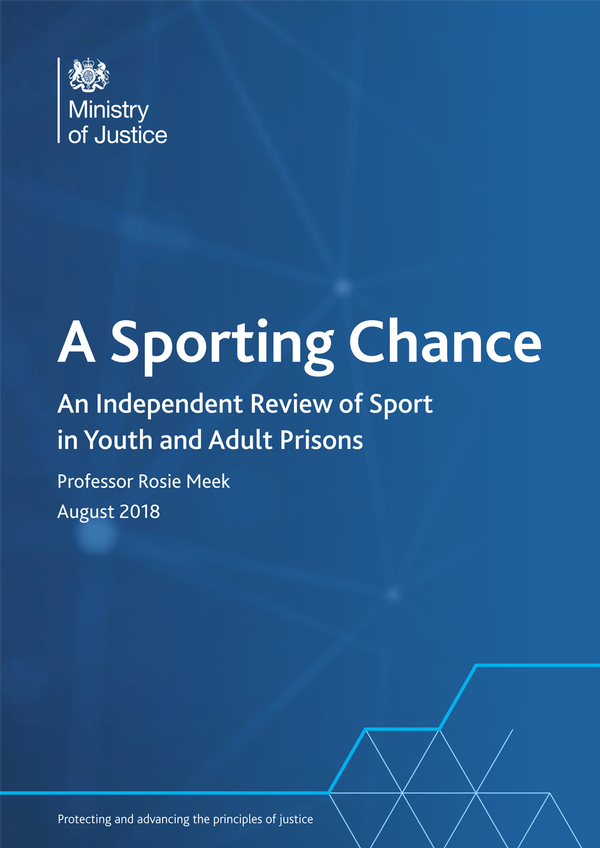
Published in August 2018, the Sporting Chance report – commonly referred to as the Meek Report – outlined 12 recommendations (see briefing box, page 46) to give prisoners “a sporting chance”, each with a weight of evidence and case studies behind them.

Overall, the report has been well received: the government responded in favour of 11 of Meek’s 12 recommendations, pledging £1.8m a year to enhance educational and physical activity opportunities across the justice system, including “new education and sports-based projects, community partnerships, and upskilling staff to facilitate a broader education curriculum”.

But there is currently one sticking point, namely recommendation #7 – re-introducing boxing and martial arts as physical activity options for prison inmates – which the government pushed back with a strong, some might argue short-sighted, ‘no’.

It is, said co-panellist and former pro boxer Barry McGuigan, “a crying shame”, as he named numerous examples of famous boxers – from Mike Tyson to Anthony Joshua – whose lives were turned around by taking up boxing. Indeed, it’s for exactly this reason that McGuigan now runs boxing academies for troubled youths across some of the more deprived areas of London.

Meek agreed: “We’ve seen the power of boxing when it comes to working with disengaged, disenfranchised and often violent young people. We’ve seen the evidence. My argument is that we should at least pilot some carefully designed boxing programmes in prison.”

Yet the government is as yet unwavering in its response: it has “no plans to make boxing or martial arts based activities permissible” in a custodial environment.

This may change, suggested Lee in defence of the Ministry of Justice (MoJ). “I think it will come,” he said. But the problem for now, he explained, searching for a diplomatic way to describe the obstacle, is that it “requires some people higher in government to understand the value of sport, full stop”.

Active rehabilitation
Nevertheless, with a positive response to the lion’s share of this report, the momentum would now seem to be behind the Active Justice agenda.

The now Minister of Justice, Edward Argar MP, shared the following observations in his response to the Meek Report: “Emerging evidence from programmes being delivered in custody is building a picture of the rehabilitative value of physical activity. These programmes provide young people with access to positive role models, mentors and team-mates, as well as opportunities to gain qualifications to develop their own career in sport.

“Whether or not offenders choose to pursue sport or coaching as a career themselves, the skills they learn enhance their prospects for getting jobs, increasing the likelihood that they will turn their backs on crime for good.”

He added: “Sport on its own does not provide all the answers, but if it is harnessed in the right way then it can have transformative effects on the lives of young offenders. It can help them to realise their potential and recognise skills they never knew they had – leadership, teamwork, communication and discipline.

“Many of these young people will have had challenging educational experiences, but a positive one with sport can give them the confidence to engage again with education; it can change their self-perception, helping them see themselves as successful, talented and hard-working people. If we are to make rehabilitation really work, then this is a key step.”

Towards collaboration
However, as Meek stressed in her Guardian article published a few days before the ukactive Summit: “Promises from the MoJ of supporting an already stretched prison service will only go so far. We need more collaboration with our physical activity sector and other community partners, who must now get behind the recommendations and activate the plan.”

She echoed this sentiment at the Summit, urging the fitness sector to make it happen and to get involved.

But it won’t be easy, not least because the typical health club or leisure centre simply doesn’t appeal to this group. As Claire Dhami of the West Midlands Combined Authority – which is exploring the positive impact of physical activity in early intervention – explained: “One size does not fit all: these young people won’t just turn up at a mainstream gym or health club, sign a form and engage.”

Indeed, she said, the people are more important than the place or the programme when it comes to engaging these young people: “What’s really needed are individuals who can relate to their experiences and also inspire and engage them.”

But this in itself can be seen as an opportunity, said McGuigan: “Most programmes start with just one or two really passionate people. If you have that commitment, it will rocket.”

If the fitness and physical activity sector really wants to make a difference, though, collaboration is the answer, said Meek, suggesting an MoJ-facilitated twinning scheme between prisons and local sporting organisations, or prisons and universities, to fuel more outreach programmes. “There are about the same number of prisons as there are universities in England and Wales,” she observed.

It’s already been shown to work. Meek’s review highlights positive sporting achievements that have already taken place in the prison environment, supported by organisations such as parkrun UK: in 2017, HMP Haverigg became the first prison to host a weekly parkrun event, and more have since followed.

Initiatives such as these “have provided the motivation and skills for people to turn their lives around,” says Meek. “But provision of sporting opportunities still remains patchy and under-developed.”

A chance to change lives
Certainly the majority of initiatives are still small pilot projects, with consequent challenges around gathering sufficient evidence to justify government expenditure. However, said Meek, collating data sets from a number of projects would better show “what’s working, and for whom” – and with it provide the irrefutable evidence needed to secure the wider-scale roll-out of effective, targeted initiatives.

“It isn’t easy to measure results in this field, with the sensitivity around reoffending data for example, but that isn’t a reason not to try,” she added, pointing to the Alliance for Sport website as one initiative designed to “bring projects together in critical mass”.

Alongside all the above are opportunities for the sport and fitness sector to cater better for women in prison – only a small percentage of inmates, but the least active of all; to recognise the ageing population within prisons and ensure programmes cater for the over-60s; and to drive teaching standards within prisons to help inmates come out with Level 3 – rather than the current Level 1 or Level 2 – qualifications.

There’s also an option to create work placements for those on temporary release, as well as creating job opportunities for former prisoners who have done relevant qualifications while in prison – and the latter is something Virgin Active and Places for People Leisure have already committed to, with pilots scheduled for early next year.

Working with ukactive, CIMSPA, the MoJ and Her Majesty’s Prison & Probation Service, Virgin Active and Places for People will provide training and opportunities for vetted, former Category D offenders [open prisons] to work in various roles, from receptionists to caterers, lifeguards to personal trainers.

“These pilot programmes will seek to make greater use of prison estate facilities and will guarantee job interviews upon the completion of training,” says Meek. “It’s just a start, but this type of joined-up approach could inject new hope into our system and really change lives for everyone involved.”

12 recommendations to give offenders a Sporting Chance

Recommendation 1
Every prison, Young Offender Institution, Secure Training Centre and Secure Children’s Home should devise and implement an integrated physical activity and wellbeing strategy.

Recommendation 2
Commissioners and education providers should develop a flexible approach to delivery which enables collaborations and creative delivery.

Recommendation 3
Prisons should offer nutritional advice as part of their physical activity and wellbeing provision, and promote a readily-available range of healthy eating options.

Recommendation 4
Bringing prisoners together for sport can resolve conflict. Governors should revise keep-apart list policies and establishments should include gym staff in keep-apart decision making.

Recommendation 5
Sport provision needs to be responsive to individual needs, with a focus on health, wellbeing and rehabilitation at the heart of practice.

Recommendation 6
The Ministry of Justice should develop a physical activity strategy for women and girls in prison.

Recommendation 7 (not adoped)
The Ministry of Justice should re-consider the national martial arts / boxing policy and pilot the introduction of targeted programmes which draw on boxing exercises, qualifications and associated activities.

Recommendation 8
Senior managers and the Ministry of Justice need to monitor physical activity participation and outcomes according to ethnicity, and ensure that any disproportionality is addressed.

Recommendation 9
Senior managers need to encourage partnerships between prisons, communities, sporting groups and bodies.

Recommendation 10
The Ministry of Justice should review Release on Temporary Licence, Mobility and related policies to facilitate meaningful sports-based learning, team-building activities, placements and training.

Recommendation 11
The Ministry of Justice, HM Prison and Probation Service and senior managers need to provide the leadership, staffing, training and facilities required to support a wide-reaching and high-quality sport and physical activity provision.

Recommendation 12
HM Prison and Probation Service should create and implement a dedicated physical activity monitoring and evaluation strategy which supplements existing Ofsted and HM Inspectorate of Prisons monitoring.

Access the report

The full Meek Report – and the government’s response
to it – can be downloaded from: www.gov.uk/government/publications/a-sporting-chance-an-independent-review-of-sport-in-justice

Sign up here to get HCM's weekly ezine and every issue of HCM magazine free on digital.
Rosie Meek, the expert behind the new report on sport in prisons
Former boxer Barry McGuigan says the government’s stance on martial arts is ‘a crying shame’ / PHOTO: SHUTTERSTOCK.COM
Former boxer Barry McGuigan says the government’s stance on martial arts is ‘a crying shame’
Pilot programmes have shown sport in prisons can get reoffending rates down from 70 per cent to six per cent / PHOTO: SHUTTERSTOCK.COM
https://www.leisureopportunities.co.uk/images/930703_662231.png
Evidence shows we can transform the lives of young offenders through exercise. Kate Cracknell talks to Rosie Meek
Kate Cracknell, Journalist, Leisure Media Rosie Meek, professor of psychology, Royal Holloway University in London Barry McGuigan,young offenders, Rosie Meek, Barry McGuigan, prisons, Royal Holloway University in London
HCM magazine
Collaborations with the medical profession and greater aspirations around wellbeing are creating a need for more experts in our sector. It’s time to reboot our thinking around the workforce
HCM magazine
If the health service is to survive, we must recognise that it is a disease service – and that wellbeing rests with us, says the activity advocate and healthy ageing champion. He talks to Kate Cracknell
HCM magazine
Small improvements to sleep, diet and physical activity have major benefits for the heart, according to new research from the University of Sydney
HCM magazine
Strength training is evolving, driven by changing consumer preferences. Julie Cramer talks to innovators about how their products are meeting this demand
HCM magazine
For every member with a tripod and a big following, there are others irritated at the way equipment is being hogged or wary they’ll be in the background on someone’s Insta feed. Do influencers offer valuable, free marketing or are they just a nuisance? Kath Hudson finds out how operators are responding
HCM promotional features
Sponsored
Starpool supports Olympic champion Marcell Jacobs, says Riccardo Turri
HCM promotional features
Sponsored
Third Space partnered with IndigoFitness to deliver a bespoke training space for its new club at The Whiteley
HCM promotional features
Sponsored
Greg Bradley looks at the shift towards strength training in gyms and advises on how operators can create the ultimate training environment
HCM promotional features
Sponsored
SnowDome Fitness has added 50 per cent more space with cutting-edge Technogym solutions
HCM promotional features
Sponsored
Find out how your gym can tap into the corporate wellness boom
HCM promotional features
Sponsored
David Lloyd is stepping up its commitment to women’s health as it continues to explore what fit-for-purpose looks like for the female population
HCM promotional features
Sponsored
EGYM has opened a new HQ in Paternoster Square, London and revealed a range of new launches
HCM promotional features
Sponsored
The industry is embracing consumer-facing tech. Now it’s time to streamline back-of-house systems with Orbit4, says Daniel Jones
HCM promotional features
Promotion
BLK BOX has been reimagining elite performance spaces for more than a decade. Founder and former athlete, Greg Bradley, tells us what it takes
HCM promotional features
Latest News
Nuffield Health has told HCM that it takes its responsibilities towards its colleagues seriously and ...
Latest News
Technogym has announced the launch of the Run X World Treadmill Championship, the first world ...
Latest News
Shocked by the UK loneliness statistics, charitable trust Mytime Active has been doubling down on ...
Latest News
Portugal’s leading operator, SC Fitness, is celebrating a milestone by reaching 100 gyms.  The company ...
Latest News
Australia’s fast-growing fitness network, Viva Leisure, is adding a low-cost gym brand to its already ...
Latest News
Speedflex has launched a strength training programme for 10 to 16-year-olds, to make it safer, ...
Latest News
Tewinbury Farm Hotel in Hertfordshire, UK is expanding its premium leisure proposition with the launch ...
Latest News

Work is underway in Madrid on one of Europe’s most significant multi-functional complexes, ...

Opinion
promotion
Strength training has moved from the margins to the mainstream.
Opinion: Building smarter strength spaces for today’s operators
Featured supplier news
Featured supplier news: Supporting long-term health: why whole body vibration belongs in clinical settings
As healthcare continues to shift towards prevention, there’s a growing focus on helping people stay active, independent and feeling good for longer.
Featured supplier news
Featured supplier news: W3Fit EMEA celebrates its fifth anniversary
Celebrating its milestone 5th anniversary, W3Fit EMEA returns in 2026 with an unmissable gathering of the Health & Fitness industry’s most influential leaders.
Company profiles
Company profile: Sporty Group AS
With more than 90 fitness centres across the country and more than 130.000 members, Sporty ...
Company profiles
Company profile: Pulse Fitness
With an award-winning portfolio of over 450 pieces of cutting-edge, premium fitness equipment, Pulse Fitness ...
Supplier Showcases
Supplier Showcase - From nightclub to health club
Supplier Showcases
Supplier Showcase - Future-proofing
Catalogue Gallery
Click on a catalogue to view it online
Featured press releases
Technogym press release: Great success for Technogym’s “Let’s Move & Donate Food” campaign: one million meals donated
Thanks to the participation of 150,000 people across 141 countries, the social campaign surpassed one billion Moves collected, which were converted into a donation of one million school meals to support children in need.
Featured press releases
ukactive press release: Are they Fit for Office? UK Active and Technogym throw down the gauntlet to MPs
Hundreds of staff, MPs and Peers from across Westminster have signed up for the Fit for Office parliamentary physical activity challenge, which takes place throughout June and is hosted by ukactive and Technogym.
Directory
Spa and beauty equipment
Living Earth Crafts: Spa and beauty equipment
Water experiences and hydrotherapy solutions
Aquaform s.r.l.: Water experiences and hydrotherapy solutions
Hot tubs
MSpa International Ltd: Hot tubs
Fitness tracking platform
SpiviTech: Fitness tracking platform
Industrial washing machines
Miele Company Limited: Industrial washing machines
Lockers
Crown Sports Lockers: Lockers
Property & Tenders
Stratford, East London.
Lee Valley Regional Park Authority
Property & Tenders
Y Felinheli, LL56 4QN
Newmark
Property & Tenders
Diary dates
13-13 Jun 2026
Worldwide, Various,
Diary dates
21-24 Sep 2026
The Langham Huntington Pasadena , Pasadena, United States
Diary dates
06-08 Oct 2026
Messe Stuttgart, Stuttgart, Germany
Diary dates
22-22 Oct 2026
QEII Conference Centre, London,
Diary dates
26-29 Oct 2027
Koelnmesse Exhibition Centre, Cologne, Germany
Diary dates

features

Report: Active justice

What role can sport and physical activity play in preventing crime and anti-social behaviour – and are our prisons making the most of this opportunity to change lives? Kate Cracknell reports

By Kate Cracknell | Published in Health Club Management 2018 issue 10
Active justice / PHOTO: SHUTTERSTOCK.COM
Participation can not only improve health and behaviour but can directly contribute to efforts to tackle re-offending, reduce violence and conflict - Professor Rosie Meek

In prisons, just as in our communities, the impact of exercise and sport can be far-reaching. Participation can not only improve health and behaviour but can directly contribute to efforts to tackle re-offending, reduce violence and conflict, develop communication skills, and in particular provide a meaningful route into education and employment.”

These are the words of Rosie Meek, professor of psychology at Royal Holloway University in London; author of the book Sport in Prison; the expert behind August’s government-commissioned report, A Sporting Chance: An independent review of sport in justice; and part of a panel exploring the role of physical activity in preventing crime and anti-social behaviour which took place at the recent ukactive National Summit.

Meek was joined on the panel by Dr Phillip Lee MP who, in his former role as Minister for Youth Justice, had commissioned the report from Meek – specifically, a review of existing sport provision in the justice system, with a particular focus on health, re-offending and youth custody.

“When I started at the Justice Department in July 2016, there was an appalling recidivism rate among young people of around 70 per cent,” Lee explained. “When you’re spending the best part of £230–240m on youth justice each year, that cannot be seen as a success.”

He continued: “We investigated the typical day for young offenders in prison and found they were often locked up and inactive.” Indeed, over one-third of 18- to 21-year-old inmates report being locked up for at least 22 hours a day.

“Lacking positive, responsible role models in their lives, they were also regularly in and out of prison,” Lee added.

“I therefore thought it sensible to commission a report into the value of sport in the justice system, through the process of which I met remarkable people who are already doing great things, as well as hearing remarkable stories from those whose lives have been turned around by sport.”

And not only are the stories heart-warming, but the results speak for themselves, with plummeting rates of recidivism among participants: some sport-based programmes for young inmates in English prisons report repeat offending rates as low as 6 per cent (the Chelsea FC and RFU rugby academies at HMP & YOI Portland) or 7 per cent (The Street Soccer programme at HMP Forest Bank) among their 18- to 21-year-old participants.

“I’ve since left the Justice Department, but I’m determined to still do whatever I can to shine a light on these projects,” added Lee. “The more of this we can do, the better – both for the individuals and for society.”

Bring back boxing
Published in August 2018, the Sporting Chance report – commonly referred to as the Meek Report – outlined 12 recommendations (see briefing box, page 46) to give prisoners “a sporting chance”, each with a weight of evidence and case studies behind them.

Overall, the report has been well received: the government responded in favour of 11 of Meek’s 12 recommendations, pledging £1.8m a year to enhance educational and physical activity opportunities across the justice system, including “new education and sports-based projects, community partnerships, and upskilling staff to facilitate a broader education curriculum”.

But there is currently one sticking point, namely recommendation #7 – re-introducing boxing and martial arts as physical activity options for prison inmates – which the government pushed back with a strong, some might argue short-sighted, ‘no’.

It is, said co-panellist and former pro boxer Barry McGuigan, “a crying shame”, as he named numerous examples of famous boxers – from Mike Tyson to Anthony Joshua – whose lives were turned around by taking up boxing. Indeed, it’s for exactly this reason that McGuigan now runs boxing academies for troubled youths across some of the more deprived areas of London.

Meek agreed: “We’ve seen the power of boxing when it comes to working with disengaged, disenfranchised and often violent young people. We’ve seen the evidence. My argument is that we should at least pilot some carefully designed boxing programmes in prison.”

Yet the government is as yet unwavering in its response: it has “no plans to make boxing or martial arts based activities permissible” in a custodial environment.

This may change, suggested Lee in defence of the Ministry of Justice (MoJ). “I think it will come,” he said. But the problem for now, he explained, searching for a diplomatic way to describe the obstacle, is that it “requires some people higher in government to understand the value of sport, full stop”.

Active rehabilitation
Nevertheless, with a positive response to the lion’s share of this report, the momentum would now seem to be behind the Active Justice agenda.

The now Minister of Justice, Edward Argar MP, shared the following observations in his response to the Meek Report: “Emerging evidence from programmes being delivered in custody is building a picture of the rehabilitative value of physical activity. These programmes provide young people with access to positive role models, mentors and team-mates, as well as opportunities to gain qualifications to develop their own career in sport.

“Whether or not offenders choose to pursue sport or coaching as a career themselves, the skills they learn enhance their prospects for getting jobs, increasing the likelihood that they will turn their backs on crime for good.”

He added: “Sport on its own does not provide all the answers, but if it is harnessed in the right way then it can have transformative effects on the lives of young offenders. It can help them to realise their potential and recognise skills they never knew they had – leadership, teamwork, communication and discipline.

“Many of these young people will have had challenging educational experiences, but a positive one with sport can give them the confidence to engage again with education; it can change their self-perception, helping them see themselves as successful, talented and hard-working people. If we are to make rehabilitation really work, then this is a key step.”

Towards collaboration
However, as Meek stressed in her Guardian article published a few days before the ukactive Summit: “Promises from the MoJ of supporting an already stretched prison service will only go so far. We need more collaboration with our physical activity sector and other community partners, who must now get behind the recommendations and activate the plan.”

She echoed this sentiment at the Summit, urging the fitness sector to make it happen and to get involved.

But it won’t be easy, not least because the typical health club or leisure centre simply doesn’t appeal to this group. As Claire Dhami of the West Midlands Combined Authority – which is exploring the positive impact of physical activity in early intervention – explained: “One size does not fit all: these young people won’t just turn up at a mainstream gym or health club, sign a form and engage.”

Indeed, she said, the people are more important than the place or the programme when it comes to engaging these young people: “What’s really needed are individuals who can relate to their experiences and also inspire and engage them.”

But this in itself can be seen as an opportunity, said McGuigan: “Most programmes start with just one or two really passionate people. If you have that commitment, it will rocket.”

If the fitness and physical activity sector really wants to make a difference, though, collaboration is the answer, said Meek, suggesting an MoJ-facilitated twinning scheme between prisons and local sporting organisations, or prisons and universities, to fuel more outreach programmes. “There are about the same number of prisons as there are universities in England and Wales,” she observed.

It’s already been shown to work. Meek’s review highlights positive sporting achievements that have already taken place in the prison environment, supported by organisations such as parkrun UK: in 2017, HMP Haverigg became the first prison to host a weekly parkrun event, and more have since followed.

Initiatives such as these “have provided the motivation and skills for people to turn their lives around,” says Meek. “But provision of sporting opportunities still remains patchy and under-developed.”

A chance to change lives
Certainly the majority of initiatives are still small pilot projects, with consequent challenges around gathering sufficient evidence to justify government expenditure. However, said Meek, collating data sets from a number of projects would better show “what’s working, and for whom” – and with it provide the irrefutable evidence needed to secure the wider-scale roll-out of effective, targeted initiatives.

“It isn’t easy to measure results in this field, with the sensitivity around reoffending data for example, but that isn’t a reason not to try,” she added, pointing to the Alliance for Sport website as one initiative designed to “bring projects together in critical mass”.

Alongside all the above are opportunities for the sport and fitness sector to cater better for women in prison – only a small percentage of inmates, but the least active of all; to recognise the ageing population within prisons and ensure programmes cater for the over-60s; and to drive teaching standards within prisons to help inmates come out with Level 3 – rather than the current Level 1 or Level 2 – qualifications.

There’s also an option to create work placements for those on temporary release, as well as creating job opportunities for former prisoners who have done relevant qualifications while in prison – and the latter is something Virgin Active and Places for People Leisure have already committed to, with pilots scheduled for early next year.

Working with ukactive, CIMSPA, the MoJ and Her Majesty’s Prison & Probation Service, Virgin Active and Places for People will provide training and opportunities for vetted, former Category D offenders [open prisons] to work in various roles, from receptionists to caterers, lifeguards to personal trainers.

“These pilot programmes will seek to make greater use of prison estate facilities and will guarantee job interviews upon the completion of training,” says Meek. “It’s just a start, but this type of joined-up approach could inject new hope into our system and really change lives for everyone involved.”

12 recommendations to give offenders a Sporting Chance

Recommendation 1
Every prison, Young Offender Institution, Secure Training Centre and Secure Children’s Home should devise and implement an integrated physical activity and wellbeing strategy.

Recommendation 2
Commissioners and education providers should develop a flexible approach to delivery which enables collaborations and creative delivery.

Recommendation 3
Prisons should offer nutritional advice as part of their physical activity and wellbeing provision, and promote a readily-available range of healthy eating options.

Recommendation 4
Bringing prisoners together for sport can resolve conflict. Governors should revise keep-apart list policies and establishments should include gym staff in keep-apart decision making.

Recommendation 5
Sport provision needs to be responsive to individual needs, with a focus on health, wellbeing and rehabilitation at the heart of practice.

Recommendation 6
The Ministry of Justice should develop a physical activity strategy for women and girls in prison.

Recommendation 7 (not adoped)
The Ministry of Justice should re-consider the national martial arts / boxing policy and pilot the introduction of targeted programmes which draw on boxing exercises, qualifications and associated activities.

Recommendation 8
Senior managers and the Ministry of Justice need to monitor physical activity participation and outcomes according to ethnicity, and ensure that any disproportionality is addressed.

Recommendation 9
Senior managers need to encourage partnerships between prisons, communities, sporting groups and bodies.

Recommendation 10
The Ministry of Justice should review Release on Temporary Licence, Mobility and related policies to facilitate meaningful sports-based learning, team-building activities, placements and training.

Recommendation 11
The Ministry of Justice, HM Prison and Probation Service and senior managers need to provide the leadership, staffing, training and facilities required to support a wide-reaching and high-quality sport and physical activity provision.

Recommendation 12
HM Prison and Probation Service should create and implement a dedicated physical activity monitoring and evaluation strategy which supplements existing Ofsted and HM Inspectorate of Prisons monitoring.

Access the report

The full Meek Report – and the government’s response
to it – can be downloaded from: www.gov.uk/government/publications/a-sporting-chance-an-independent-review-of-sport-in-justice

Sign up here to get HCM's weekly ezine and every issue of HCM magazine free on digital.
Rosie Meek, the expert behind the new report on sport in prisons
Former boxer Barry McGuigan says the government’s stance on martial arts is ‘a crying shame’ / PHOTO: SHUTTERSTOCK.COM
Former boxer Barry McGuigan says the government’s stance on martial arts is ‘a crying shame’
Pilot programmes have shown sport in prisons can get reoffending rates down from 70 per cent to six per cent / PHOTO: SHUTTERSTOCK.COM
https://www.leisureopportunities.co.uk/images/930703_662231.png
Evidence shows we can transform the lives of young offenders through exercise. Kate Cracknell talks to Rosie Meek
Kate Cracknell, Journalist, Leisure Media Rosie Meek, professor of psychology, Royal Holloway University in London Barry McGuigan,young offenders, Rosie Meek, Barry McGuigan, prisons, Royal Holloway University in London
Latest News
Nuffield Health has told HCM that it takes its responsibilities towards its colleagues seriously and ...
Latest News
Technogym has announced the launch of the Run X World Treadmill Championship, the first world ...
Latest News
Shocked by the UK loneliness statistics, charitable trust Mytime Active has been doubling down on ...
Latest News
Portugal’s leading operator, SC Fitness, is celebrating a milestone by reaching 100 gyms.  The company ...
Latest News
Australia’s fast-growing fitness network, Viva Leisure, is adding a low-cost gym brand to its already ...
Latest News
Speedflex has launched a strength training programme for 10 to 16-year-olds, to make it safer, ...
Latest News
Tewinbury Farm Hotel in Hertfordshire, UK is expanding its premium leisure proposition with the launch ...
Latest News

Work is underway in Madrid on one of Europe’s most significant multi-functional complexes, ...

Latest News
PureGym is encouraging people to step away from their screens and go for a walk, ...
Latest News
Small improvements to sleep, diet quality, and physical activity, made in combination lead to a ...
Latest News
Therme Manchester’s 28-acre development, which will include interconnected glass pavilions that measure 65,000sq m, will ...
Opinion
promotion
Strength training has moved from the margins to the mainstream.
Opinion: Building smarter strength spaces for today’s operators
Featured supplier news
Featured supplier news: Supporting long-term health: why whole body vibration belongs in clinical settings
As healthcare continues to shift towards prevention, there’s a growing focus on helping people stay active, independent and feeling good for longer.
Featured supplier news
Featured supplier news: W3Fit EMEA celebrates its fifth anniversary
Celebrating its milestone 5th anniversary, W3Fit EMEA returns in 2026 with an unmissable gathering of the Health & Fitness industry’s most influential leaders.
Company profiles
Company profile: Sporty Group AS
With more than 90 fitness centres across the country and more than 130.000 members, Sporty ...
Company profiles
Company profile: Pulse Fitness
With an award-winning portfolio of over 450 pieces of cutting-edge, premium fitness equipment, Pulse Fitness ...
Supplier Showcases
Supplier Showcase - From nightclub to health club
Supplier Showcases
Supplier Showcase - Future-proofing
Catalogue Gallery
Click on a catalogue to view it online
Featured press releases
Technogym press release: Great success for Technogym’s “Let’s Move & Donate Food” campaign: one million meals donated
Thanks to the participation of 150,000 people across 141 countries, the social campaign surpassed one billion Moves collected, which were converted into a donation of one million school meals to support children in need.
Featured press releases
ukactive press release: Are they Fit for Office? UK Active and Technogym throw down the gauntlet to MPs
Hundreds of staff, MPs and Peers from across Westminster have signed up for the Fit for Office parliamentary physical activity challenge, which takes place throughout June and is hosted by ukactive and Technogym.



Directory
Spa and beauty equipment
Living Earth Crafts: Spa and beauty equipment
Water experiences and hydrotherapy solutions
Aquaform s.r.l.: Water experiences and hydrotherapy solutions
Hot tubs
MSpa International Ltd: Hot tubs
Fitness tracking platform
SpiviTech: Fitness tracking platform
Industrial washing machines
Miele Company Limited: Industrial washing machines
Lockers
Crown Sports Lockers: Lockers
Property & Tenders
Stratford, East London.
Lee Valley Regional Park Authority
Property & Tenders
Y Felinheli, LL56 4QN
Newmark
Property & Tenders
Diary dates
13-13 Jun 2026
Worldwide, Various,
Diary dates
21-24 Sep 2026
The Langham Huntington Pasadena , Pasadena, United States
Diary dates
06-08 Oct 2026
Messe Stuttgart, Stuttgart, Germany
Diary dates
22-22 Oct 2026
QEII Conference Centre, London,
Diary dates
26-29 Oct 2027
Koelnmesse Exhibition Centre, Cologne, Germany
Diary dates
Search news, features & products:
Find a supplier:
The Leisure Media Company Ltd
Partner sites