














Elevate Arena
Elevate Arena
Elevate Arena
Follow Health Club Management on Twitter Like Health Club Management on Facebook Join the discussion with Health Club Management on LinkedIn
FITNESS, HEALTH, WELLNESS

features

Indoor rowing: Row right

Rowing machines are found in gyms worldwide, yet members are rarely shown the correct technique. With this omission placing users at risk of serious injuries which operators can be liable for, Steph Eaves asks how gyms can help members use these machines effectively
By Steph Eaves, Health Club Management and Sports Management | Published in Health Club Management 2017 issue 8
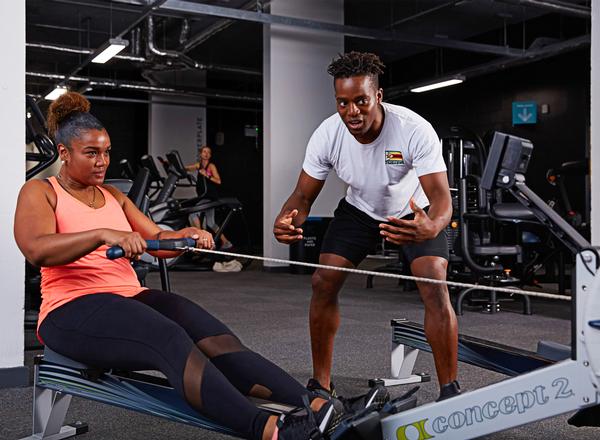
Instructors must intervene to prevent bad rowing technique
The rowing machine is the single most effective piece of kit in the gym, for those looking for a complete body workout – Eric Kent, British Rowing

Walk into a gym anywhere in the world, and a variety of weird and wonderful indoor rowing techniques are likely to be seen. From those who throw their hands up into a high arc over the knees, to others who jerk their arms and body back and forth, barely moving their legs.

This poor understanding of rowing machine technique is nobody’s fault. Rowing is not a popular spectator sport or one that everyone tries when they’re at school. It’s also not a particularly intuitive movement and can feel unnatural at first. But as an activity that uses all the joints of the body, correct technique must be mastered early on if exercisers are to avoid sustaining injures, especially to the upper back, neck and shoulder.

For gym goers to master the technique, however, instructors themselves must first be taught how to row safely and effectively, so they can pass on this knowledge.

For this reason, British Rowing is sending master trainers into gyms around the UK to train and educate gym instructors on how to help members get the most out of the indoor rowing machine.

“A large proportion of trainers, including me, believe that the rowing machine is the single most effective piece of kit in the gym, for those looking for a complete body workout,” says Eric Kent, one of British Rowing’s master trainers.

“However, we know that indoor rowing has long suffered from a lack of education. For gyms to fully utilise their indoor rowing machines, it’s vital to provide staff with professional training. This ensures that members are taught correct technique and given useful exercise programmes. Ultimately, this results in happier members who see better results.”

Getting technical
Kent explains that learning the basics of good rowing technique is quite easy, and that even a simple 10-minute introduction can significantly reduce the risk of injury, while making a huge difference to the quality and enjoyment of a rowing workout.

Mark Edgar, head of sport medicine for the British rowing team, agrees: “There are excellent physiological advantages of indoor rowing training. However, anyone who uses a rowing machine – whether they are a rower or a gym user – needs to be aware of good rowing technique in order to minimise the risk of injuries.”

So what does good technique consist of? The experts agree that one of the most important things to understand is that rowing is not primarily an upper-body sport.

“It’s more about driving with your legs than it is pulling with your arms,” says Concept2’s marketing manager David Hart. “Just like with deadlifts, you want to make sure you get the most out of the big muscles in your legs before you start using your arms.”

This is why the rowing machine has a sliding seat. It allows users to utilise the explosive power in their legs before finishing off the stroke by pulling with the body and then the arms. By employing these muscle groups in a sequence of most to least powerful, each can be used to its full potential.

Ben Duggan, UK & Ireland sales manager for WaterRower, suggests breaking the stroke into smaller segments to get each part right before putting them all together. “Try rowing with only the arms, then only the body and, finally, only the legs,” he says.

Train like an Olympian
Once members have mastered the basics of indoor rowing technique, it’s important to help them understand how the rowing machine can be incorporated into their training.

“Misconceptions remain around how to effectively integrate the rower into your workout routine,” says Duggan. “Hands up all those who only use the rowing machine to warm up!”

“One of the most common errors people make,” says Helen Rowbotham, director of innovation at British Rowing, “is that they just jump on the machine and go hell for leather for a short period of time. But this is not the best way to improve. It’s the same as when you start running – you want to start slowly, focus on technique and gradually build your pace and distance. Beginners wouldn’t sprint straight away or run a half marathon, and it’s no different with rowing.”

Even experienced indoor rowers don’t row fast all the time. Will Satch, GB rower and Olympic Gold Medallist, says: “The rowing machine is the cornerstone for fitness conditioning in the British Rowing team. Whether it’s a long, steady row for 90 minutes plus, or a short higher-intensity piece, the rowing machine can’t be beaten.”

Matt Gleed, master trainer for Matrix Fitness, agrees that speed isn’t necessarily the key to an effective rowing workout. “I always encourage an increase in power rather than speed,” he says. “Your technique will be better and you actually maximise resistance from the force you produce.”

This is an important point to realise: the intensity of a workout is controlled by how hard the user pushes with their legs and pulls with their body and arms. Even with the damper set at 10, if no force is put into the stroke, the user can slide up and down quite easily. It’s up to the individual to put the pressure on.

Educating members
Most gym members are willing to train hard, but they need to be given the correct information to do so – and to do so both safely and effectively. Delivering rowing education via well-trained gym instructors is key to achieving this goal, and this, in turn, will ensure that operators can keep their members safe, while adding serious value to their offering.

Expert Tip

David Hart
David Hart
David Hart,

Marketing Manager,

Concept2


“Set the monitor to show the force curve. This is a graph that represents how you’re applying power over the course of each stroke. Try to create a smooth bell shaped curve.”

Expert Tip

Matt Gleed
Matt Gleed
Matt Gleed,

Master trainer,

Matrix Fitness


“Breathe out during the drive phase. This will encourage diaphragmatic breathing, which will also engage more core muscles.”

Indoor rowing 101

• Focus on your legs – 60 per cent of the power comes from the legs, 30 per cent from the body and just 10 per cent from the arms

• Maintain good core stability at all times and avoid slumping the back and shoulders

•Keep the stroke rate low – don’t rush up and down the slide, instead, focus on putting more power into each stroke
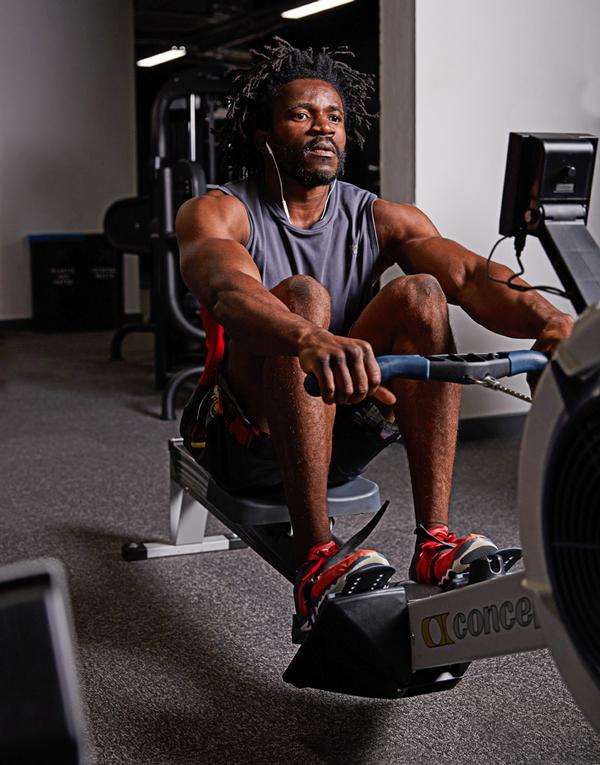
Mastering rowing basics is essential

Graham Benton

At age 21, Graeme Benton was a regular gym-goer, but had always stuck to weight training. A 500m indoor rowing competition at his gym changed that. Achieving a time of 1 minute 19 seconds (1:19), he became hooked.

He trained on the rower for the next few years, and started competing in indoor rowing events, becoming the first ‘non-rower’ to win the men’s open event at the British Indoor Rowing Championships in 2004.

Benton continued to win this event year after year, and in 2006 became the first GB rower since Sir Steve Redgrave to win the Men’s Open event at the World Indoor Rowing Championships. Benton’s personal best of 5:42 for 2km is still the second fastest British time recorded at an indoor rowing competition, beaten only by Olympian Moe Sbihi.
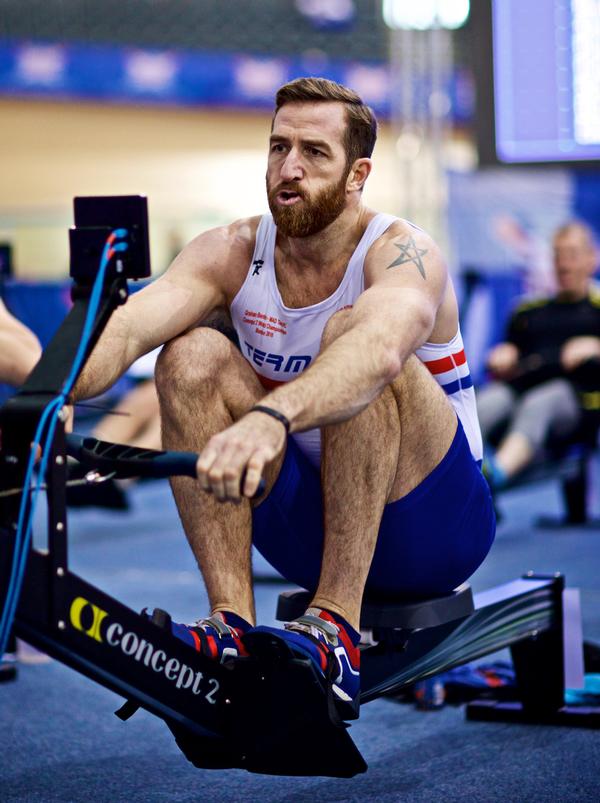
Benton says that becoming part of indoor rowing has been ‘life changing’

Mastering your rowing Technique

British Rowing is sending master trainers to gyms around the country to ensure that instructors know how to teach correctly. Here, we look at the basics of rowing technique

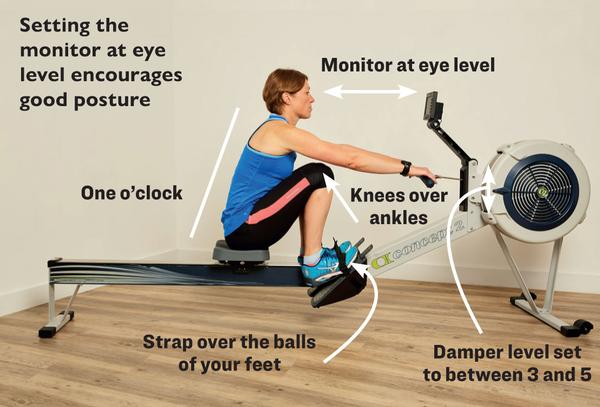
Step 1: Getting on the machine

• First set your foot height. This is important, as it allows you to row comfortably, without overstretching.

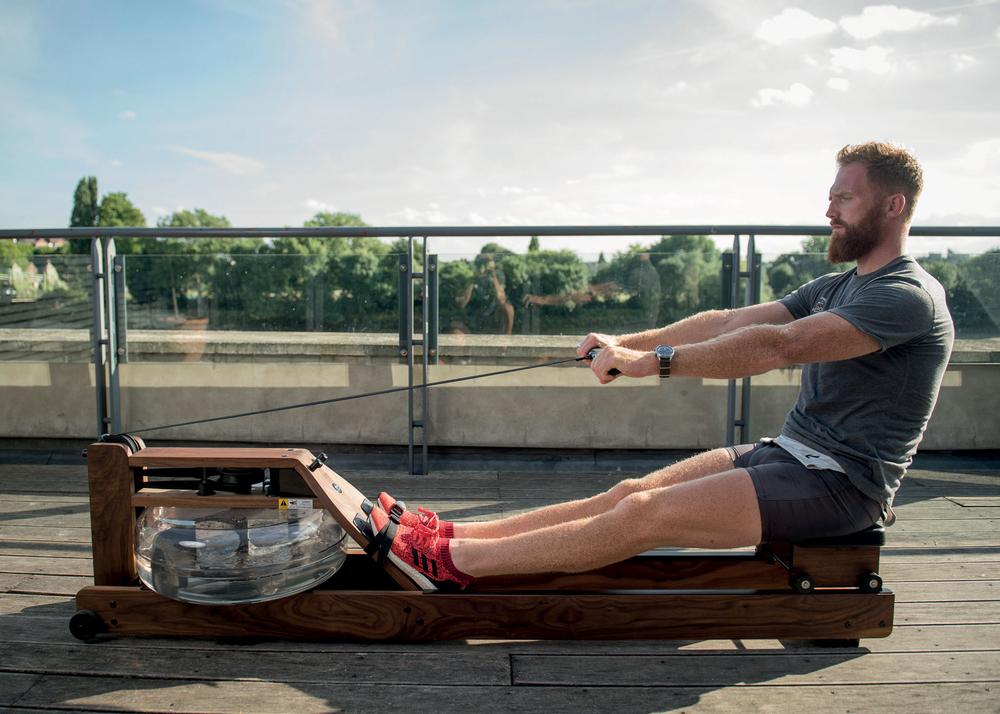
• Find the optimal foot height by getting into the starting position of the stroke (left). Knees should be over your ankles, your shins vertical and your knees reaching to just below arm level.

• Tighten the foot strap over the balls of your feet.

• If using a Concept2 rowing machine, set the damper level to between and 3 and 5 to help maintain good technique and to avoid overloading your lower back.

• Bring the monitor to eye level. This should encourage you to sit up tall with your body tipped forwards from the hips in a strong one o’clock position.

• Pick up the handle and you’re ready for the drive.
Step 2: The drive
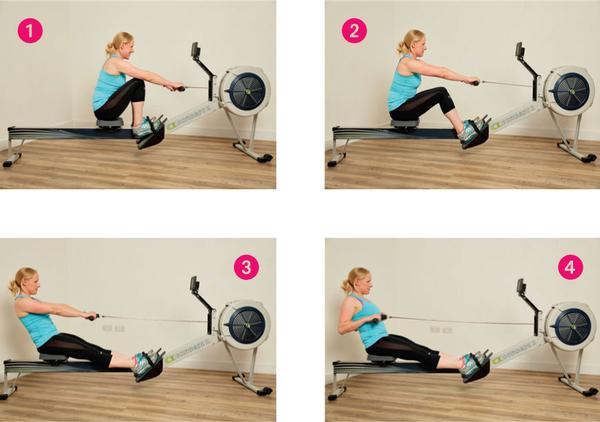
• This is where you add intensity by pushing with the legs and pulling with the body and arms.

• The order of sequencing is legs, body, arms. The first movement should be with your legs, then your body and, lastly, your arms.

Legs: Push with your legs, keeping your body tipped forward at the one o’clock position and your arms straight for as long as possible.

Body: Once your legs are nearly straight, tip your hips back to an 11 o’clock position. Keep your arms straight and your wrists flat with your hands over your knees. Keep sitting up tall and try not to slump.

Arms: When your legs are straight and your body is tipped back, draw the handle into your lower rib cage to finish off the drive.


Step 3: The recovery
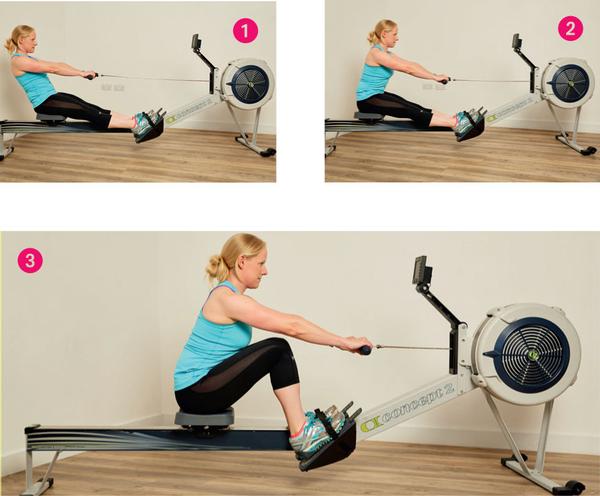
• This part of the stroke is your recovery. It’s a chance to rest and breathe before you take your next drive. As such, it should take twice as long as the drive.

• The movement works in reverse to the drive, starting with the arms, then the body and finishing with the legs.

• Make sure your arms are straight and your hands are over the knees before your knees bend and you roll back up the machine.

Arms: From your finished position, allow your arms to straighten, keeping your spine long and straight.

Body: Keeping your legs straight, tip your body forward from your hips, moving from 11 o’clock to one o’clock.

Legs: Keeping your body at the one o’clock position, bend your knees and let the seat roll forwards until your knees are over your ankles.
Sign up here to get HCM's weekly ezine and every issue of HCM magazine free on digital.
GB rower Will Satch demonstrating correct stroke technique on the WaterRower
https://www.leisureopportunities.co.uk/images/644587_511956.jpg
Rowing machines are found in gyms worldwide, yet members are rarely shown correct technique. We investigate how gyms can prevent injury and enhance members' indoor rowing workouts...
Steph Eaves, Journalist, Leisure Media Eric Kent, British Rowing Will Satch, GB Rowing Team David Hart, marketing manager, Concept2 Matt Gleed, master trainer, Matrix Fitness,rowing machines, operators, indoor rowing
HCM magazine
As the entrepreneur who started Wexer, Fresh Fitness, Fitness DK and Repeat, as well as being a former elite athlete, Rasmus Ingerslev’s life looked perfect from the outside, but onthe inside it was a different story. He talks to Kath Hudson about healing old wounds
HCM magazine
For every member with a tripod and a big following, there are others irritated at the way equipment is being hogged or wary they’ll be in the background on someone’s Insta feed. Do influencers offer valuable, free marketing or are they just a nuisance? Kath Hudson finds out how operators are responding
HCM magazine
If the health service is to survive, we must recognise that it is a disease service – and that wellbeing rests with us, says the activity advocate and healthy ageing champion. He talks to Kate Cracknell
HCM magazine
Strength training is evolving, driven by changing consumer preferences. Julie Cramer talks to innovators about how their products are meeting this demand
HCM magazine
HCM People

Stephen Price

Founder, SP&Co Group
Working in public health over the last few years has lit up parts of my brain again
HCM promotional features
Sponsored
SnowDome Fitness has added 50 per cent more space with cutting-edge Technogym solutions
HCM promotional features
Sponsored
Greg Bradley looks at the shift towards strength training in gyms and advises on how operators can create the ultimate training environment
HCM promotional features
Sponsored
Third Space partnered with IndigoFitness to deliver a bespoke training space for its new club at The Whiteley
HCM promotional features
Sponsored
Find out how your gym can tap into the corporate wellness boom
HCM promotional features
Sponsored
Starpool supports Olympic champion Marcell Jacobs, says Riccardo Turri
HCM promotional features
Sponsored
David Lloyd is stepping up its commitment to women’s health as it continues to explore what fit-for-purpose looks like for the female population
HCM promotional features
Sponsored
EGYM has opened a new HQ in Paternoster Square, London and revealed a range of new launches
HCM promotional features
Sponsored
New launch, Salus House, elevates boutique wellness with high service levels and a partnership with Technogym
HCM promotional features
Promotion
BLK BOX has been reimagining elite performance spaces for more than a decade. Founder and former athlete, Greg Bradley, tells us what it takes
HCM promotional features
Latest News
Australia’s fast-growing fitness network, Viva Leisure, is adding a low-cost gym brand to its already ...
Latest News
Speedflex has launched a strength training programme for 10 to 16-year-olds, to make it safer, ...
Latest News
Tewinbury Farm Hotel in Hertfordshire, UK is expanding its premium leisure proposition with the launch ...
Latest News

Work is underway in Madrid on one of Europe’s most significant multi-functional complexes, ...

Latest News
PureGym is encouraging people to step away from their screens and go for a walk, ...
Latest News
Small improvements to sleep, diet quality, and physical activity, made in combination lead to a ...
Latest News
Therme Manchester’s 28-acre development, which will include interconnected glass pavilions that measure 65,000sq m, will ...
Latest News
The Yard Gym (TYG) is to become Nike Training’s official global training partner in a ...
Opinion
promotion
Strength training has moved from the margins to the mainstream.
Opinion: Building smarter strength spaces for today’s operators
Featured supplier news
Featured supplier news: Reaching the people most gyms miss: Bedford Gym & Swim Campaign delivers 410 new members
One of the biggest mistakes the fitness industry still makes is advertising almost exclusively to people who already look and live like gym members.
Featured supplier news
Featured supplier news: Supporting long-term health: why whole body vibration belongs in clinical settings
As healthcare continues to shift towards prevention, there’s a growing focus on helping people stay active, independent and feeling good for longer.
Company profiles
Company profile: Matrix Fitness
Matrix provides equipment to facilities in all market sectors including private health clubs, residential housing, ...
Company profiles
Company profile: Fold
Fold is the company behind the UK's leading at home foldable reformer pilates bed, bringing ...
Supplier Showcases
Supplier Showcase - Future-proofing
Catalogue Gallery
Click on a catalogue to view it online
Featured press releases
ukactive press release: Are they Fit for Office? UK Active and Technogym throw down the gauntlet to MPs
Hundreds of staff, MPs and Peers from across Westminster have signed up for the Fit for Office parliamentary physical activity challenge, which takes place throughout June and is hosted by ukactive and Technogym.
Featured press releases
Innerva press release: Lex Leisure’s power-assisted exercise suite smashes targets in record time
Crook Log Leisure Centre has more than doubled the membership target for its new power- assisted exercise suite in less than six months.
Directory
Water experiences and hydrotherapy solutions
Aquaform s.r.l.: Water experiences and hydrotherapy solutions
Fitness tracking platform
SpiviTech: Fitness tracking platform
Industrial washing machines
Miele Company Limited: Industrial washing machines
Hot tubs
MSpa International Ltd: Hot tubs
Lockers
Crown Sports Lockers: Lockers
Spa and beauty equipment
Living Earth Crafts: Spa and beauty equipment
Property & Tenders
Stratford, East London.
Lee Valley Regional Park Authority
Property & Tenders
Y Felinheli, LL56 4QN
Newmark
Property & Tenders
Diary dates
13-13 Jun 2026
Worldwide, Various,
Diary dates
21-24 Sep 2026
The Langham Huntington Pasadena , Pasadena, United States
Diary dates
06-08 Oct 2026
Messe Stuttgart, Stuttgart, Germany
Diary dates
22-22 Oct 2026
QEII Conference Centre, London,
Diary dates
26-29 Oct 2027
Koelnmesse Exhibition Centre, Cologne, Germany
Diary dates

features

Indoor rowing: Row right

Rowing machines are found in gyms worldwide, yet members are rarely shown the correct technique. With this omission placing users at risk of serious injuries which operators can be liable for, Steph Eaves asks how gyms can help members use these machines effectively

By Steph Eaves, Health Club Management and Sports Management | Published in Health Club Management 2017 issue 8
Instructors must intervene to prevent bad rowing technique
The rowing machine is the single most effective piece of kit in the gym, for those looking for a complete body workout – Eric Kent, British Rowing

Walk into a gym anywhere in the world, and a variety of weird and wonderful indoor rowing techniques are likely to be seen. From those who throw their hands up into a high arc over the knees, to others who jerk their arms and body back and forth, barely moving their legs.

This poor understanding of rowing machine technique is nobody’s fault. Rowing is not a popular spectator sport or one that everyone tries when they’re at school. It’s also not a particularly intuitive movement and can feel unnatural at first. But as an activity that uses all the joints of the body, correct technique must be mastered early on if exercisers are to avoid sustaining injures, especially to the upper back, neck and shoulder.

For gym goers to master the technique, however, instructors themselves must first be taught how to row safely and effectively, so they can pass on this knowledge.

For this reason, British Rowing is sending master trainers into gyms around the UK to train and educate gym instructors on how to help members get the most out of the indoor rowing machine.

“A large proportion of trainers, including me, believe that the rowing machine is the single most effective piece of kit in the gym, for those looking for a complete body workout,” says Eric Kent, one of British Rowing’s master trainers.

“However, we know that indoor rowing has long suffered from a lack of education. For gyms to fully utilise their indoor rowing machines, it’s vital to provide staff with professional training. This ensures that members are taught correct technique and given useful exercise programmes. Ultimately, this results in happier members who see better results.”

Getting technical
Kent explains that learning the basics of good rowing technique is quite easy, and that even a simple 10-minute introduction can significantly reduce the risk of injury, while making a huge difference to the quality and enjoyment of a rowing workout.

Mark Edgar, head of sport medicine for the British rowing team, agrees: “There are excellent physiological advantages of indoor rowing training. However, anyone who uses a rowing machine – whether they are a rower or a gym user – needs to be aware of good rowing technique in order to minimise the risk of injuries.”

So what does good technique consist of? The experts agree that one of the most important things to understand is that rowing is not primarily an upper-body sport.

“It’s more about driving with your legs than it is pulling with your arms,” says Concept2’s marketing manager David Hart. “Just like with deadlifts, you want to make sure you get the most out of the big muscles in your legs before you start using your arms.”

This is why the rowing machine has a sliding seat. It allows users to utilise the explosive power in their legs before finishing off the stroke by pulling with the body and then the arms. By employing these muscle groups in a sequence of most to least powerful, each can be used to its full potential.

Ben Duggan, UK & Ireland sales manager for WaterRower, suggests breaking the stroke into smaller segments to get each part right before putting them all together. “Try rowing with only the arms, then only the body and, finally, only the legs,” he says.

Train like an Olympian
Once members have mastered the basics of indoor rowing technique, it’s important to help them understand how the rowing machine can be incorporated into their training.

“Misconceptions remain around how to effectively integrate the rower into your workout routine,” says Duggan. “Hands up all those who only use the rowing machine to warm up!”

“One of the most common errors people make,” says Helen Rowbotham, director of innovation at British Rowing, “is that they just jump on the machine and go hell for leather for a short period of time. But this is not the best way to improve. It’s the same as when you start running – you want to start slowly, focus on technique and gradually build your pace and distance. Beginners wouldn’t sprint straight away or run a half marathon, and it’s no different with rowing.”

Even experienced indoor rowers don’t row fast all the time. Will Satch, GB rower and Olympic Gold Medallist, says: “The rowing machine is the cornerstone for fitness conditioning in the British Rowing team. Whether it’s a long, steady row for 90 minutes plus, or a short higher-intensity piece, the rowing machine can’t be beaten.”

Matt Gleed, master trainer for Matrix Fitness, agrees that speed isn’t necessarily the key to an effective rowing workout. “I always encourage an increase in power rather than speed,” he says. “Your technique will be better and you actually maximise resistance from the force you produce.”

This is an important point to realise: the intensity of a workout is controlled by how hard the user pushes with their legs and pulls with their body and arms. Even with the damper set at 10, if no force is put into the stroke, the user can slide up and down quite easily. It’s up to the individual to put the pressure on.

Educating members
Most gym members are willing to train hard, but they need to be given the correct information to do so – and to do so both safely and effectively. Delivering rowing education via well-trained gym instructors is key to achieving this goal, and this, in turn, will ensure that operators can keep their members safe, while adding serious value to their offering.

Expert Tip

David Hart
David Hart
David Hart,

Marketing Manager,

Concept2


“Set the monitor to show the force curve. This is a graph that represents how you’re applying power over the course of each stroke. Try to create a smooth bell shaped curve.”

Expert Tip

Matt Gleed
Matt Gleed
Matt Gleed,

Master trainer,

Matrix Fitness


“Breathe out during the drive phase. This will encourage diaphragmatic breathing, which will also engage more core muscles.”

Indoor rowing 101

• Focus on your legs – 60 per cent of the power comes from the legs, 30 per cent from the body and just 10 per cent from the arms

• Maintain good core stability at all times and avoid slumping the back and shoulders

•Keep the stroke rate low – don’t rush up and down the slide, instead, focus on putting more power into each stroke

Mastering rowing basics is essential

Graham Benton

At age 21, Graeme Benton was a regular gym-goer, but had always stuck to weight training. A 500m indoor rowing competition at his gym changed that. Achieving a time of 1 minute 19 seconds (1:19), he became hooked.

He trained on the rower for the next few years, and started competing in indoor rowing events, becoming the first ‘non-rower’ to win the men’s open event at the British Indoor Rowing Championships in 2004.

Benton continued to win this event year after year, and in 2006 became the first GB rower since Sir Steve Redgrave to win the Men’s Open event at the World Indoor Rowing Championships. Benton’s personal best of 5:42 for 2km is still the second fastest British time recorded at an indoor rowing competition, beaten only by Olympian Moe Sbihi.

Benton says that becoming part of indoor rowing has been ‘life changing’

Mastering your rowing Technique

British Rowing is sending master trainers to gyms around the country to ensure that instructors know how to teach correctly. Here, we look at the basics of rowing technique

Step 1: Getting on the machine

• First set your foot height. This is important, as it allows you to row comfortably, without overstretching.

• Find the optimal foot height by getting into the starting position of the stroke (left). Knees should be over your ankles, your shins vertical and your knees reaching to just below arm level.

• Tighten the foot strap over the balls of your feet.

• If using a Concept2 rowing machine, set the damper level to between and 3 and 5 to help maintain good technique and to avoid overloading your lower back.

• Bring the monitor to eye level. This should encourage you to sit up tall with your body tipped forwards from the hips in a strong one o’clock position.

• Pick up the handle and you’re ready for the drive.

Step 2: The drive

• This is where you add intensity by pushing with the legs and pulling with the body and arms.

• The order of sequencing is legs, body, arms. The first movement should be with your legs, then your body and, lastly, your arms.

Legs: Push with your legs, keeping your body tipped forward at the one o’clock position and your arms straight for as long as possible.

Body: Once your legs are nearly straight, tip your hips back to an 11 o’clock position. Keep your arms straight and your wrists flat with your hands over your knees. Keep sitting up tall and try not to slump.

Arms: When your legs are straight and your body is tipped back, draw the handle into your lower rib cage to finish off the drive.


Step 3: The recovery

• This part of the stroke is your recovery. It’s a chance to rest and breathe before you take your next drive. As such, it should take twice as long as the drive.

• The movement works in reverse to the drive, starting with the arms, then the body and finishing with the legs.

• Make sure your arms are straight and your hands are over the knees before your knees bend and you roll back up the machine.

Arms: From your finished position, allow your arms to straighten, keeping your spine long and straight.

Body: Keeping your legs straight, tip your body forward from your hips, moving from 11 o’clock to one o’clock.

Legs: Keeping your body at the one o’clock position, bend your knees and let the seat roll forwards until your knees are over your ankles.

Sign up here to get HCM's weekly ezine and every issue of HCM magazine free on digital.
GB rower Will Satch demonstrating correct stroke technique on the WaterRower
https://www.leisureopportunities.co.uk/images/644587_511956.jpg
Rowing machines are found in gyms worldwide, yet members are rarely shown correct technique. We investigate how gyms can prevent injury and enhance members' indoor rowing workouts...
Steph Eaves, Journalist, Leisure Media Eric Kent, British Rowing Will Satch, GB Rowing Team David Hart, marketing manager, Concept2 Matt Gleed, master trainer, Matrix Fitness,rowing machines, operators, indoor rowing
Latest News
Australia’s fast-growing fitness network, Viva Leisure, is adding a low-cost gym brand to its already ...
Latest News
Speedflex has launched a strength training programme for 10 to 16-year-olds, to make it safer, ...
Latest News
Tewinbury Farm Hotel in Hertfordshire, UK is expanding its premium leisure proposition with the launch ...
Latest News

Work is underway in Madrid on one of Europe’s most significant multi-functional complexes, ...

Latest News
PureGym is encouraging people to step away from their screens and go for a walk, ...
Latest News
Small improvements to sleep, diet quality, and physical activity, made in combination lead to a ...
Latest News
Therme Manchester’s 28-acre development, which will include interconnected glass pavilions that measure 65,000sq m, will ...
Latest News
The Yard Gym (TYG) is to become Nike Training’s official global training partner in a ...
Latest News
Everlast Gyms' York site has reopened following a refurbishment to bring it up to the ...
Latest News
Luxury hospitality and wellness pioneer Jeremy McCarthy has launched Leisure Alchemy, a digital platform that ...
Latest News
A contrast therapy and breathwork facility called Reset has opened in Islington, London, in the ...
Opinion
promotion
Strength training has moved from the margins to the mainstream.
Opinion: Building smarter strength spaces for today’s operators
Featured supplier news
Featured supplier news: Reaching the people most gyms miss: Bedford Gym & Swim Campaign delivers 410 new members
One of the biggest mistakes the fitness industry still makes is advertising almost exclusively to people who already look and live like gym members.
Featured supplier news
Featured supplier news: Supporting long-term health: why whole body vibration belongs in clinical settings
As healthcare continues to shift towards prevention, there’s a growing focus on helping people stay active, independent and feeling good for longer.

Company profiles
Company profile: Matrix Fitness
Matrix provides equipment to facilities in all market sectors including private health clubs, residential housing, ...
Company profiles
Company profile: Fold
Fold is the company behind the UK's leading at home foldable reformer pilates bed, bringing ...
Supplier Showcases
Supplier Showcase - Future-proofing
Catalogue Gallery
Click on a catalogue to view it online
Featured press releases
ukactive press release: Are they Fit for Office? UK Active and Technogym throw down the gauntlet to MPs
Hundreds of staff, MPs and Peers from across Westminster have signed up for the Fit for Office parliamentary physical activity challenge, which takes place throughout June and is hosted by ukactive and Technogym.
Featured press releases
Innerva press release: Lex Leisure’s power-assisted exercise suite smashes targets in record time
Crook Log Leisure Centre has more than doubled the membership target for its new power- assisted exercise suite in less than six months.
Directory
Water experiences and hydrotherapy solutions
Aquaform s.r.l.: Water experiences and hydrotherapy solutions
Fitness tracking platform
SpiviTech: Fitness tracking platform
Industrial washing machines
Miele Company Limited: Industrial washing machines
Hot tubs
MSpa International Ltd: Hot tubs
Lockers
Crown Sports Lockers: Lockers
Spa and beauty equipment
Living Earth Crafts: Spa and beauty equipment
Property & Tenders
Stratford, East London.
Lee Valley Regional Park Authority
Property & Tenders
Y Felinheli, LL56 4QN
Newmark
Property & Tenders
Diary dates
13-13 Jun 2026
Worldwide, Various,
Diary dates
21-24 Sep 2026
The Langham Huntington Pasadena , Pasadena, United States
Diary dates
06-08 Oct 2026
Messe Stuttgart, Stuttgart, Germany
Diary dates
22-22 Oct 2026
QEII Conference Centre, London,
Diary dates
26-29 Oct 2027
Koelnmesse Exhibition Centre, Cologne, Germany
Diary dates
Search news, features & products:
Find a supplier:
Elevate Arena
Elevate Arena
Partner sites