















EGYM
EGYM
EGYM
Follow Health Club Management on Twitter Like Health Club Management on Facebook Join the discussion with Health Club Management on LinkedIn
FITNESS, HEALTH, WELLNESS

features

ukactive update: The new public health landscape

David Stalker, CEO of ukactive, outlines the changes to public health commissioning that took effect on 1 April and examines the impact these will have on all providers, both in the health and wellness sectors and in the wider healthcare industry

By David Stalker, ukactive | Published in Health Club Management 2013 issue 4

Last March, the coalition government’s Health and Social Care Act passed through parliament. It represented a radical shake-up of the NHS and has brought extensive changes to the entire NHS and public health landscape, setting out a major programme of reforms to restructure healthcare services and public health responsibilities.

A new public health structure, born out of these wide-ranging reforms, came into force on 1 April 2013.

Background
The coalition government’s strategy for public health was originally laid out in the white paper Healthy Lives, Healthy People, which envisaged moving to a more local and patient-focused health system. The White Paper proposed changes to the way public health services are commissioned and delivered, which were subsequently formalised in the Health and Social Care Act 2012.

The rationale for the change is to better meet the needs of local populations, and to enable the integration of public health into local systems and services, acknowledging the importance of local issues and the social determinants of health (eg housing, education, financial security and the built environment).

The changes are also driven by a need for the NHS to find £20bn of efficiency savings by the end of 2013/2014, as well as ongoing cost efficiency opportunities within a national health system that’s pressured by rising levels of chronic conditions and an ageing population with complex social care needs.

All change
The key changes that came into place on 1 April 2013 include:

• Primary Care Trusts (PCTs) are replaced by Clinical Commissioning Groups (CCGs), giving greater control to GPs in the commissioning of primary, secondary and social care.

• Local authorities will now be responsible for all areas of public health, including tobacco control, locally-led nutrition initiatives, public mental health services, increasing levels of physical activity in local populations and decreasing inactivity, managing chronic conditions and obesity levels, and initiatives on workplace health. Local authorities will be guided by a new structure, Public Health England, on how to distribute their £2.7bn ringfenced public health budget.

• Local authorities will need to demonstrate improvements in public health outcomes, measured in terms of progress against indicators of local health needs. These needs will be set out by the local authorities and CCGs in Joint Strategic Needs Assessment (JSNA) and reflected in Joint Health and Wellbeing Strategies (JHWS).

• GPs are charged with making decisions on commissioning – prescriptions will come out of their own budget, so they will be seeking cost-effective solutions and preventative interventions.

The reforms mark the first time there has been structural recognition of the importance of prevention in healthcare and the role of public health. Physical activity levels among the UK population are one of the indicators in the Public Health Outcomes Framework (see below) – that will be used to measure the outcomes of the changes detailed above.

Measuring outcomes
The outcomes of these changes to public health delivery will be measured through a number of frameworks:

NHS Outcomes Framework
A framework to provide a national overview of how well the NHS is performing, wherever possible in an international context. It will also act as a catalyst for driving quality improvement and outcome measurement in the NHS by encouraging a change in culture and behaviour, including a stronger focus on tackling health inequalities.

Quality Outcomes Framework (QOF)
A voluntary annual reward and incentive programme for all GP surgeries in England, detailing practice achievement results. It’s not about performance management but rather resourcing and then rewarding good practice.

Public Health Outcomes Framework
From April 2013, all local councils will receive a ringfenced budget (a share of around £5.2bn based on 2012/2013 funding) for public health spending, and will be able to choose how they spend it according to the needs of their population. There are 353 councils in England and their performance will be measured against this framework, of which physical activity is one of the sixty-six indicators.
Other indicators include: sickness absence rate, excess weight in four- to five-year-olds and 10- to 11-year-olds, excess weight in adults, recorded diabetes, falls and fall injuries in the over-65s, mortality from causes considered preventable, mortality from all cardiovascular diseases, mortality from cancer, and health-related quality of life for older people.

So what’s the situation now?
As of 1 April 2013:

• The NHS Commissioning Board has taken on its full statutory functions as the national independent body to allocate resources to CCGs and provide commissioning guidance for predominantly primary care services.

• Public Health England is established as an executive agency of the Department of Health and will allocate ringfenced budgets (weighted for inequalities) to local authorities to commission public health services, build evidence bases and co-ordinate service integration.

• Clinical Commissioning Groups are established and assume statutory responsibilities for the healthcare budgets of their local communities (211 in total). GP practices must be members of either an authorised CCG or shadow CCG.

• All Strategic Health Authorities and Primary Care Trusts are abolished.

• Health and Wellbeing Boards are established and assume statutory responsibilities (see p24).

• Local authorities have taken on new responsibility to improve the health of their populations. They will have employed directors of public health, received ringfenced funding for public health, and started the process of developing their local JSNAs and JHWSs through the new HWBs.

• Local HealthWatch is established to give local people a say in how health and social care services are provided.

• Monitor takes on the role of economic regulator for all providers of health and adult social care services, with all providers of NHS services expected to hold a Monitor license.

• Health Education England takes over strategic health authorities’ (which previously oversaw local NHS trusts) responsibilities for the areas of local education and training.

The new public health structures

NHS Commissioning Board (NHSCB)
An independent board established to allocate resources and provide commissioning guidance. It will have responsibility for a budget of around £80bn. Its functions will include delivering improved health outcomes, supporting quality improvements, developing commissioning guidance, championing patient interests, overseeing the commissioning budget, and supervising the development and overall outcomes of CCGs (see below).

Clinical Commissioning Group (CCGs)
CCGs replace Primary Care Trusts (PCTs) as the new health commissioning organisations. They will be responsible for commissioning the majority of local health services and will have a statutory duty to obtain advice from other health and care professionals and involve patients and the public.

In each NHS region, GP surgeries are grouping together to form CCGs (there will be 221 in total). They will be responsible for around £60bn of the NHS annual budget, which will be allocated to them directly by the NHSCB.

Each CCG will have a governing board comprising healthcare professionals including GPs, nurses, hospital doctors and others including physiotherapists and patient representatives. CCGs will work closely with the newly established Health and Wellbeing Boards (see below) to ensure services are integrated and deliver the best quality health and care outcomes for their population.

Health and Wellbeing Boards (HWBs)
The aim of HWBs is to bring together local commissioners to improve the health and wellbeing of their population and reduce health inequalities. They will be made up of local commissioners across the NHS, public health and social care, elected representatives and patient representatives.

At a minimum, a HWB must include one local elected representative, the director of adult social services for the local authority, the director of children’s services for the local authority, the director of public health for the local authority, a representative of the local HealthWatch (see below) organisation in that area, and a representative of each local commissioning group.

HWBs can expand their membership to include a wider range of expertise and have a statutory duty to involve local people. Boards will bring together CCGs and local authorities to develop a shared understanding of the health and wellbeing needs of the community. They will undertake the Joint Strategic Needs Assessment (JSNA) and develop a Joint Health and Wellbeing Strategy (JHWS) on how these needs can be addressed, thereby driving local commissioning of healthcare, social care and public health. Other services impacting health, such as housing provision, will also be addressed.

HWBs will influence investment decisions right across the local authority, with the goal of enhancing health and wellbeing. Crucially, they will push to ensure public health is always considered when local authorities, GP consortia and the NHS make decisions.

HealthWatch England
HealthWatch will be a national independent body that enables the collective views of the people who use NHS and adult social care services to influence national policy, advice and guidance. It will advise the NHSCB, local authorities, Monitor (the economic regulator) and the Secretary of State for Health. It will also have the power to recommend that action is taken by the Care Quality Commission (see below) when there are concerns about health and social care services.

Care Quality Commission (CQC)
The role of the CQC will be strengthened as an effective quality inspectorate by giving it a clearer focus on the essential levels of safety and quality of providers.

NHS Foundation Trusts
The Act requires “all trusts to become foundation trusts (or become part of a foundation trust)” as soon as is feasible, with a clear target of April 2014. This means semi-independence of Whitehall control with, for example, the freedom to earn money by treating certain numbers of private patients. Around half of the hospitals in England already have that status.

Reform of the NHS Structure
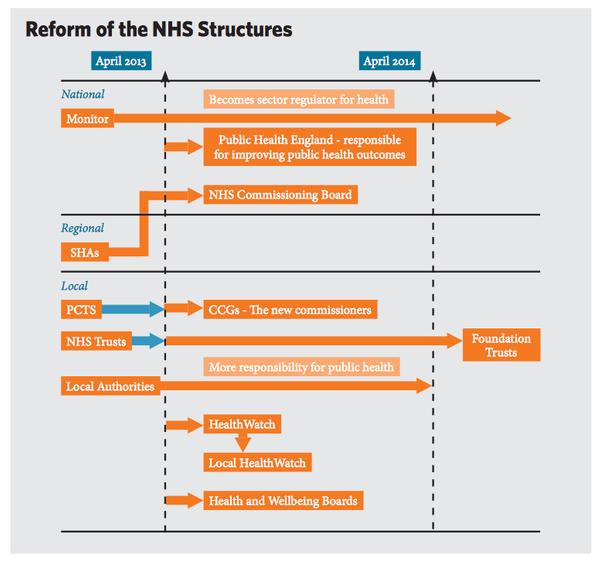
Reform of the NHS Structure

For further information

For more information on public health reforms, visit www.ukactive.com

See also p30 for expert comment on
how these changes will affect the physical activity sector.

Sign up here to get HCM's weekly ezine and every issue of HCM magazine free on digital.
Local authorities will now be responsible for all areas of public health, including increasing physical activity and tackling obesity levels / Photo: shutterstock.com/dot shock
GP commissioning groups will be in charge of around £60bn of the NHS annual budget / monkey business images/shutterstock.com
https://www.leisureopportunities.co.uk/images/HCM2013_4ukactive.gif
CEO David Stalker outlines the key changes to public health commissioning which came into force this month, and what these mean for health and wellbeing providers
CEO David Stalker ukactive,Public health, PCTs, CCGs, NHS
HCM magazine
As the entrepreneur who started Wexer, Fresh Fitness, Fitness DK and Repeat, as well as being a former elite athlete, Rasmus Ingerslev’s life looked perfect from the outside, but onthe inside it was a different story. He talks to Kath Hudson about healing old wounds
HCM magazine
If the health service is to survive, we must recognise that it is a disease service – and that wellbeing rests with us, says the activity advocate and healthy ageing champion. He talks to Kate Cracknell
HCM magazine
Raphael Cuomo explores the powerful link between addiction, health and behaviour change
HCM magazine
HCM People

Stephen Price

Founder, SP&Co Group
Working in public health over the last few years has lit up parts of my brain again
HCM magazine
Collaborations with the medical profession and greater aspirations around wellbeing are creating a need for more experts in our sector. It’s time to reboot our thinking around the workforce
HCM promotional features
Sponsored
Greg Bradley looks at the shift towards strength training in gyms and advises on how operators can create the ultimate training environment
HCM promotional features
Sponsored
David Lloyd is stepping up its commitment to women’s health as it continues to explore what fit-for-purpose looks like for the female population
HCM promotional features
Sponsored
SnowDome Fitness has added 50 per cent more space with cutting-edge Technogym solutions
HCM promotional features
Sponsored
Find out how your gym can tap into the corporate wellness boom
HCM promotional features
Sponsored
Starpool supports Olympic champion Marcell Jacobs, says Riccardo Turri
HCM promotional features
Sponsored
Third Space partnered with IndigoFitness to deliver a bespoke training space for its new club at The Whiteley
HCM promotional features
Sponsored
EGYM has opened a new HQ in Paternoster Square, London and revealed a range of new launches
HCM promotional features
Sponsored
Pulse Fitness has created a new health club delivering an elevated wellness experience
HCM promotional features
Promotion
Performance Health Systems, manufacturer of Power Plate, has a new CEO, with an ambitious vision for the company
HCM promotional features
Latest News
Nuffield Health has told HCM that it takes its responsibilities towards its colleagues seriously and ...
Latest News
Technogym has announced the launch of the Run X World Treadmill Championship, the first world ...
Latest News
Shocked by the UK loneliness statistics, charitable trust Mytime Active has been doubling down on ...
Latest News
Portugal’s leading operator, SC Fitness, is celebrating a milestone by reaching 100 gyms.  The company ...
Latest News
Australia’s fast-growing fitness network, Viva Leisure, is adding a low-cost gym brand to its already ...
Latest News
Speedflex has launched a strength training programme for 10 to 16-year-olds, to make it safer, ...
Latest News
Tewinbury Farm Hotel in Hertfordshire, UK is expanding its premium leisure proposition with the launch ...
Latest News

Work is underway in Madrid on one of Europe’s most significant multi-functional complexes, ...

Opinion
promotion
Strength training has moved from the margins to the mainstream.
Opinion: Building smarter strength spaces for today’s operators
Featured supplier news
Featured supplier news: W3Fit EMEA celebrates its fifth anniversary
Celebrating its milestone 5th anniversary, W3Fit EMEA returns in 2026 with an unmissable gathering of the Health & Fitness industry’s most influential leaders.
Featured supplier news
Featured supplier news: Supporting long-term health: why whole body vibration belongs in clinical settings
As healthcare continues to shift towards prevention, there’s a growing focus on helping people stay active, independent and feeling good for longer.
Company profiles
Company profile: Kemitron GmbH
Kemitron is a German family-owned company specialising in the development and manufacture of high-quality products ...
Company profiles
Company profile: Total Vibration Solutions Ltd (TVS Group)
TVS Group includes TVS Sports Surfaces, TVS Gym Flooring, TVS Play Surfaces and TVS Acoustics. ...
Supplier Showcases
Supplier Showcase - Future-proofing
Catalogue Gallery
Click on a catalogue to view it online
Featured press releases
GYMNATION press release: Massive ‘Good Luck’ message appears in Saudi Desert as Green Falcons head to World Cup
Passengers flying out of Riyadh this week have been treated to an extraordinary sight from the skies after GymNation unveiled a giant desert sand mural supporting the Saudi Arabia National Football Team ahead of the FIFA World Cup in the United States.
Featured press releases
BLK BOX press release: BLK BOX strengthens European growth with the appointment of Germany country manager Timo Garrels
BLK BOX is proud to welcome Timo Garrels as Germany country manager, marking another important step in the brand’s continued growth across Europe.
Directory
Lockers
Crown Sports Lockers: Lockers
Water experiences and hydrotherapy solutions
Aquaform s.r.l.: Water experiences and hydrotherapy solutions
Industrial washing machines
Miele Company Limited: Industrial washing machines
Fitness tracking platform
SpiviTech: Fitness tracking platform
Spa and beauty equipment
Living Earth Crafts: Spa and beauty equipment
Hot tubs
MSpa International Ltd: Hot tubs
Property & Tenders
Stratford, East London.
Lee Valley Regional Park Authority
Property & Tenders
Y Felinheli, LL56 4QN
Newmark
Property & Tenders
Diary dates
13-13 Jun 2026
Worldwide, Various,
Diary dates
21-24 Sep 2026
The Langham Huntington Pasadena , Pasadena, United States
Diary dates
06-08 Oct 2026
Messe Stuttgart, Stuttgart, Germany
Diary dates
22-22 Oct 2026
QEII Conference Centre, London,
Diary dates
26-29 Oct 2027
Koelnmesse Exhibition Centre, Cologne, Germany
Diary dates

features

ukactive update: The new public health landscape

David Stalker, CEO of ukactive, outlines the changes to public health commissioning that took effect on 1 April and examines the impact these will have on all providers, both in the health and wellness sectors and in the wider healthcare industry

By David Stalker, ukactive | Published in Health Club Management 2013 issue 4

Last March, the coalition government’s Health and Social Care Act passed through parliament. It represented a radical shake-up of the NHS and has brought extensive changes to the entire NHS and public health landscape, setting out a major programme of reforms to restructure healthcare services and public health responsibilities.

A new public health structure, born out of these wide-ranging reforms, came into force on 1 April 2013.

Background
The coalition government’s strategy for public health was originally laid out in the white paper Healthy Lives, Healthy People, which envisaged moving to a more local and patient-focused health system. The White Paper proposed changes to the way public health services are commissioned and delivered, which were subsequently formalised in the Health and Social Care Act 2012.

The rationale for the change is to better meet the needs of local populations, and to enable the integration of public health into local systems and services, acknowledging the importance of local issues and the social determinants of health (eg housing, education, financial security and the built environment).

The changes are also driven by a need for the NHS to find £20bn of efficiency savings by the end of 2013/2014, as well as ongoing cost efficiency opportunities within a national health system that’s pressured by rising levels of chronic conditions and an ageing population with complex social care needs.

All change
The key changes that came into place on 1 April 2013 include:

• Primary Care Trusts (PCTs) are replaced by Clinical Commissioning Groups (CCGs), giving greater control to GPs in the commissioning of primary, secondary and social care.

• Local authorities will now be responsible for all areas of public health, including tobacco control, locally-led nutrition initiatives, public mental health services, increasing levels of physical activity in local populations and decreasing inactivity, managing chronic conditions and obesity levels, and initiatives on workplace health. Local authorities will be guided by a new structure, Public Health England, on how to distribute their £2.7bn ringfenced public health budget.

• Local authorities will need to demonstrate improvements in public health outcomes, measured in terms of progress against indicators of local health needs. These needs will be set out by the local authorities and CCGs in Joint Strategic Needs Assessment (JSNA) and reflected in Joint Health and Wellbeing Strategies (JHWS).

• GPs are charged with making decisions on commissioning – prescriptions will come out of their own budget, so they will be seeking cost-effective solutions and preventative interventions.

The reforms mark the first time there has been structural recognition of the importance of prevention in healthcare and the role of public health. Physical activity levels among the UK population are one of the indicators in the Public Health Outcomes Framework (see below) – that will be used to measure the outcomes of the changes detailed above.

Measuring outcomes
The outcomes of these changes to public health delivery will be measured through a number of frameworks:

NHS Outcomes Framework
A framework to provide a national overview of how well the NHS is performing, wherever possible in an international context. It will also act as a catalyst for driving quality improvement and outcome measurement in the NHS by encouraging a change in culture and behaviour, including a stronger focus on tackling health inequalities.

Quality Outcomes Framework (QOF)
A voluntary annual reward and incentive programme for all GP surgeries in England, detailing practice achievement results. It’s not about performance management but rather resourcing and then rewarding good practice.

Public Health Outcomes Framework
From April 2013, all local councils will receive a ringfenced budget (a share of around £5.2bn based on 2012/2013 funding) for public health spending, and will be able to choose how they spend it according to the needs of their population. There are 353 councils in England and their performance will be measured against this framework, of which physical activity is one of the sixty-six indicators.
Other indicators include: sickness absence rate, excess weight in four- to five-year-olds and 10- to 11-year-olds, excess weight in adults, recorded diabetes, falls and fall injuries in the over-65s, mortality from causes considered preventable, mortality from all cardiovascular diseases, mortality from cancer, and health-related quality of life for older people.

So what’s the situation now?
As of 1 April 2013:

• The NHS Commissioning Board has taken on its full statutory functions as the national independent body to allocate resources to CCGs and provide commissioning guidance for predominantly primary care services.

• Public Health England is established as an executive agency of the Department of Health and will allocate ringfenced budgets (weighted for inequalities) to local authorities to commission public health services, build evidence bases and co-ordinate service integration.

• Clinical Commissioning Groups are established and assume statutory responsibilities for the healthcare budgets of their local communities (211 in total). GP practices must be members of either an authorised CCG or shadow CCG.

• All Strategic Health Authorities and Primary Care Trusts are abolished.

• Health and Wellbeing Boards are established and assume statutory responsibilities (see p24).

• Local authorities have taken on new responsibility to improve the health of their populations. They will have employed directors of public health, received ringfenced funding for public health, and started the process of developing their local JSNAs and JHWSs through the new HWBs.

• Local HealthWatch is established to give local people a say in how health and social care services are provided.

• Monitor takes on the role of economic regulator for all providers of health and adult social care services, with all providers of NHS services expected to hold a Monitor license.

• Health Education England takes over strategic health authorities’ (which previously oversaw local NHS trusts) responsibilities for the areas of local education and training.

The new public health structures

NHS Commissioning Board (NHSCB)
An independent board established to allocate resources and provide commissioning guidance. It will have responsibility for a budget of around £80bn. Its functions will include delivering improved health outcomes, supporting quality improvements, developing commissioning guidance, championing patient interests, overseeing the commissioning budget, and supervising the development and overall outcomes of CCGs (see below).

Clinical Commissioning Group (CCGs)
CCGs replace Primary Care Trusts (PCTs) as the new health commissioning organisations. They will be responsible for commissioning the majority of local health services and will have a statutory duty to obtain advice from other health and care professionals and involve patients and the public.

In each NHS region, GP surgeries are grouping together to form CCGs (there will be 221 in total). They will be responsible for around £60bn of the NHS annual budget, which will be allocated to them directly by the NHSCB.

Each CCG will have a governing board comprising healthcare professionals including GPs, nurses, hospital doctors and others including physiotherapists and patient representatives. CCGs will work closely with the newly established Health and Wellbeing Boards (see below) to ensure services are integrated and deliver the best quality health and care outcomes for their population.

Health and Wellbeing Boards (HWBs)
The aim of HWBs is to bring together local commissioners to improve the health and wellbeing of their population and reduce health inequalities. They will be made up of local commissioners across the NHS, public health and social care, elected representatives and patient representatives.

At a minimum, a HWB must include one local elected representative, the director of adult social services for the local authority, the director of children’s services for the local authority, the director of public health for the local authority, a representative of the local HealthWatch (see below) organisation in that area, and a representative of each local commissioning group.

HWBs can expand their membership to include a wider range of expertise and have a statutory duty to involve local people. Boards will bring together CCGs and local authorities to develop a shared understanding of the health and wellbeing needs of the community. They will undertake the Joint Strategic Needs Assessment (JSNA) and develop a Joint Health and Wellbeing Strategy (JHWS) on how these needs can be addressed, thereby driving local commissioning of healthcare, social care and public health. Other services impacting health, such as housing provision, will also be addressed.

HWBs will influence investment decisions right across the local authority, with the goal of enhancing health and wellbeing. Crucially, they will push to ensure public health is always considered when local authorities, GP consortia and the NHS make decisions.

HealthWatch England
HealthWatch will be a national independent body that enables the collective views of the people who use NHS and adult social care services to influence national policy, advice and guidance. It will advise the NHSCB, local authorities, Monitor (the economic regulator) and the Secretary of State for Health. It will also have the power to recommend that action is taken by the Care Quality Commission (see below) when there are concerns about health and social care services.

Care Quality Commission (CQC)
The role of the CQC will be strengthened as an effective quality inspectorate by giving it a clearer focus on the essential levels of safety and quality of providers.

NHS Foundation Trusts
The Act requires “all trusts to become foundation trusts (or become part of a foundation trust)” as soon as is feasible, with a clear target of April 2014. This means semi-independence of Whitehall control with, for example, the freedom to earn money by treating certain numbers of private patients. Around half of the hospitals in England already have that status.

Reform of the NHS Structure

Reform of the NHS Structure

For further information

For more information on public health reforms, visit www.ukactive.com

See also p30 for expert comment on
how these changes will affect the physical activity sector.

Sign up here to get HCM's weekly ezine and every issue of HCM magazine free on digital.
Local authorities will now be responsible for all areas of public health, including increasing physical activity and tackling obesity levels / Photo: shutterstock.com/dot shock
GP commissioning groups will be in charge of around £60bn of the NHS annual budget / monkey business images/shutterstock.com
https://www.leisureopportunities.co.uk/images/HCM2013_4ukactive.gif
CEO David Stalker outlines the key changes to public health commissioning which came into force this month, and what these mean for health and wellbeing providers
CEO David Stalker ukactive,Public health, PCTs, CCGs, NHS
Latest News
Nuffield Health has told HCM that it takes its responsibilities towards its colleagues seriously and ...
Latest News
Technogym has announced the launch of the Run X World Treadmill Championship, the first world ...
Latest News
Shocked by the UK loneliness statistics, charitable trust Mytime Active has been doubling down on ...
Latest News
Portugal’s leading operator, SC Fitness, is celebrating a milestone by reaching 100 gyms.  The company ...
Latest News
Australia’s fast-growing fitness network, Viva Leisure, is adding a low-cost gym brand to its already ...
Latest News
Speedflex has launched a strength training programme for 10 to 16-year-olds, to make it safer, ...
Latest News
Tewinbury Farm Hotel in Hertfordshire, UK is expanding its premium leisure proposition with the launch ...
Latest News

Work is underway in Madrid on one of Europe’s most significant multi-functional complexes, ...

Latest News
PureGym is encouraging people to step away from their screens and go for a walk, ...
Latest News
Small improvements to sleep, diet quality, and physical activity, made in combination lead to a ...
Latest News
Therme Manchester’s 28-acre development, which will include interconnected glass pavilions that measure 65,000sq m, will ...
Opinion
promotion
Strength training has moved from the margins to the mainstream.
Opinion: Building smarter strength spaces for today’s operators
Featured supplier news
Featured supplier news: W3Fit EMEA celebrates its fifth anniversary
Celebrating its milestone 5th anniversary, W3Fit EMEA returns in 2026 with an unmissable gathering of the Health & Fitness industry’s most influential leaders.
Featured supplier news
Featured supplier news: Supporting long-term health: why whole body vibration belongs in clinical settings
As healthcare continues to shift towards prevention, there’s a growing focus on helping people stay active, independent and feeling good for longer.

Company profiles
Company profile: Kemitron GmbH
Kemitron is a German family-owned company specialising in the development and manufacture of high-quality products ...
Company profiles
Company profile: Total Vibration Solutions Ltd (TVS Group)
TVS Group includes TVS Sports Surfaces, TVS Gym Flooring, TVS Play Surfaces and TVS Acoustics. ...
Supplier Showcases
Supplier Showcase - Future-proofing
Catalogue Gallery
Click on a catalogue to view it online
Featured press releases
GYMNATION press release: Massive ‘Good Luck’ message appears in Saudi Desert as Green Falcons head to World Cup
Passengers flying out of Riyadh this week have been treated to an extraordinary sight from the skies after GymNation unveiled a giant desert sand mural supporting the Saudi Arabia National Football Team ahead of the FIFA World Cup in the United States.
Featured press releases
BLK BOX press release: BLK BOX strengthens European growth with the appointment of Germany country manager Timo Garrels
BLK BOX is proud to welcome Timo Garrels as Germany country manager, marking another important step in the brand’s continued growth across Europe.
Directory
Lockers
Crown Sports Lockers: Lockers
Water experiences and hydrotherapy solutions
Aquaform s.r.l.: Water experiences and hydrotherapy solutions
Industrial washing machines
Miele Company Limited: Industrial washing machines
Fitness tracking platform
SpiviTech: Fitness tracking platform
Spa and beauty equipment
Living Earth Crafts: Spa and beauty equipment
Hot tubs
MSpa International Ltd: Hot tubs
Property & Tenders
Stratford, East London.
Lee Valley Regional Park Authority
Property & Tenders
Y Felinheli, LL56 4QN
Newmark
Property & Tenders
Diary dates
13-13 Jun 2026
Worldwide, Various,
Diary dates
21-24 Sep 2026
The Langham Huntington Pasadena , Pasadena, United States
Diary dates
06-08 Oct 2026
Messe Stuttgart, Stuttgart, Germany
Diary dates
22-22 Oct 2026
QEII Conference Centre, London,
Diary dates
26-29 Oct 2027
Koelnmesse Exhibition Centre, Cologne, Germany
Diary dates
Search news, features & products:
Find a supplier:
EGYM
EGYM
Partner sites