





















Les Mills
Les Mills
Les Mills
Follow Health Club Management on Twitter Like Health Club Management on Facebook Join the discussion with Health Club Management on LinkedIn
FITNESS, HEALTH, WELLNESS

features

Retention series: Attention retention

Think retention was bad before? Just look at what’s happening now, says Dr Paul Bedford

By Dr Paul Bedford PhD, Retention Guru | Published in Health Club Management 2013 issue 9

The most recent research on UK health club member retention reveals a worrying decline in an already unsatisfactory situation – namely the industry’s ability to retain members.

The first study of this type was conducted as part of the FIA’s (now ukactive) Winning the Retention Battle series, conducted by Dr Melvyn Hillsdon back in 2002. At that time, from a sample of just over 70,000 members, 60 per cent retained membership for 12 months. The subsequent national study in 2008, involving 293,000 members, revealed that 66 per cent of members had retained their membership for 12 months.

But the latest figures have fallen back down – and beyond. Based on 342,759 member records and covering the four-year period from 2009–2012, The National Retention Report (see information panel, p66) indicates that only 52 per cent of members are maintaining membership at their club for 12 months.

Although comparing data from different samples is not the most academic research approach, nevertheless the findings allow us to draw some broad conclusions, as well as allowing us to identify some of the characteristics that defined the market then and now, helping us understand where the key changes have been taking place.

Scores on the doors
Our report shows that 51.9 per cent of members retain membership for at least 12 months; 24.4 per cent are still there after 24 months; 14.1 per cent survive to 36 months; and only 10.4 per cent are members to 48 months. (see Figure 1)

Figure 2 gives an overview of retention rates for specific periods of membership, providing a comparison of our 2013 report with the findings from 2002 and 2008. You can see that at each period, the 2013 results are worse than previous years. In 2002 and 2008, more than six out of 10 members retained their membership for at least 12 months, compared to five out of 10 in 2013.

Within this, there are some interesting variances by age. The latest report identifies that members aged 16–24 years have a 12-month retention rate of 50 per cent compared to those aged over 55, 66 per cent of whom stay for a year. By the end of the study period (48 months), only 5 per cent of the 16–24 group were still members, compared with 22 per cent of those over the age of 55.

Meanwhile, when data is analysed by contract length, 48 per cent of those on one-month agreements complete 12 months of membership, compared to 65 per cent of those on a 12-month contract. This lies at the heart of the difference in retention rates between the public and private sectors: private operators perform significantly better than the public sector for the first 11 months, after which retention rates level out across the board.

Turning to attrition, in 2008 clubs lost members at an average rate of 35 members per thousand members per month. In this new study, they lost them at a rate of 55 per thousand members per month. That’s a loss of an additional 240 members a year that need replacing.

When these figures are scaled up to a national level, the size of the problem really becomes clear. In the 2012 State of the UK Fitness Industry Report, produced by The Leisure Database Company, there were 7,601,114 health club members in the UK. If you extract the 2012 retention figures from The National Retention Report, this would equate to a loss of 3,952,579 members.

Many of these will, of course, have left one gym to join another – it’s not currently possible to track that change (although this could be remedied were the industry to adopt a single, individual membership approach similar to National Insurance numbers, allowing us to track ‘loss to industry’ versus ‘lost to competitor’). However, even acknowledging this, a figure of 3,952,579 annual lapsers is still an unacceptably high number.

Meanwhile, if we look at how long members stay, we can see a wide difference between the best and worst performers. Median length of membership is currently just 12.3 months. However, the worst performing clubs only manage to hold on to members for six months, whereas the best performing clubs keep them for an additional 23.5 months. Based on a club of 1,000 members, each paying £35 a month, that would equate to a difference in income of £595,000 between the best and worst performers.

Customer profile
MOSAIC profiling is used to understand characteristics of households and the individuals living there. The essence of the system is that small areas which share similar housing, lifestyle, demographic and socio-economic features will show similar likelihood of using specific services (eg gyms).

If we review the demographics of the members in The National Retention Report sample using MOSAIC profiling, we can see that the health club industry currently attracts the majority of its members from just seven of the 15 MOSAIC groups. The report suggests the industry is dominated by the middle classes, failing to attract the highest or lowest income groups. Rural areas and older people are also under-represented.

This is true across all sectors. Indeed, while previous reports have shown that MOSAIC types differ by public and private sector, the new report suggests this is no longer the case, with types that were previously only seen in more expensive private sector clubs now being found equally in public sector facilities.

Perhaps most worrying in this is the fact that leisure facilities set up to provide opportunities for the least well-off do not seem to be attracting those groups sufficiently to represent their community.

So why is this happening? Certainly the past four years have seen some dramatic changes in the fitness offering being made available to the buying public.

First of all, the variety of offerings has diminished in the sector. Public sector sites have been rejuvenated by refits and rebuilds, and the quality of the product offering improved.

Public sector operators have also been keen to employ sales approaches that mimic the private sector – the sort of approaches that previously set private operators apart – while still maintaining their community values. In short, they have upped their game.

Meanwhile the private sector has experienced challenging times. Health and fitness clubs have often had to maintain an ageing portfolio of facilities in the face of increased competition from the low-cost market – which has boomed in both private and public sectors – as well as a newly invigorated public sector.

Homogenous offering
In their book Funky Business, Kjell Nordström and Jonas Ridderstråle offer their thoughts on what they refer to as the ‘surplus society’: “The surplus society has a surplus of similar companies, employing similar people, with similar educational backgrounds, working in similar jobs, coming up with similar ideas, producing similar things, with similar prices and similar quality.”

This could also be said of the fitness industry: we’re seeing similar marketing strategies targeting the same types of members, who are being sold similar types of contracts with similar time periods, which provide access to similar facilities and similar classes and equipment. It’s becoming increasingly difficult to separate public and private by facility design, content or contract type.

However, where facilities do have a clear USP, the financial rewards are huge, as can be seen in the best and worst performing clubs example above.

Of course, not all factors relating to retention are entirely under operators’ control: the regulation of length of membership contracts has had an impact, for example, as have the challenges in the wider economy over the last four years.

However, in general, we really haven’t been very imaginative in our offering, nor in the way we provide support to members, with a focus on PT over service. Larger health clubs – those offering gym, studios, tennis, swimming pools – will routinely generate membership revenues of £260k a month. F&B adds another £45–50k and PT just £18–20k. Yet while large amounts of time and effort are devoted to driving up secondary spend, many operators place little effort on improving retention, which is where the big money remains.

Figure 1. Length of membership retention
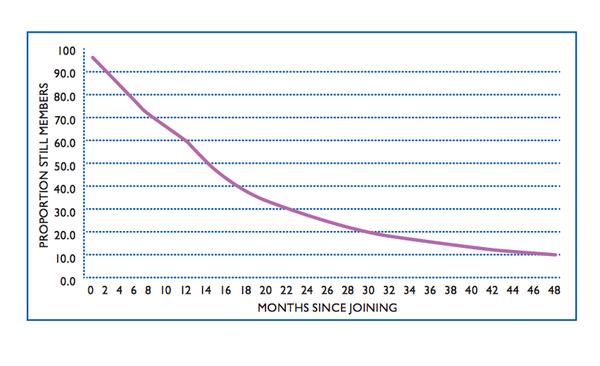
Figure 1.
Figure 1.

Figure2. Overview of retention rate trends
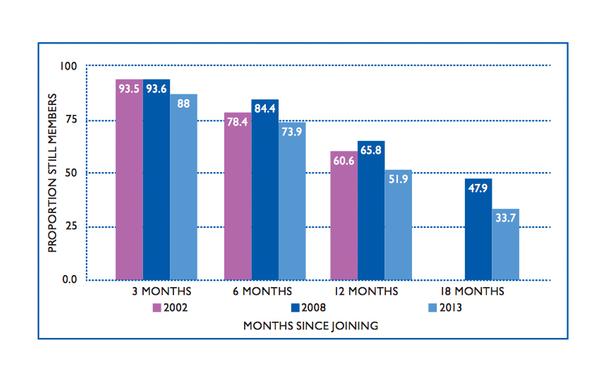
Figure2
Figure2

METHODOLOGY

Published in 2013, The National Retention Report (The White Report) – produced by Dr Paul Bedford – offers a valuable insight into the retention and attrition rates of the UK health and fitness market over a four-year period. Not only is it the longest study of its type to date, it’s also the most representative sample.

Data was sourced from 100 sites, with a breakdown – the proportion of chains, independents, trusts, local authority sites and privately managed public facilities – that mirrors the wider UK market.

Within these 100 sites, 38 different club operators were represented, with a total of 729,389 individual member records supplied. After the data was cleaned for irregularities, 342,759 member records remained for analysis.

The measurement methodology from the previous reports (2002 and 2008) was once again used to provide continuity and allow some comparison, offering a definitive way of measuring retention and attrition, as well as enabling participating clubs to compare their own performance against industry benchmarks.

Membership data was extracted to include the period 1 January 2009 to 31 December 2012, thus providing a maximum of 48 months’ follow-up.

About the Aurthor

Paul Bedford PhD has worked in the fitness industry for more than 20 years. His business, Retention Guru, helps health club operators
increase retention, reduce attrition and improve member loyalty.

Paul will be presenting on the findings of The National Retention Report at Leisure Industry Week this month – Tuesday 24 September, 1.30pm, in the LIW Keynote Theatre.

Email paul-retentionguru.co.uk
Twitter @guru_paul
Linkedin Paul Bedford

Sign up here to get HCM's weekly ezine and every issue of HCM magazine free on digital.
Many clubs focus on driving secondary spend such as PT, even though the big money still lies in membership fees / all photos © shutterstock.com/ Andresr
The best performing clubs hold on to their members for 23.5 months more, on average, than the worst performing sites
Older members are more loyal than younger members – 66 per cent of those aged over 55 maintain membership for a year / photo: shutterstock.com
Improved retention rates will have major impact on a club’s bottom line / photo: shutterstock.com/ Andresr
https://www.leisureopportunities.co.uk/images/HCM2013_9series.gif
Member retention rates continue to drop across the fitness sector, according to a new national report by Dr Paul Bedford
Paul Bedford PhD, The National Retention Report,Retention, The National Retention Report, quantitative, research
HCM magazine
Raphael Cuomo explores the powerful link between addiction, health and behaviour change
HCM magazine
If the health service is to survive, we must recognise that it is a disease service – and that wellbeing rests with us, says the activity advocate and healthy ageing champion. He talks to Kate Cracknell
HCM magazine
Strength training is evolving, driven by changing consumer preferences. Julie Cramer talks to innovators about how their products are meeting this demand
HCM magazine
For every member with a tripod and a big following, there are others irritated at the way equipment is being hogged or wary they’ll be in the background on someone’s Insta feed. Do influencers offer valuable, free marketing or are they just a nuisance? Kath Hudson finds out how operators are responding
HCM magazine
Small improvements to sleep, diet and physical activity have major benefits for the heart, according to new research from the University of Sydney
HCM promotional features
Sponsored
Starpool supports Olympic champion Marcell Jacobs, says Riccardo Turri
HCM promotional features
Sponsored
Find out how your gym can tap into the corporate wellness boom
HCM promotional features
Sponsored
SnowDome Fitness has added 50 per cent more space with cutting-edge Technogym solutions
HCM promotional features
Sponsored
Third Space partnered with IndigoFitness to deliver a bespoke training space for its new club at The Whiteley
HCM promotional features
Sponsored
David Lloyd is stepping up its commitment to women’s health as it continues to explore what fit-for-purpose looks like for the female population
HCM promotional features
Sponsored
Greg Bradley looks at the shift towards strength training in gyms and advises on how operators can create the ultimate training environment
HCM promotional features
Sponsored
EGYM has opened a new HQ in Paternoster Square, London and revealed a range of new launches
HCM promotional features
Sponsored
Pulse Fitness has created a new health club delivering an elevated wellness experience
HCM promotional features
Sponsored
The industry is embracing consumer-facing tech. Now it’s time to streamline back-of-house systems with Orbit4, says Daniel Jones
HCM promotional features
Latest News
PureGym Group has announced that group chief financial officer, Alex Wood, is taking over the ...
Latest News
Independent operator, Fitness Worx Gyms, is introducing private blood testing as a service to members. ...
Latest News
International industry lobbying associations are calling for physical activity and strength training to be deeply ...
Latest News
Global group exercise specialist, Les Mills, is inviting operators to sign up to its Workout ...
Latest News
Global luxury hospitality brand, Six Senses, has partnered with longevity healthcare provider, HUM2N, to launch ...
Latest News
Premium London health club, KX Chelsea, is gearing up to unveil its most significant redevelopment ...
Latest News
Researchers in the US have identified an antibody which could greatly reduce the loss of ...
Latest News
Peloton has made the strategic acquisition of Pilates start-up, Skōp, to support the expansion of ...
Opinion
promotion
Strength training has moved from the margins to the mainstream.
Opinion: Building smarter strength spaces for today’s operators
Featured supplier news
Featured supplier news: Elevate 2026 to mark 10-year anniversary with biggest ever waterfront drinks reception
Elevate is set to celebrate its 10th anniversary in style this June, with organisers confirming the event’s largest-ever drinks reception as registrations continue to run more than 10% ahead of last year.
Featured supplier news
Featured supplier news: CoverMe extends matching service to personal training, rewriting how members and personal trainers connect
CoverMe, the global leader in fitness workforce management, today launches CoverMe PT, an on-demand personal training platform that connects the right personal trainer to the right client in under 10 seconds.
Company profiles
Company profile: Swim England
Swim England was the only governing body of swimming in the world when it was ...
Company profiles
Company profile: Absolute Performance
Absolute Performance is one of the UK’s leading gym design and installation companies. We install ...
Supplier Showcases
Supplier Showcase - From nightclub to health club
Supplier Showcases
Supplier Showcase - Future-proofing
Catalogue Gallery
Click on a catalogue to view it online
Featured press releases
Everyone Active press release: Everyone Active celebrates Summer Solstice and International Yoga Day with wellness events across UK
A nationwide celebration for the upcoming Summer Solstice and International Yoga Day will take place at Everyone Active facilities across the country on Friday, 19 June 2026.
Featured press releases
Zynk Design press release: Gym lighting design: how to specify lighting that motivates members
Gym lighting design is one of the most underrated tools an operator has, and one of the most commonly mishandled.
Directory
Water experiences and hydrotherapy solutions
Aquaform s.r.l.: Water experiences and hydrotherapy solutions
Fitness tracking platform
SpiviTech: Fitness tracking platform
Spa and beauty equipment
Living Earth Crafts: Spa and beauty equipment
Hot tubs
MSpa International Ltd: Hot tubs
Lockers
Crown Sports Lockers: Lockers
Industrial washing machines
Miele Company Limited: Industrial washing machines
Property & Tenders
Stratford, East London.
Lee Valley Regional Park Authority
Property & Tenders
Y Felinheli, LL56 4QN
Newmark
Property & Tenders
Diary dates
22-23 Jun 2026
WX Wakefield , Wakefield, United Kingdom
Diary dates
21-24 Sep 2026
The Langham Huntington Pasadena , Pasadena, United States
Diary dates
06-08 Oct 2026
Messe Stuttgart, Stuttgart, Germany
Diary dates
22-22 Oct 2026
QEII Conference Centre, London,
Diary dates
26-29 Oct 2027
Koelnmesse Exhibition Centre, Cologne, Germany
Diary dates

features

Retention series: Attention retention

Think retention was bad before? Just look at what’s happening now, says Dr Paul Bedford

By Dr Paul Bedford PhD, Retention Guru | Published in Health Club Management 2013 issue 9

The most recent research on UK health club member retention reveals a worrying decline in an already unsatisfactory situation – namely the industry’s ability to retain members.

The first study of this type was conducted as part of the FIA’s (now ukactive) Winning the Retention Battle series, conducted by Dr Melvyn Hillsdon back in 2002. At that time, from a sample of just over 70,000 members, 60 per cent retained membership for 12 months. The subsequent national study in 2008, involving 293,000 members, revealed that 66 per cent of members had retained their membership for 12 months.

But the latest figures have fallen back down – and beyond. Based on 342,759 member records and covering the four-year period from 2009–2012, The National Retention Report (see information panel, p66) indicates that only 52 per cent of members are maintaining membership at their club for 12 months.

Although comparing data from different samples is not the most academic research approach, nevertheless the findings allow us to draw some broad conclusions, as well as allowing us to identify some of the characteristics that defined the market then and now, helping us understand where the key changes have been taking place.

Scores on the doors
Our report shows that 51.9 per cent of members retain membership for at least 12 months; 24.4 per cent are still there after 24 months; 14.1 per cent survive to 36 months; and only 10.4 per cent are members to 48 months. (see Figure 1)

Figure 2 gives an overview of retention rates for specific periods of membership, providing a comparison of our 2013 report with the findings from 2002 and 2008. You can see that at each period, the 2013 results are worse than previous years. In 2002 and 2008, more than six out of 10 members retained their membership for at least 12 months, compared to five out of 10 in 2013.

Within this, there are some interesting variances by age. The latest report identifies that members aged 16–24 years have a 12-month retention rate of 50 per cent compared to those aged over 55, 66 per cent of whom stay for a year. By the end of the study period (48 months), only 5 per cent of the 16–24 group were still members, compared with 22 per cent of those over the age of 55.

Meanwhile, when data is analysed by contract length, 48 per cent of those on one-month agreements complete 12 months of membership, compared to 65 per cent of those on a 12-month contract. This lies at the heart of the difference in retention rates between the public and private sectors: private operators perform significantly better than the public sector for the first 11 months, after which retention rates level out across the board.

Turning to attrition, in 2008 clubs lost members at an average rate of 35 members per thousand members per month. In this new study, they lost them at a rate of 55 per thousand members per month. That’s a loss of an additional 240 members a year that need replacing.

When these figures are scaled up to a national level, the size of the problem really becomes clear. In the 2012 State of the UK Fitness Industry Report, produced by The Leisure Database Company, there were 7,601,114 health club members in the UK. If you extract the 2012 retention figures from The National Retention Report, this would equate to a loss of 3,952,579 members.

Many of these will, of course, have left one gym to join another – it’s not currently possible to track that change (although this could be remedied were the industry to adopt a single, individual membership approach similar to National Insurance numbers, allowing us to track ‘loss to industry’ versus ‘lost to competitor’). However, even acknowledging this, a figure of 3,952,579 annual lapsers is still an unacceptably high number.

Meanwhile, if we look at how long members stay, we can see a wide difference between the best and worst performers. Median length of membership is currently just 12.3 months. However, the worst performing clubs only manage to hold on to members for six months, whereas the best performing clubs keep them for an additional 23.5 months. Based on a club of 1,000 members, each paying £35 a month, that would equate to a difference in income of £595,000 between the best and worst performers.

Customer profile
MOSAIC profiling is used to understand characteristics of households and the individuals living there. The essence of the system is that small areas which share similar housing, lifestyle, demographic and socio-economic features will show similar likelihood of using specific services (eg gyms).

If we review the demographics of the members in The National Retention Report sample using MOSAIC profiling, we can see that the health club industry currently attracts the majority of its members from just seven of the 15 MOSAIC groups. The report suggests the industry is dominated by the middle classes, failing to attract the highest or lowest income groups. Rural areas and older people are also under-represented.

This is true across all sectors. Indeed, while previous reports have shown that MOSAIC types differ by public and private sector, the new report suggests this is no longer the case, with types that were previously only seen in more expensive private sector clubs now being found equally in public sector facilities.

Perhaps most worrying in this is the fact that leisure facilities set up to provide opportunities for the least well-off do not seem to be attracting those groups sufficiently to represent their community.

So why is this happening? Certainly the past four years have seen some dramatic changes in the fitness offering being made available to the buying public.

First of all, the variety of offerings has diminished in the sector. Public sector sites have been rejuvenated by refits and rebuilds, and the quality of the product offering improved.

Public sector operators have also been keen to employ sales approaches that mimic the private sector – the sort of approaches that previously set private operators apart – while still maintaining their community values. In short, they have upped their game.

Meanwhile the private sector has experienced challenging times. Health and fitness clubs have often had to maintain an ageing portfolio of facilities in the face of increased competition from the low-cost market – which has boomed in both private and public sectors – as well as a newly invigorated public sector.

Homogenous offering
In their book Funky Business, Kjell Nordström and Jonas Ridderstråle offer their thoughts on what they refer to as the ‘surplus society’: “The surplus society has a surplus of similar companies, employing similar people, with similar educational backgrounds, working in similar jobs, coming up with similar ideas, producing similar things, with similar prices and similar quality.”

This could also be said of the fitness industry: we’re seeing similar marketing strategies targeting the same types of members, who are being sold similar types of contracts with similar time periods, which provide access to similar facilities and similar classes and equipment. It’s becoming increasingly difficult to separate public and private by facility design, content or contract type.

However, where facilities do have a clear USP, the financial rewards are huge, as can be seen in the best and worst performing clubs example above.

Of course, not all factors relating to retention are entirely under operators’ control: the regulation of length of membership contracts has had an impact, for example, as have the challenges in the wider economy over the last four years.

However, in general, we really haven’t been very imaginative in our offering, nor in the way we provide support to members, with a focus on PT over service. Larger health clubs – those offering gym, studios, tennis, swimming pools – will routinely generate membership revenues of £260k a month. F&B adds another £45–50k and PT just £18–20k. Yet while large amounts of time and effort are devoted to driving up secondary spend, many operators place little effort on improving retention, which is where the big money remains.

Figure 1. Length of membership retention

Figure 1.
Figure 1.

Figure2. Overview of retention rate trends

Figure2
Figure2

METHODOLOGY

Published in 2013, The National Retention Report (The White Report) – produced by Dr Paul Bedford – offers a valuable insight into the retention and attrition rates of the UK health and fitness market over a four-year period. Not only is it the longest study of its type to date, it’s also the most representative sample.

Data was sourced from 100 sites, with a breakdown – the proportion of chains, independents, trusts, local authority sites and privately managed public facilities – that mirrors the wider UK market.

Within these 100 sites, 38 different club operators were represented, with a total of 729,389 individual member records supplied. After the data was cleaned for irregularities, 342,759 member records remained for analysis.

The measurement methodology from the previous reports (2002 and 2008) was once again used to provide continuity and allow some comparison, offering a definitive way of measuring retention and attrition, as well as enabling participating clubs to compare their own performance against industry benchmarks.

Membership data was extracted to include the period 1 January 2009 to 31 December 2012, thus providing a maximum of 48 months’ follow-up.

About the Aurthor

Paul Bedford PhD has worked in the fitness industry for more than 20 years. His business, Retention Guru, helps health club operators
increase retention, reduce attrition and improve member loyalty.

Paul will be presenting on the findings of The National Retention Report at Leisure Industry Week this month – Tuesday 24 September, 1.30pm, in the LIW Keynote Theatre.

Email paul-retentionguru.co.uk
Twitter @guru_paul
Linkedin Paul Bedford

Sign up here to get HCM's weekly ezine and every issue of HCM magazine free on digital.
Many clubs focus on driving secondary spend such as PT, even though the big money still lies in membership fees / all photos © shutterstock.com/ Andresr
The best performing clubs hold on to their members for 23.5 months more, on average, than the worst performing sites
Older members are more loyal than younger members – 66 per cent of those aged over 55 maintain membership for a year / photo: shutterstock.com
Improved retention rates will have major impact on a club’s bottom line / photo: shutterstock.com/ Andresr
https://www.leisureopportunities.co.uk/images/HCM2013_9series.gif
Member retention rates continue to drop across the fitness sector, according to a new national report by Dr Paul Bedford

Paul Bedford PhD, The National Retention Report,Retention, The National Retention Report, quantitative, research
Latest News
PureGym Group has announced that group chief financial officer, Alex Wood, is taking over the ...

Latest News
Independent operator, Fitness Worx Gyms, is introducing private blood testing as a service to members. ...
Latest News
International industry lobbying associations are calling for physical activity and strength training to be deeply ...
Latest News
Global group exercise specialist, Les Mills, is inviting operators to sign up to its Workout ...
Latest News
Global luxury hospitality brand, Six Senses, has partnered with longevity healthcare provider, HUM2N, to launch ...
Latest News
Premium London health club, KX Chelsea, is gearing up to unveil its most significant redevelopment ...
Latest News
Researchers in the US have identified an antibody which could greatly reduce the loss of ...
Latest News
Peloton has made the strategic acquisition of Pilates start-up, Skōp, to support the expansion of ...
Latest News
Crunch Fitness has announced the launch of Crunch Reform Pilates – its own reformer concept ...
Latest News
The 20th State of the Industry Report from LeisureDB has revealed a resilient, expanding and ...
Latest News
Purpose Brands has announced its entry into the Italian market, having sold the franchise rights ...
Opinion
promotion
Strength training has moved from the margins to the mainstream.
Opinion: Building smarter strength spaces for today’s operators
Featured supplier news
Featured supplier news: Elevate 2026 to mark 10-year anniversary with biggest ever waterfront drinks reception
Elevate is set to celebrate its 10th anniversary in style this June, with organisers confirming the event’s largest-ever drinks reception as registrations continue to run more than 10% ahead of last year.
Featured supplier news
Featured supplier news: CoverMe extends matching service to personal training, rewriting how members and personal trainers connect
CoverMe, the global leader in fitness workforce management, today launches CoverMe PT, an on-demand personal training platform that connects the right personal trainer to the right client in under 10 seconds.
Company profiles
Company profile: Swim England
Swim England was the only governing body of swimming in the world when it was ...
Company profiles
Company profile: Absolute Performance
Absolute Performance is one of the UK’s leading gym design and installation companies. We install ...
Supplier Showcases
Supplier Showcase - From nightclub to health club
Supplier Showcases
Supplier Showcase - Future-proofing
Catalogue Gallery
Click on a catalogue to view it online
Featured press releases
Everyone Active press release: Everyone Active celebrates Summer Solstice and International Yoga Day with wellness events across UK
A nationwide celebration for the upcoming Summer Solstice and International Yoga Day will take place at Everyone Active facilities across the country on Friday, 19 June 2026.
Featured press releases
Zynk Design press release: Gym lighting design: how to specify lighting that motivates members
Gym lighting design is one of the most underrated tools an operator has, and one of the most commonly mishandled.
Directory
Water experiences and hydrotherapy solutions
Aquaform s.r.l.: Water experiences and hydrotherapy solutions
Fitness tracking platform
SpiviTech: Fitness tracking platform
Spa and beauty equipment
Living Earth Crafts: Spa and beauty equipment
Hot tubs
MSpa International Ltd: Hot tubs
Lockers
Crown Sports Lockers: Lockers
Industrial washing machines
Miele Company Limited: Industrial washing machines
Property & Tenders
Stratford, East London.
Lee Valley Regional Park Authority
Property & Tenders
Y Felinheli, LL56 4QN
Newmark
Property & Tenders
Diary dates
22-23 Jun 2026
WX Wakefield , Wakefield, United Kingdom
Diary dates
21-24 Sep 2026
The Langham Huntington Pasadena , Pasadena, United States
Diary dates
06-08 Oct 2026
Messe Stuttgart, Stuttgart, Germany
Diary dates
22-22 Oct 2026
QEII Conference Centre, London,
Diary dates
26-29 Oct 2027
Koelnmesse Exhibition Centre, Cologne, Germany
Diary dates
Search news, features & products:
Find a supplier:
Les Mills
Les Mills
Partner sites