




















Follow Health Club Management on Twitter Like Health Club Management on Facebook Join the discussion with Health Club Management on LinkedIn
FITNESS, HEALTH, WELLNESS

features

Retention: New year, new strategy

Targeting older members, focusing on interaction and friendship, reducing queueing and incorporating group exercise. Dr Melvyn Hillsdon offers his top five new year’s resolutions for clubs looking to improve member retention levels

By Dr Melvyn Hillsdon , University of Exeter | Published in Health Club Management 2015 issue 1
New Year, New Strategy
/ photo: www.shutterstock.com/Tyler Olson
New Year, New Strategy / photo: www.shutterstock.com/Tyler Olson

What will your club do differently when it comes to member retention this year, and how might this impact your bottom line?

During 2014, Health Club Management published a number of articles reporting on the results of the TRP 10,000 study – a longitudinal study of 10,000 members, conducted by myself in conjunction with The Retention People, which was designed to understand member behaviour at all points of the member journey, and how different factors influence retention. In the HCM series, we highlighted a range of factors that are positively associated with membership retention – including motivation, progress, group exercise, hassles and uplifts, and communication.

In this article, we’ll pull together the lessons learned so far into a strategy for 2015. The focus will be on the financial gain from improved member retention and potential memberships saved.

Data and analysis
To estimate income from member dues, we’ll model the effect of retention on 1,000 members over the first eight months of membership (the follow-up period of TRP 10,000). To standardise fees, we will assume all members pay a monthly fee of £50. All members pay the first monthly payment, yielding £50,000 (1,000 x £50), and from then on we can plot the income for every other month by multiplying the £50 monthly fee by 1,000 and then by the proportion of members still paying in the given month. So if 90 per cent of members survive the second month, the yield from membership dues would be £50 x 1,000 x 0.9 = £45,000.

Overall yield from 1,000 TRP members?
Eighty five per cent of TRP 10,000 members retain their membership for at least eight months. Figure 1 shows that the total yield from a sample of 1,000 members over the first eight months of their membership, based on the TRP 10,000 retention rate, would be £366,165. So how can this be improved?

Resolution 1: Develop a marketing strategy that attracts more members aged 35 years and older
Members aged 35+ have a cancellation rate that’s 50 per cent lower than members aged under 35 years. Over the first eight months of membership, based on 1,000 members aged 35+ versus 1,000 members younger than 35 years, this translates into a difference in income of £27,035 (see Figure 2).

If all members were aged at least 35 years, 30 per cent of membership cancellations would be avoided, lowering demand on sales by the same proportion. This does not, of course, mean turning new members away – rather it’s about making sure your message, imagery, offer and member experience is more attractive to this older demographic.

Resolution 2: Help members set realistic goals focused on enjoyment and friendship, and help them to achieve these goals
In previous articles, we’ve reported that members who are motivated by appearance, and who perceive they are not making progress, have a high cancellation rate, whereas members who have social motivations and report making a friend have low cancellation rates.

Figure 3 estimates the eight-month income for these two scenarios. Over eight months, the socially motivated members yield an additional £32,335 compared to 1,000 members who fail to achieve a goal of improved appearance.

Further, if all members who were motivated by appearance, but who failed to make progress, had been ‘replaced’ by socially motivated members who made a friend, 28 per cent of all membership cancellations would have been avoided.

Resolution 3: Encourage and assist members to include some group-based exercise into their routine
Members who include at least some group-based exercise in their routine are 30 per cent less likely to have cancelled over the eight-month follow-up period compared to members who never do any group-based exercise. If all members included some group-based exercise into their routines, there would be 18 per cent fewer cancellations.

Based on 1,000 members paying £50 a month, and the TRP 10,000 retention levels, the members who report at least some group-based exercise would yield an additional £12,560 in income over eight months compared to members reporting no group exercise (Figure 4).

Resolution 4: Minimise the time members must queue for equipment
Along with staff failing to talk to members, the most annoying hassle that members report is having to queue for gym equipment.

Health club and leisure centre members who say they frequently have to queue for equipment in the gym, and who find it annoying, are 50 per cent more likely to cancel than those members who do not. If no members had to queue for equipment, 5 per cent of TRP 10,000 cancellations would have been avoided.

One thousand members who never have to queue for equipment would yield £14,715 more over eight months than 1,000 members who have to queue frequently (see Figure 5).

Resolution 5: Develop a strategy to ensure both reception and fitness staff speak to members on every visit
TRP 10,000 has consistently found that both reception and fitness staff have an important role to play in helping retain members. Members who report not being spoken to by either reception or fitness staff are more than twice as likely to cancel as members who are always spoken to by staff.

If both reception and fitness staff always spoke to all members, it’s estimated that 44 per cent of cancellations would be avoided. For every 1,000 members who are always spoken to by reception and fitness staff, an additional £23,495 would be yielded compared to members who are never spoken to by staff (see Figure 6).

Combining resolutions
The data presented in this article highlight the significant financial benefits of relatively small improvements in member retention – and as yet we only have eight months of follow-up in the TRP 10,000 study; the true financial gains will be even greater when taken across 18–24 months.

All of the proposed retention resolutions can be achieved at relatively low cost and are primarily operational and management issues. Therefore, the return on investment for these retention strategies will be substantial.

Of course, the effect on club-level retention of each of these five resolutions is a function of how big the risk of cancelling each resolution presents, combined with how many people experience the risk.

For example, the likelihood of an individual member cancelling in a given month if the fitness staff do not talk them is approximately 3 per cent, or 3 in 100. However, because so many members report fitness staff not talking to them, removing the risk by ensuring all members get spoken to has a much larger effect on overall retention than implementing a resolution which only affects a small number of members, even if the risk of cancelling among those individuals affected is higher.

For example, club members who report frequently queueing for equipment have a monthly risk of cancelling of around 4 per cent – but in TRP 10,000, far fewer members report experiencing this risk factor, meaning removing it saves fewer members.

When developing retention strategies, managers should therefore consider how likely the strategy is to reduce the risk of a member cancelling and how many members will be affected.

Nevertheless – while the five resolutions described in this article are independent of each other, and it’s important to prioritise the biggest wins – there’s no single ‘silver bullet’. If you’re serious about making significant and sustained improvement, the power lies in combining all the resolutions together over time.

Dr Melvyn Hillsdon
Dr Melvyn Hillsdon

Dr Melvyn Hillsdon is associate professor of exercise and health at the University of Exeter, where he researches physical activity and population health. Since his landmark retention report in 2001 (Winning the Retention Battle), his research into retention and attrition has led to the development of appropriate measures of retention, attrition and longevity that provide data for operators that can directly inform business decisions. In partnership with TRP, he has published numerous reports into the determinants of membership retention.

FIGURE 1 Estimated income over eight months based on TRP 10,000 retention data, from a sample of 1,000 members paying £50 a month
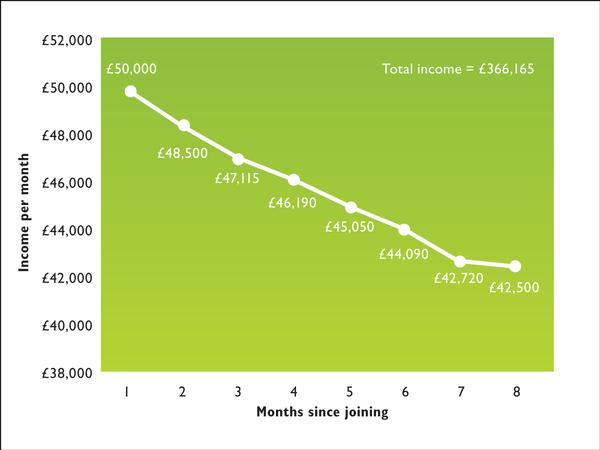
FIGURE 1
FIGURE 1

FIGURE 2 Estimated income over eight months, based on TRP 10,000 retention data, from an initial sample of 1,000 members – by age group
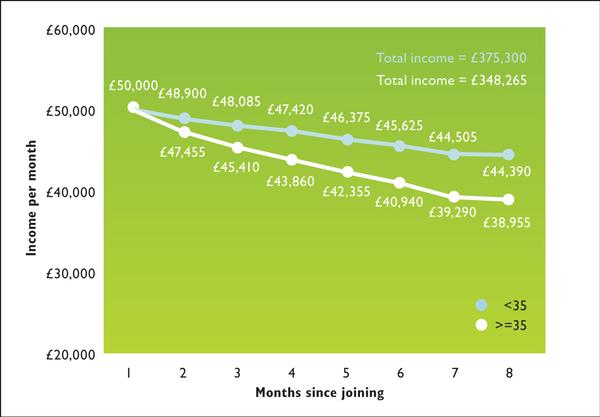
FIGURE 2
FIGURE 2

FIGURE 3 Estimated income over eight months from appearance-driven members who made no progress vs socially-focused members who made a friend – from an initial sample of 1,000 members
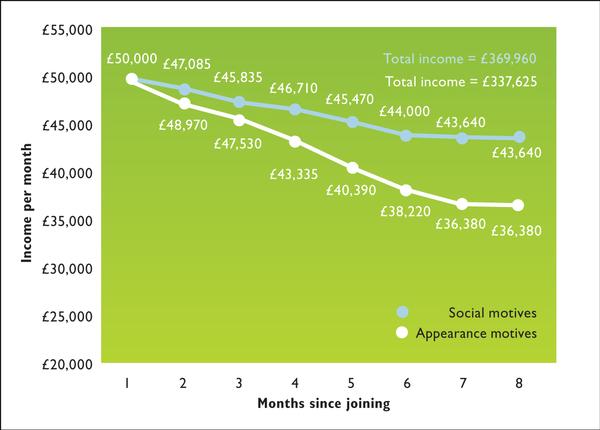
FIGURE 3
FIGURE 3

Figure 4 Estimated income over eight months, based on TRP 10,000 retention data, from members who participate in group exercise versus those who don’t, from an initial sample of 1,000 members
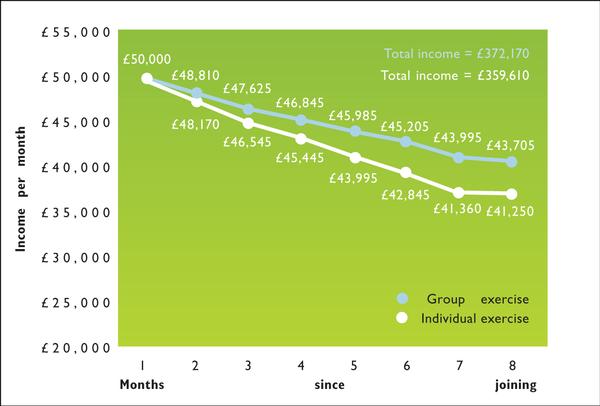
Figure 4
Figure 4

Figure 5 Estimated income over eight months, based on TRP 10,000 retention data, from members who frequently have to queue for kit versus members who don’t, from an initial sample of 1,000 members
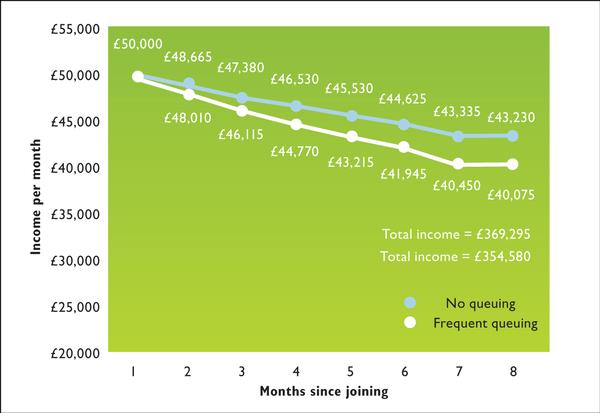
Figure 5
Figure 5

Figure 6 Estimated income over eight months, based on TRP 10,000 retention data, from members who are always spoken to by staff vs. those who are never spoken to, from a sample of 1,000 members
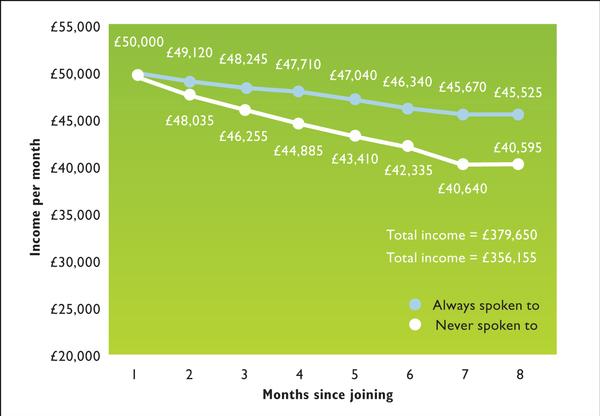

Figure 6
Figure 6
Sign up here to get HCM's weekly ezine and every issue of HCM magazine free on digital.
Members who make a friend at the gym are less likely to cancel / www.shutterstock.com/
Sticking with it: Over-35s have a 50 per cent lower cancellation rate compared to under-35s / PHOTO: WWW.SHUTTERSTOCK.COM/KURHAN
Interaction with reception and fitness staff has a significant impact on retention / PHOTO: WWW.SHUTTERSTOCK.COM/KZENON
https://www.leisureopportunities.co.uk/images/743683_786486.jpg
Targeting older members and focusing on social interaction are among Dr Melvyn Hillsdon’s top five tips for boosting retention in 2015
Dr Melvyn Hillsdon ,Retention, older members, social interaction, group exercise, queueing, Dr Melvyn Hillsdon, new year’s resolutions, TRP 10,000
HCM magazine
As the entrepreneur who started Wexer, Fresh Fitness, Fitness DK and Repeat, as well as being a former elite athlete, Rasmus Ingerslev’s life looked perfect from the outside, but onthe inside it was a different story. He talks to Kath Hudson about healing old wounds
HCM magazine
If the health service is to survive, we must recognise that it is a disease service – and that wellbeing rests with us, says the activity advocate and healthy ageing champion. He talks to Kate Cracknell
HCM magazine
I experienced a blissful feeling of joy I hadn’t felt since I was a kid
HCM magazine
Small improvements to sleep, diet and physical activity have major benefits for the heart, according to new research from the University of Sydney
HCM magazine
For every member with a tripod and a big following, there are others irritated at the way equipment is being hogged or wary they’ll be in the background on someone’s Insta feed. Do influencers offer valuable, free marketing or are they just a nuisance? Kath Hudson finds out how operators are responding
HCM promotional features
Sponsored
SnowDome Fitness has added 50 per cent more space with cutting-edge Technogym solutions
HCM promotional features
Sponsored
Third Space partnered with IndigoFitness to deliver a bespoke training space for its new club at The Whiteley
HCM promotional features
Sponsored
Greg Bradley looks at the shift towards strength training in gyms and advises on how operators can create the ultimate training environment
HCM promotional features
Sponsored
David Lloyd is stepping up its commitment to women’s health as it continues to explore what fit-for-purpose looks like for the female population
HCM promotional features
Sponsored
Find out how your gym can tap into the corporate wellness boom
HCM promotional features
Sponsored
Starpool supports Olympic champion Marcell Jacobs, says Riccardo Turri
HCM promotional features
Sponsored
EGYM has opened a new HQ in Paternoster Square, London and revealed a range of new launches
HCM promotional features
Promotion
Performance Health Systems, manufacturer of Power Plate, has a new CEO, with an ambitious vision for the company
HCM promotional features
Sponsored
Active IQ is calling for greater accountability in online fitness advice with the launch of a new trustmark
HCM promotional features
Latest News
People taking GLP-1 weight loss medications such as Ozempic, Wegovy, Mounjaro and Zepbound may be ...
Latest News
Low-cost gym operator, PureGym, is trialling recovery zones at two of its UK sites, democratising ...
Latest News
In a milestone moment, mental health has become a core part of CIMSPA’s occupational professional ...
Latest News
US high-value, low-price chain, Eos Fitness, has announced plans to pilot reformer Pilates in three ...
Latest News
Preventive healthcare company Neko Health has added body composition analysis to its full-body health scan ...
Latest News
Chequan Lewis is the new CEO of Crunch Fitness, taking over from Jim Rowley, who ...
Latest News
Sea Lanes Canary Wharf has officially opened. The 50-metre, six-lane pool, which uses the natural ...
Latest News
London-based high-performance fitness club, ONE LDN, is raising funds for a multi-site expansion across London, ...
Opinion
promotion
Strength training has moved from the margins to the mainstream.
Opinion: Building smarter strength spaces for today’s operators
Featured supplier news
Featured supplier news: Cornerstone Connect helps Active Blackpool tackle health inequalities
Active Blackpool is deploying Cornerstone Connect, a new digital interface allowing disparate information from multiple systems to be aggregated into one dataset, to support its focus on reducing health inequalities and improving healthy life expectancy.
Featured supplier news
Featured supplier news: CoverMe extends matching service to personal training, rewriting how members and personal trainers connect
CoverMe, the global leader in fitness workforce management, today launches CoverMe PT, an on-demand personal training platform that connects the right personal trainer to the right client in under 10 seconds.
Company profiles
Company profile: Perfect Gym Solutions S.A.
Perfect Gym, part of the Sport Alliance group, is a global software provider specialising in ...
Company profiles
Company profile: Leisure Energy Ltd
Leisure Energy is an award-winning renewable technology company, energy consultancy, and principal contractor. We specialise ...
Supplier Showcases
Supplier Showcase - Future-proofing
Catalogue Gallery
Click on a catalogue to view it online
Featured press releases
Swim England press release: Swim England launches new Learn to Swim Growth Plan to support aquatic programme expansion
Swim England has strengthened its sector-leading Business Solutions offer with the launch of its Learn to Swim Growth Plan, designed to help aquatic providers unlock sustainable programme growth.
Featured press releases
CoverMe Ltd press release: CoverMe and Jobs In. Fitness partner to create end-to-end talent solution
CoverMe, the UK’s leading fitness workforce management and recruitment platform, has partnered with Jobs In. Fitness, the specialist executive search and advisory firm for the fitness and wellbeing sector, to give operators a single route to talent at every level – from frontline staffing to C-suite.
Directory
Fitness tracking platform
SpiviTech: Fitness tracking platform
Spa and beauty equipment
Oakworks Inc: Spa and beauty equipment
Hot tubs
MSpa International Ltd: Hot tubs
Water experiences and hydrotherapy solutions
Aquaform s.r.l.: Water experiences and hydrotherapy solutions
Industrial washing machines
Miele Company Limited: Industrial washing machines
Lockers
Crown Sports Lockers: Lockers
Property & Tenders
Stratford, East London.
Lee Valley Regional Park Authority
Property & Tenders
Y Felinheli, LL56 4QN
Newmark
Property & Tenders
Diary dates
21-24 Sep 2026
The Langham Huntington Pasadena , Pasadena, United States
Diary dates
06-08 Oct 2026
Messe Stuttgart, Stuttgart, Germany
Diary dates
22-22 Oct 2026
QEII Conference Centre, London,
Diary dates
26-29 Oct 2027
Koelnmesse Exhibition Centre, Cologne, Germany
Diary dates

features

Retention: New year, new strategy

Targeting older members, focusing on interaction and friendship, reducing queueing and incorporating group exercise. Dr Melvyn Hillsdon offers his top five new year’s resolutions for clubs looking to improve member retention levels

By Dr Melvyn Hillsdon , University of Exeter | Published in Health Club Management 2015 issue 1
New Year, New Strategy
/ photo: www.shutterstock.com/Tyler Olson
New Year, New Strategy / photo: www.shutterstock.com/Tyler Olson

What will your club do differently when it comes to member retention this year, and how might this impact your bottom line?

During 2014, Health Club Management published a number of articles reporting on the results of the TRP 10,000 study – a longitudinal study of 10,000 members, conducted by myself in conjunction with The Retention People, which was designed to understand member behaviour at all points of the member journey, and how different factors influence retention. In the HCM series, we highlighted a range of factors that are positively associated with membership retention – including motivation, progress, group exercise, hassles and uplifts, and communication.

In this article, we’ll pull together the lessons learned so far into a strategy for 2015. The focus will be on the financial gain from improved member retention and potential memberships saved.

Data and analysis
To estimate income from member dues, we’ll model the effect of retention on 1,000 members over the first eight months of membership (the follow-up period of TRP 10,000). To standardise fees, we will assume all members pay a monthly fee of £50. All members pay the first monthly payment, yielding £50,000 (1,000 x £50), and from then on we can plot the income for every other month by multiplying the £50 monthly fee by 1,000 and then by the proportion of members still paying in the given month. So if 90 per cent of members survive the second month, the yield from membership dues would be £50 x 1,000 x 0.9 = £45,000.

Overall yield from 1,000 TRP members?
Eighty five per cent of TRP 10,000 members retain their membership for at least eight months. Figure 1 shows that the total yield from a sample of 1,000 members over the first eight months of their membership, based on the TRP 10,000 retention rate, would be £366,165. So how can this be improved?

Resolution 1: Develop a marketing strategy that attracts more members aged 35 years and older
Members aged 35+ have a cancellation rate that’s 50 per cent lower than members aged under 35 years. Over the first eight months of membership, based on 1,000 members aged 35+ versus 1,000 members younger than 35 years, this translates into a difference in income of £27,035 (see Figure 2).

If all members were aged at least 35 years, 30 per cent of membership cancellations would be avoided, lowering demand on sales by the same proportion. This does not, of course, mean turning new members away – rather it’s about making sure your message, imagery, offer and member experience is more attractive to this older demographic.

Resolution 2: Help members set realistic goals focused on enjoyment and friendship, and help them to achieve these goals
In previous articles, we’ve reported that members who are motivated by appearance, and who perceive they are not making progress, have a high cancellation rate, whereas members who have social motivations and report making a friend have low cancellation rates.

Figure 3 estimates the eight-month income for these two scenarios. Over eight months, the socially motivated members yield an additional £32,335 compared to 1,000 members who fail to achieve a goal of improved appearance.

Further, if all members who were motivated by appearance, but who failed to make progress, had been ‘replaced’ by socially motivated members who made a friend, 28 per cent of all membership cancellations would have been avoided.

Resolution 3: Encourage and assist members to include some group-based exercise into their routine
Members who include at least some group-based exercise in their routine are 30 per cent less likely to have cancelled over the eight-month follow-up period compared to members who never do any group-based exercise. If all members included some group-based exercise into their routines, there would be 18 per cent fewer cancellations.

Based on 1,000 members paying £50 a month, and the TRP 10,000 retention levels, the members who report at least some group-based exercise would yield an additional £12,560 in income over eight months compared to members reporting no group exercise (Figure 4).

Resolution 4: Minimise the time members must queue for equipment
Along with staff failing to talk to members, the most annoying hassle that members report is having to queue for gym equipment.

Health club and leisure centre members who say they frequently have to queue for equipment in the gym, and who find it annoying, are 50 per cent more likely to cancel than those members who do not. If no members had to queue for equipment, 5 per cent of TRP 10,000 cancellations would have been avoided.

One thousand members who never have to queue for equipment would yield £14,715 more over eight months than 1,000 members who have to queue frequently (see Figure 5).

Resolution 5: Develop a strategy to ensure both reception and fitness staff speak to members on every visit
TRP 10,000 has consistently found that both reception and fitness staff have an important role to play in helping retain members. Members who report not being spoken to by either reception or fitness staff are more than twice as likely to cancel as members who are always spoken to by staff.

If both reception and fitness staff always spoke to all members, it’s estimated that 44 per cent of cancellations would be avoided. For every 1,000 members who are always spoken to by reception and fitness staff, an additional £23,495 would be yielded compared to members who are never spoken to by staff (see Figure 6).

Combining resolutions
The data presented in this article highlight the significant financial benefits of relatively small improvements in member retention – and as yet we only have eight months of follow-up in the TRP 10,000 study; the true financial gains will be even greater when taken across 18–24 months.

All of the proposed retention resolutions can be achieved at relatively low cost and are primarily operational and management issues. Therefore, the return on investment for these retention strategies will be substantial.

Of course, the effect on club-level retention of each of these five resolutions is a function of how big the risk of cancelling each resolution presents, combined with how many people experience the risk.

For example, the likelihood of an individual member cancelling in a given month if the fitness staff do not talk them is approximately 3 per cent, or 3 in 100. However, because so many members report fitness staff not talking to them, removing the risk by ensuring all members get spoken to has a much larger effect on overall retention than implementing a resolution which only affects a small number of members, even if the risk of cancelling among those individuals affected is higher.

For example, club members who report frequently queueing for equipment have a monthly risk of cancelling of around 4 per cent – but in TRP 10,000, far fewer members report experiencing this risk factor, meaning removing it saves fewer members.

When developing retention strategies, managers should therefore consider how likely the strategy is to reduce the risk of a member cancelling and how many members will be affected.

Nevertheless – while the five resolutions described in this article are independent of each other, and it’s important to prioritise the biggest wins – there’s no single ‘silver bullet’. If you’re serious about making significant and sustained improvement, the power lies in combining all the resolutions together over time.

Dr Melvyn Hillsdon
Dr Melvyn Hillsdon

Dr Melvyn Hillsdon is associate professor of exercise and health at the University of Exeter, where he researches physical activity and population health. Since his landmark retention report in 2001 (Winning the Retention Battle), his research into retention and attrition has led to the development of appropriate measures of retention, attrition and longevity that provide data for operators that can directly inform business decisions. In partnership with TRP, he has published numerous reports into the determinants of membership retention.

FIGURE 1 Estimated income over eight months based on TRP 10,000 retention data, from a sample of 1,000 members paying £50 a month

FIGURE 1
FIGURE 1

FIGURE 2 Estimated income over eight months, based on TRP 10,000 retention data, from an initial sample of 1,000 members – by age group

FIGURE 2
FIGURE 2

FIGURE 3 Estimated income over eight months from appearance-driven members who made no progress vs socially-focused members who made a friend – from an initial sample of 1,000 members

FIGURE 3
FIGURE 3

Figure 4 Estimated income over eight months, based on TRP 10,000 retention data, from members who participate in group exercise versus those who don’t, from an initial sample of 1,000 members

Figure 4
Figure 4

Figure 5 Estimated income over eight months, based on TRP 10,000 retention data, from members who frequently have to queue for kit versus members who don’t, from an initial sample of 1,000 members

Figure 5
Figure 5

Figure 6 Estimated income over eight months, based on TRP 10,000 retention data, from members who are always spoken to by staff vs. those who are never spoken to, from a sample of 1,000 members

Figure 6
Figure 6
Sign up here to get HCM's weekly ezine and every issue of HCM magazine free on digital.
Members who make a friend at the gym are less likely to cancel / www.shutterstock.com/
Sticking with it: Over-35s have a 50 per cent lower cancellation rate compared to under-35s / PHOTO: WWW.SHUTTERSTOCK.COM/KURHAN
Interaction with reception and fitness staff has a significant impact on retention / PHOTO: WWW.SHUTTERSTOCK.COM/KZENON
https://www.leisureopportunities.co.uk/images/743683_786486.jpg
Targeting older members and focusing on social interaction are among Dr Melvyn Hillsdon’s top five tips for boosting retention in 2015
Dr Melvyn Hillsdon ,Retention, older members, social interaction, group exercise, queueing, Dr Melvyn Hillsdon, new year’s resolutions, TRP 10,000
Latest News
People taking GLP-1 weight loss medications such as Ozempic, Wegovy, Mounjaro and Zepbound may be ...
Latest News
Low-cost gym operator, PureGym, is trialling recovery zones at two of its UK sites, democratising ...

Latest News
In a milestone moment, mental health has become a core part of CIMSPA’s occupational professional ...

Latest News
US high-value, low-price chain, Eos Fitness, has announced plans to pilot reformer Pilates in three ...
Latest News
Preventive healthcare company Neko Health has added body composition analysis to its full-body health scan ...
Latest News
Chequan Lewis is the new CEO of Crunch Fitness, taking over from Jim Rowley, who ...
Latest News
Sea Lanes Canary Wharf has officially opened. The 50-metre, six-lane pool, which uses the natural ...
Latest News
London-based high-performance fitness club, ONE LDN, is raising funds for a multi-site expansion across London, ...
Latest News
A new brain clinic has opened in London, which uses non-invasive brain stimulation to treat ...
Latest News
Good Boost’s digital exercise programmes are helping adults with MSK at a lower cost than ...
Latest News
With Prime Minister, Keir Starmer, announcing his resignation this morning and Andy Burnham as a ...
Opinion
promotion
Strength training has moved from the margins to the mainstream.
Opinion: Building smarter strength spaces for today’s operators
Featured supplier news
Featured supplier news: Cornerstone Connect helps Active Blackpool tackle health inequalities
Active Blackpool is deploying Cornerstone Connect, a new digital interface allowing disparate information from multiple systems to be aggregated into one dataset, to support its focus on reducing health inequalities and improving healthy life expectancy.
Featured supplier news
Featured supplier news: CoverMe extends matching service to personal training, rewriting how members and personal trainers connect
CoverMe, the global leader in fitness workforce management, today launches CoverMe PT, an on-demand personal training platform that connects the right personal trainer to the right client in under 10 seconds.
Company profiles
Company profile: Perfect Gym Solutions S.A.
Perfect Gym, part of the Sport Alliance group, is a global software provider specialising in ...
Company profiles
Company profile: Leisure Energy Ltd
Leisure Energy is an award-winning renewable technology company, energy consultancy, and principal contractor. We specialise ...
Supplier Showcases
Supplier Showcase - Future-proofing
Catalogue Gallery
Click on a catalogue to view it online
Featured press releases
Swim England press release: Swim England launches new Learn to Swim Growth Plan to support aquatic programme expansion
Swim England has strengthened its sector-leading Business Solutions offer with the launch of its Learn to Swim Growth Plan, designed to help aquatic providers unlock sustainable programme growth.
Featured press releases
CoverMe Ltd press release: CoverMe and Jobs In. Fitness partner to create end-to-end talent solution
CoverMe, the UK’s leading fitness workforce management and recruitment platform, has partnered with Jobs In. Fitness, the specialist executive search and advisory firm for the fitness and wellbeing sector, to give operators a single route to talent at every level – from frontline staffing to C-suite.
Directory
Fitness tracking platform
SpiviTech: Fitness tracking platform
Spa and beauty equipment
Oakworks Inc: Spa and beauty equipment
Hot tubs
MSpa International Ltd: Hot tubs
Water experiences and hydrotherapy solutions
Aquaform s.r.l.: Water experiences and hydrotherapy solutions
Industrial washing machines
Miele Company Limited: Industrial washing machines
Lockers
Crown Sports Lockers: Lockers
Property & Tenders
Stratford, East London.
Lee Valley Regional Park Authority
Property & Tenders
Y Felinheli, LL56 4QN
Newmark
Property & Tenders
Diary dates
21-24 Sep 2026
The Langham Huntington Pasadena , Pasadena, United States
Diary dates
06-08 Oct 2026
Messe Stuttgart, Stuttgart, Germany
Diary dates
22-22 Oct 2026
QEII Conference Centre, London,
Diary dates
26-29 Oct 2027
Koelnmesse Exhibition Centre, Cologne, Germany
Diary dates
Search news, features & products:
Find a supplier:
Partner sites