

















Les Mills
Les Mills
Les Mills
Follow Health Club Management on Twitter Like Health Club Management on Facebook Join the discussion with Health Club Management on LinkedIn
FITNESS, HEALTH, WELLNESS

features

Research: The road to recovery

New research shows that UK public sector health and fitness is on track for recovery, but operators face shifts in their member profiles that mean operators will need to adapt to thrive

Published in Health Club Management 2020 issue 9
The industry is on track for recovery according to the 4global study / Shutterstock / Jacob Lund
Group exercise continues to present high occupancy levels, with the quickest recovery rates and highest demand of the three main activities

In a story now all too familiar, March 2020 saw the temporary closure of the sport, leisure and physical activity industry at the hands of the pandemic. Thousands of facilities were forced to close as the country went into lockdown.

Two months later, with the industry showing signs of life as we got closer to a reopening date, ukactive and 4global – powered by the DataHub and supported by organisations from across the sector – attempted the impossible. Researchers used modelling and analytics to predict the future, providing public sector operators, trusts and national bodies with evidence on which to build their financial and operational plans.

The research
Using member and participation data from pre-lockdown, combined with consumer confidence data from inside and outside the industry, the research team used predictive modelling to map the sector’s expected path out of lockdown.

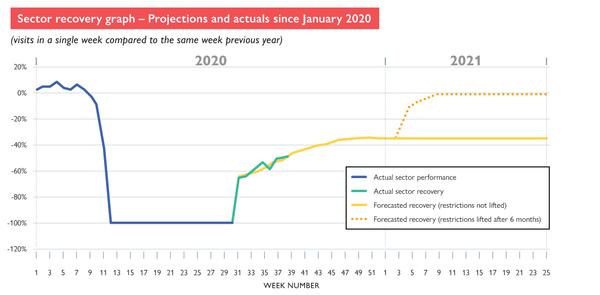
The calculations considered restrictions on facility capacity, a lower rate of participation by older age groups and a reduced amount of swimming and team sports. It was estimated that if restrictions were lifted six months after opening, the industry would reach -1 per cent (minus 1 per cent) of participation by the end of February 2021, when compared to 2020 figures.

Taking into consideration a steady increase in consumer confidence (the willingness of people to use facilities), and with operators across the UK being required to limit class sizes and gym entry during peak time, calculations for late September 2020 projected that participation at local authority and trust facilities would be 51 per cent of the figure for the same week in 2019.

Is the sector on track?
Against these projections, live participation figures from the DataHub show that the calculations from the research team were exactly right, at an accuracy level above 98 per cent in the first eight weeks of re-opening.

“The projections we made back in May are being realised, as participation across the sector is impacted by consumer confidence and capacity restrictions,” says Utku Toprakseven, partner at 4global Consulting.

Toprakseven led this latest research, which was published almost exactly six months after the UK first faced lockdown.

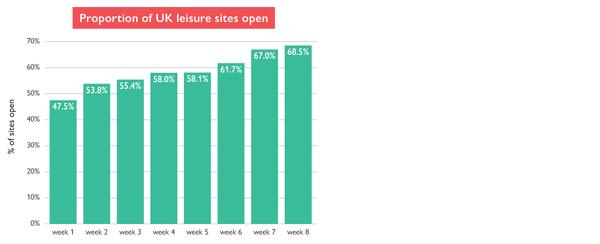
The data, which was taken from over 800 local government and trust sites across the UK, showed the proportion of the industry that was open grew from 48 per cent in the first week post re-opening, to 69 per cent by the end of week eight.

From this representative view, the participation data has been analysed by facility type, focusing on health and fitness, swimming and group exercise.

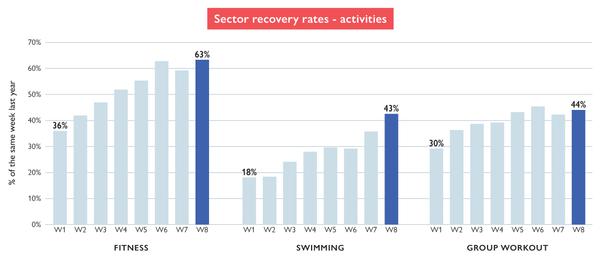
As shown in Figure 1, fitness has shown a steady increase from 36 per cent in the first week following re-opening, to 63 per cent by the end of week eight, when compared to the previous year.

Group exercise, which has been impacted to a greater extent in terms of capacities and floor space than fitness, has had its participation numbers capped in comparison with last year, but continues to present high occupancy levels and be a driver for returning to centre-based activity – it’s also had the quickest recovery rates and highest demand of the three main activities.

Operating swimming facilities has also been a challenge across the sector, driven by low consumer confidence immediately following lockdown, combined with high running costs and the extensive processes required to run a pool safely.

Among other considerations, pool space has contributed to a difference in recovery journeys between the public and private sector. While the public sector has struggled to make the numbers add up in the absence of swimming lessons and lower overall participation, the private sector has recovered more quickly. Fitness and group workout represent a higher proportion of footfall and revenue for private operators, leading to higher participation figures and greater member recovery.

Changing face of leisure centres
COVID-19 has impacted the traditional leisure facility member base. “The profile of people using leisure facilities is changing,” says 4global’s Ed Hubbard –co-author of the original COVID-19 Impact Report. “Women and girls have returned to facilities more slowly than their male counterparts, while some older people have chosen to exercise at home or outside.”

The data shows that participation for members aged 65+ is falling slightly as a proportion of all visits to leisure facilities, but with only a two per cent swing against figures from 2019. The proportion of participation by children aged 1-15 has also fallen slightly, from 23 per cent of total participation in late September 2019 to 19 per cent at the same point this year – primarily as a result of restriction in school swimming and other courses.

This has been offset by an increase in the proportion of visits by those aged 16-54, a trend which was forecast following early survey data that indicated older adults were less confident returning to health and fitness facilities than their younger counterparts.

The next challenge
In line with projections for the sector, participation has grown steadily since reopening and members have continued to gain confidence in the safety, cleaning and operational processes instated by operators. Now we have the opportunity to look at the challenge the sector faces going forward.

Local and regional restrictions continue to be broadened, with approximately one third of the UK’s population subject to restrictions at the time of writing. This will undoubtedly have an impact on the performance of the sector in these geographical areas, either through mandated closures or reduced consumer confidence.

As member and participation data in these areas of the UK is available and statistically robust, the research team at 4global will continue to monitor sector performance and update future projections accordingly.

Modelling undertaken as part of the COVID-19 Impact Report assumed, as a worst case scenario, that restrictions on capacity and entry to facilities would be lifted at the start of the seventh month following the original re-opening date.

This anticipated that consumer confidence would increase significantly and that a removal of restrictions would allow the sector to get close to full recovery by early 2021. However, if – as implied by government announcements in September 2020 – restrictions are in place beyond March 2021, operators will be unable to reach the predicted figures. Based on current levels of government support for local authority leisure, this would mean the long-term sustainability of many facilities would be under threat without further support.

Analysts had predicted that with more people working from home and work-life balance appearing to become more flexible, the age-old challenge of facilities being too busy in peak hours and not busy enough during off-peak hours would become a thing of the past.

However, the data does not show this to be the case, with people continuing to exercise in the morning before work and in the early evening. Operational challenges around this are exacerbated by entry restrictions and limited facility and class capacity, which has ultimately led to willing gym-goers being turned away or asked to queue to access facilities, with all the challenges that accompany this in terms of customer engagement and retention.

The operators being surveyed have so far failed to persuade customers to exercise during off-peak hours – something that would ease this situation and improve their bottom line.

Re-engaging in autumn
To some extent, the mental health of people in the UK was saved by the warm, dry weather that coincided with lockdown. Participants were able to replace their regular gym workout with outdoor exercise and in some demographics, we saw increasing activity rates, as people were motivated to escape the house and improve their health and wellbeing. For the leisure industry, this created further challenges, as some members cancelled their memberships in favour of a new hybrid of outdoor activity and digital classes.

As autumn arrives across the UK, these new behaviour patterns and habits will be put to the test. Operators will be hopeful that, through a combination of vastly improved digital offers and the promise of a tried and tested membership offer, old and new members will be tempted back into the facility. Only time will tell whether the dark nights will remind people that the motivation of an instructor, class or fitness professional is just what they need to reach their goals and get through a long UK winter.

Monitoring the recovery
If the now customary 5.00pm government news conferences have taught us anything, it is that COVID-19 has brought data and insight to the forefront of everyone’s minds. Whether friends are discussing the change in the R number over their socially distanced picnic, or local newspapers are reporting on the latest increase in case numbers, the need for robust data and a process that people can understand has become of paramount importance.

“As a sector, it’s clear that if we want to build a compelling evidence base about the benefits of physical activity, while ensuring the long-term sustainability of operators, we must use data and insight to support our strategic and operational decision making,” says Toprakseven. “We must be responsive to the changing requirements of our customers, but we must also be proactive in designing facilities, programmes and initiatives that get people active and keep them coming back.”

More: www.HCMmag.com/4GlobalCOVID

Sign up here to get HCM's weekly ezine and every issue of HCM magazine free on digital.
The absence of swimming lessons has hit public sector pool operators hard / Shutterstock / Jacob Lund
Despite more flexible working arrangements, most people continue to exercise at peak times / Shutterstock / Gorodenkof
https://www.leisureopportunities.co.uk/images/2020/253076_850369.jpg
New research shows that UK public sector health and fitness is on track for recovery, but operators face shifts in their member profiles
4global, ukactive, datahub,public fitness,
HCM magazine
Raphael Cuomo explores the powerful link between addiction, health and behaviour change
HCM magazine
As the entrepreneur who started Wexer, Fresh Fitness, Fitness DK and Repeat, as well as being a former elite athlete, Rasmus Ingerslev’s life looked perfect from the outside, but onthe inside it was a different story. He talks to Kath Hudson about healing old wounds
HCM magazine
HCM People

Stephen Price

Founder, SP&Co Group
Working in public health over the last few years has lit up parts of my brain again
HCM magazine
Strength training is evolving, driven by changing consumer preferences. Julie Cramer talks to innovators about how their products are meeting this demand
HCM magazine
For every member with a tripod and a big following, there are others irritated at the way equipment is being hogged or wary they’ll be in the background on someone’s Insta feed. Do influencers offer valuable, free marketing or are they just a nuisance? Kath Hudson finds out how operators are responding
HCM promotional features
Sponsored
SnowDome Fitness has added 50 per cent more space with cutting-edge Technogym solutions
HCM promotional features
Sponsored
Greg Bradley looks at the shift towards strength training in gyms and advises on how operators can create the ultimate training environment
HCM promotional features
Sponsored
Starpool supports Olympic champion Marcell Jacobs, says Riccardo Turri
HCM promotional features
Sponsored
Third Space partnered with IndigoFitness to deliver a bespoke training space for its new club at The Whiteley
HCM promotional features
Sponsored
David Lloyd is stepping up its commitment to women’s health as it continues to explore what fit-for-purpose looks like for the female population
HCM promotional features
Sponsored
Find out how your gym can tap into the corporate wellness boom
HCM promotional features
Sponsored
EGYM has opened a new HQ in Paternoster Square, London and revealed a range of new launches
HCM promotional features
Sponsored
New launch, Salus House, elevates boutique wellness with high service levels and a partnership with Technogym
HCM promotional features
Sponsored
Pulse Fitness has created a new health club delivering an elevated wellness experience
HCM promotional features
Latest News
Nuffield Health has told HCM that it takes its responsibilities towards its colleagues seriously and ...
Latest News
Technogym has announced the launch of the Run X World Treadmill Championship, the first world ...
Latest News
Shocked by the UK loneliness statistics, charitable trust Mytime Active has been doubling down on ...
Latest News
Portugal’s leading operator, SC Fitness, is celebrating a milestone by reaching 100 gyms.  The company ...
Latest News
Australia’s fast-growing fitness network, Viva Leisure, is adding a low-cost gym brand to its already ...
Latest News
Speedflex has launched a strength training programme for 10 to 16-year-olds, to make it safer, ...
Latest News
Tewinbury Farm Hotel in Hertfordshire, UK is expanding its premium leisure proposition with the launch ...
Latest News

Work is underway in Madrid on one of Europe’s most significant multi-functional complexes, ...

Opinion
promotion
Strength training has moved from the margins to the mainstream.
Opinion: Building smarter strength spaces for today’s operators
Featured supplier news
Featured supplier news: Reaching the people most gyms miss: Bedford Gym & Swim Campaign delivers 410 new members
One of the biggest mistakes the fitness industry still makes is advertising almost exclusively to people who already look and live like gym members.
Featured supplier news
Featured supplier news: Supporting long-term health: why whole body vibration belongs in clinical settings
As healthcare continues to shift towards prevention, there’s a growing focus on helping people stay active, independent and feeling good for longer.
Company profiles
Company profile: Perfect Gym Solutions S.A.
Perfect Gym, part of the Sport Alliance group, is a global software provider specialising in ...
Company profiles
Company profile: Peak Pilates UK<br>(distributed by Gymkit UK)
Peak Pilates, founded in the US in the early 1990s and now part of Mad ...
Supplier Showcases
Supplier Showcase - From nightclub to health club
Supplier Showcases
Supplier Showcase - Future-proofing
Catalogue Gallery
Click on a catalogue to view it online
Featured press releases
GYMNATION press release: Massive ‘Good Luck’ message appears in Saudi Desert as Green Falcons head to World Cup
Passengers flying out of Riyadh this week have been treated to an extraordinary sight from the skies after GymNation unveiled a giant desert sand mural supporting the Saudi Arabia National Football Team ahead of the FIFA World Cup in the United States.
Featured press releases
BLK BOX press release: BLK BOX strengthens European growth with the appointment of Germany country manager Timo Garrels
BLK BOX is proud to welcome Timo Garrels as Germany country manager, marking another important step in the brand’s continued growth across Europe.
Directory
Hot tubs
MSpa International Ltd: Hot tubs
Lockers
Crown Sports Lockers: Lockers
Industrial washing machines
Miele Company Limited: Industrial washing machines
Spa and beauty equipment
Oakworks Inc: Spa and beauty equipment
Fitness tracking platform
SpiviTech: Fitness tracking platform
Water experiences and hydrotherapy solutions
Aquaform s.r.l.: Water experiences and hydrotherapy solutions
Property & Tenders
Stratford, East London.
Lee Valley Regional Park Authority
Property & Tenders
Y Felinheli, LL56 4QN
Newmark
Property & Tenders
Diary dates
13-13 Jun 2026
Worldwide, Various,
Diary dates
21-24 Sep 2026
The Langham Huntington Pasadena , Pasadena, United States
Diary dates
06-08 Oct 2026
Messe Stuttgart, Stuttgart, Germany
Diary dates
22-22 Oct 2026
QEII Conference Centre, London,
Diary dates
26-29 Oct 2027
Koelnmesse Exhibition Centre, Cologne, Germany
Diary dates

features

Research: The road to recovery

New research shows that UK public sector health and fitness is on track for recovery, but operators face shifts in their member profiles that mean operators will need to adapt to thrive

Published in Health Club Management 2020 issue 9
The industry is on track for recovery according to the 4global study / Shutterstock / Jacob Lund
Group exercise continues to present high occupancy levels, with the quickest recovery rates and highest demand of the three main activities

In a story now all too familiar, March 2020 saw the temporary closure of the sport, leisure and physical activity industry at the hands of the pandemic. Thousands of facilities were forced to close as the country went into lockdown.

Two months later, with the industry showing signs of life as we got closer to a reopening date, ukactive and 4global – powered by the DataHub and supported by organisations from across the sector – attempted the impossible. Researchers used modelling and analytics to predict the future, providing public sector operators, trusts and national bodies with evidence on which to build their financial and operational plans.

The research
Using member and participation data from pre-lockdown, combined with consumer confidence data from inside and outside the industry, the research team used predictive modelling to map the sector’s expected path out of lockdown.

The calculations considered restrictions on facility capacity, a lower rate of participation by older age groups and a reduced amount of swimming and team sports. It was estimated that if restrictions were lifted six months after opening, the industry would reach -1 per cent (minus 1 per cent) of participation by the end of February 2021, when compared to 2020 figures.

Taking into consideration a steady increase in consumer confidence (the willingness of people to use facilities), and with operators across the UK being required to limit class sizes and gym entry during peak time, calculations for late September 2020 projected that participation at local authority and trust facilities would be 51 per cent of the figure for the same week in 2019.

Is the sector on track?
Against these projections, live participation figures from the DataHub show that the calculations from the research team were exactly right, at an accuracy level above 98 per cent in the first eight weeks of re-opening.

“The projections we made back in May are being realised, as participation across the sector is impacted by consumer confidence and capacity restrictions,” says Utku Toprakseven, partner at 4global Consulting.

Toprakseven led this latest research, which was published almost exactly six months after the UK first faced lockdown.

The data, which was taken from over 800 local government and trust sites across the UK, showed the proportion of the industry that was open grew from 48 per cent in the first week post re-opening, to 69 per cent by the end of week eight.

From this representative view, the participation data has been analysed by facility type, focusing on health and fitness, swimming and group exercise.

As shown in Figure 1, fitness has shown a steady increase from 36 per cent in the first week following re-opening, to 63 per cent by the end of week eight, when compared to the previous year.

Group exercise, which has been impacted to a greater extent in terms of capacities and floor space than fitness, has had its participation numbers capped in comparison with last year, but continues to present high occupancy levels and be a driver for returning to centre-based activity – it’s also had the quickest recovery rates and highest demand of the three main activities.

Operating swimming facilities has also been a challenge across the sector, driven by low consumer confidence immediately following lockdown, combined with high running costs and the extensive processes required to run a pool safely.

Among other considerations, pool space has contributed to a difference in recovery journeys between the public and private sector. While the public sector has struggled to make the numbers add up in the absence of swimming lessons and lower overall participation, the private sector has recovered more quickly. Fitness and group workout represent a higher proportion of footfall and revenue for private operators, leading to higher participation figures and greater member recovery.

Changing face of leisure centres
COVID-19 has impacted the traditional leisure facility member base. “The profile of people using leisure facilities is changing,” says 4global’s Ed Hubbard –co-author of the original COVID-19 Impact Report. “Women and girls have returned to facilities more slowly than their male counterparts, while some older people have chosen to exercise at home or outside.”

The data shows that participation for members aged 65+ is falling slightly as a proportion of all visits to leisure facilities, but with only a two per cent swing against figures from 2019. The proportion of participation by children aged 1-15 has also fallen slightly, from 23 per cent of total participation in late September 2019 to 19 per cent at the same point this year – primarily as a result of restriction in school swimming and other courses.

This has been offset by an increase in the proportion of visits by those aged 16-54, a trend which was forecast following early survey data that indicated older adults were less confident returning to health and fitness facilities than their younger counterparts.

The next challenge
In line with projections for the sector, participation has grown steadily since reopening and members have continued to gain confidence in the safety, cleaning and operational processes instated by operators. Now we have the opportunity to look at the challenge the sector faces going forward.

Local and regional restrictions continue to be broadened, with approximately one third of the UK’s population subject to restrictions at the time of writing. This will undoubtedly have an impact on the performance of the sector in these geographical areas, either through mandated closures or reduced consumer confidence.

As member and participation data in these areas of the UK is available and statistically robust, the research team at 4global will continue to monitor sector performance and update future projections accordingly.

Modelling undertaken as part of the COVID-19 Impact Report assumed, as a worst case scenario, that restrictions on capacity and entry to facilities would be lifted at the start of the seventh month following the original re-opening date.

This anticipated that consumer confidence would increase significantly and that a removal of restrictions would allow the sector to get close to full recovery by early 2021. However, if – as implied by government announcements in September 2020 – restrictions are in place beyond March 2021, operators will be unable to reach the predicted figures. Based on current levels of government support for local authority leisure, this would mean the long-term sustainability of many facilities would be under threat without further support.

Analysts had predicted that with more people working from home and work-life balance appearing to become more flexible, the age-old challenge of facilities being too busy in peak hours and not busy enough during off-peak hours would become a thing of the past.

However, the data does not show this to be the case, with people continuing to exercise in the morning before work and in the early evening. Operational challenges around this are exacerbated by entry restrictions and limited facility and class capacity, which has ultimately led to willing gym-goers being turned away or asked to queue to access facilities, with all the challenges that accompany this in terms of customer engagement and retention.

The operators being surveyed have so far failed to persuade customers to exercise during off-peak hours – something that would ease this situation and improve their bottom line.

Re-engaging in autumn
To some extent, the mental health of people in the UK was saved by the warm, dry weather that coincided with lockdown. Participants were able to replace their regular gym workout with outdoor exercise and in some demographics, we saw increasing activity rates, as people were motivated to escape the house and improve their health and wellbeing. For the leisure industry, this created further challenges, as some members cancelled their memberships in favour of a new hybrid of outdoor activity and digital classes.

As autumn arrives across the UK, these new behaviour patterns and habits will be put to the test. Operators will be hopeful that, through a combination of vastly improved digital offers and the promise of a tried and tested membership offer, old and new members will be tempted back into the facility. Only time will tell whether the dark nights will remind people that the motivation of an instructor, class or fitness professional is just what they need to reach their goals and get through a long UK winter.

Monitoring the recovery
If the now customary 5.00pm government news conferences have taught us anything, it is that COVID-19 has brought data and insight to the forefront of everyone’s minds. Whether friends are discussing the change in the R number over their socially distanced picnic, or local newspapers are reporting on the latest increase in case numbers, the need for robust data and a process that people can understand has become of paramount importance.

“As a sector, it’s clear that if we want to build a compelling evidence base about the benefits of physical activity, while ensuring the long-term sustainability of operators, we must use data and insight to support our strategic and operational decision making,” says Toprakseven. “We must be responsive to the changing requirements of our customers, but we must also be proactive in designing facilities, programmes and initiatives that get people active and keep them coming back.”
More: www.HCMmag.com/4GlobalCOVID

Sign up here to get HCM's weekly ezine and every issue of HCM magazine free on digital.
The absence of swimming lessons has hit public sector pool operators hard / Shutterstock / Jacob Lund
Despite more flexible working arrangements, most people continue to exercise at peak times / Shutterstock / Gorodenkof
https://www.leisureopportunities.co.uk/images/2020/253076_850369.jpg
New research shows that UK public sector health and fitness is on track for recovery, but operators face shifts in their member profiles
4global, ukactive, datahub,public fitness,
Latest News
Nuffield Health has told HCM that it takes its responsibilities towards its colleagues seriously and ...
Latest News
Technogym has announced the launch of the Run X World Treadmill Championship, the first world ...
Latest News
Shocked by the UK loneliness statistics, charitable trust Mytime Active has been doubling down on ...
Latest News
Portugal’s leading operator, SC Fitness, is celebrating a milestone by reaching 100 gyms.  The company ...
Latest News
Australia’s fast-growing fitness network, Viva Leisure, is adding a low-cost gym brand to its already ...
Latest News
Speedflex has launched a strength training programme for 10 to 16-year-olds, to make it safer, ...
Latest News
Tewinbury Farm Hotel in Hertfordshire, UK is expanding its premium leisure proposition with the launch ...
Latest News

Work is underway in Madrid on one of Europe’s most significant multi-functional complexes, ...

Latest News
PureGym is encouraging people to step away from their screens and go for a walk, ...
Latest News
Small improvements to sleep, diet quality, and physical activity, made in combination lead to a ...
Latest News
Therme Manchester’s 28-acre development, which will include interconnected glass pavilions that measure 65,000sq m, will ...
Opinion
promotion
Strength training has moved from the margins to the mainstream.
Opinion: Building smarter strength spaces for today’s operators
Featured supplier news
Featured supplier news: Reaching the people most gyms miss: Bedford Gym & Swim Campaign delivers 410 new members
One of the biggest mistakes the fitness industry still makes is advertising almost exclusively to people who already look and live like gym members.
Featured supplier news
Featured supplier news: Supporting long-term health: why whole body vibration belongs in clinical settings
As healthcare continues to shift towards prevention, there’s a growing focus on helping people stay active, independent and feeling good for longer.
Company profiles
Company profile: Perfect Gym Solutions S.A.
Perfect Gym, part of the Sport Alliance group, is a global software provider specialising in ...
Company profiles
Company profile: Peak Pilates UK<br>(distributed by Gymkit UK)
Peak Pilates, founded in the US in the early 1990s and now part of Mad ...
Supplier Showcases
Supplier Showcase - From nightclub to health club
Supplier Showcases
Supplier Showcase - Future-proofing
Catalogue Gallery
Click on a catalogue to view it online
Featured press releases
GYMNATION press release: Massive ‘Good Luck’ message appears in Saudi Desert as Green Falcons head to World Cup
Passengers flying out of Riyadh this week have been treated to an extraordinary sight from the skies after GymNation unveiled a giant desert sand mural supporting the Saudi Arabia National Football Team ahead of the FIFA World Cup in the United States.
Featured press releases
BLK BOX press release: BLK BOX strengthens European growth with the appointment of Germany country manager Timo Garrels
BLK BOX is proud to welcome Timo Garrels as Germany country manager, marking another important step in the brand’s continued growth across Europe.
Directory
Hot tubs
MSpa International Ltd: Hot tubs
Lockers
Crown Sports Lockers: Lockers
Industrial washing machines
Miele Company Limited: Industrial washing machines
Spa and beauty equipment
Oakworks Inc: Spa and beauty equipment
Fitness tracking platform
SpiviTech: Fitness tracking platform
Water experiences and hydrotherapy solutions
Aquaform s.r.l.: Water experiences and hydrotherapy solutions
Property & Tenders
Stratford, East London.
Lee Valley Regional Park Authority
Property & Tenders
Y Felinheli, LL56 4QN
Newmark
Property & Tenders
Diary dates
13-13 Jun 2026
Worldwide, Various,
Diary dates
21-24 Sep 2026
The Langham Huntington Pasadena , Pasadena, United States
Diary dates
06-08 Oct 2026
Messe Stuttgart, Stuttgart, Germany
Diary dates
22-22 Oct 2026
QEII Conference Centre, London,
Diary dates
26-29 Oct 2027
Koelnmesse Exhibition Centre, Cologne, Germany
Diary dates
Search news, features & products:
Find a supplier:
Les Mills
Les Mills
Partner sites