


















Follow Health Club Management on Twitter Like Health Club Management on Facebook Join the discussion with Health Club Management on LinkedIn
FITNESS, HEALTH, WELLNESS

features

Insight: Safe and essential

The pandemic brought about our sector’s biggest ever collaboration on COVID safety data. Lizzie Broughton tells the story
Published in Health Club Management 2022 issue 4
Research was able to prove that group exercise classes were safe / shutterstock/Gorodenkoff
We adapted the methodology to understand the volume of group exercise class attendees to mitigate fears that classes presented a higher risk environment

This month, UK Active published its full report on COVID-19 safety data from the health and fitness sector in the UK, representing data gathered in relation to 240 million visits, making it the biggest data set in Europe.

UK Active’s safety data reporting was launched nearly two years ago, when the UK was in the middle of its first national lockdown. As the trade body for the sector, UK Active has always championed the importance of having easily accessible physical facilities for exercise for all.

In the first stages of the pandemic, early indications from Sport England’s consumer polling – with Savanta ComRes – suggested that while activity levels overall were staying constant over the lockdown, there were gaps in activity levels opening up between certain demographic groups – effectively, inequalities were growing.

As we moved towards the initial reopening of facilities in July 2020 we were confident that Fit Togehter, the safety frameworks and operating procedures created by UK Active in partnership with operator members, would keep consumers safe when facilities reopened, ensuring more people could remain active and healthy and in turn, improve our nation’s resilience against the virus.

Gyms, leisure centres and fitness facilities all put in a huge amount of work to ensure their facilities met the new standards required. As the reopening of facilities approached on 25 July (in England), UK Active recognised the growing need to demonstrate as a sector the safety of our collective facilities. Amid a landscape of uncertainty and ever-changing restrictions over the next two years, weekly data reporting became a mainstay of the UK Active Research Institute’s work, and our evidence underpinned our public campaigning and lobbying efforts with the simple message that health and fitness facilities were ‘safe and essential’.

Proving health clubs are low-risk
At a time when the spotlight fell across all sectors in determining what restrictions were necessary to reduce the spread of the virus, we looked to develop a reporting mechanism that would enable us to gather on behalf of the sector the data that was needed to demonstrate that gyms and leisure centres were low-risk spaces.

There were some key factors to consider. Firstly, the ease and simplicity of both our data collection and processing. At a time where operators were already under huge pressures due to the additional complications of operating under COVID-19 restrictions, the data we were requesting needed to be quick and simple for them to gather, and not add an extra administrative burden.

Likewise, for the team at the UK Active Research Institute to be able to produce collated weekly stats quickly and efficiently – so we always had the most up-to-date information possible – we needed a methodology that would enable us to easily convert raw data from about 2,000 sites into a set of consistent metrics each week that could be aggregated.

We determined that the key metrics we would gather from each operator each week would be: total visits, confirmed COVID-19 cases from users and staff, and Environmental Health Officer visits across different regions. Using these, we produced a data template which was circulated to the entire UK Active membership. From the initial weekend of reopening in England (24–25 July 2020), the response was incredibly positive, with operators proactively submitting their data on time across all nations. As the weeks progressed, the operation became more streamlined, with the Research Institute adding additional processes in place to automate the procedure as much as possible.

The collated data was shared on a weekly basis with UK Active members for their own internal purposes, but was also used on a much wider basis by UK Active and its members to demonstrate on an ongoing basis the low risk within facilities.

Week-on-week comparisions
Data was analysed as a COVID-19 case rate per 100,000 visits to enable easy week-on-week comparison. This was presented against the UK overall case rate per 100,000 population for the same time, not for direct comparison, but to see if the trends being seen nationwide were reflected in the data we were collecting.

We were able to use the data with each of the home nation governments to provide the reassurance that the mitigations that were in place within facilities were working.

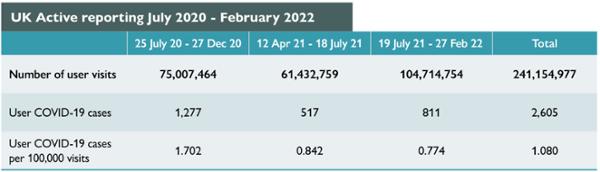
Through regular pubic statements showing the latest stats, we were able to demonstrate that even against a backdrop of rising cases within the general population, COVID-19 case rates remained extremely low throughout. The peak week saw 2,042 sites submit data. The highest weekly reported visits figure reached 5.4 million. Across the two years, the COVID-19 case rate per 100,000 visits was 1.080. Over the course of the whole project, we collected data on more than 240 million visits to facilities.

The speed of data collection and the ongoing dialogue we had with members also enabled us to adapt the methodology to respond to any new requirements. This included asking for additional information on geographical areas classified as high risk, understanding the volume of group exercise class attendees to mitigate fears that these classes presented a higher risk environment, and looking at the quantity of staff required to self-isolate and the impact this was having on business operations.

The speed at which we were able to gather this extra data meant we could respond to new concerns or risks as soon as they emerged, with high-quality evidence from a sector-wide data set available always within a week.

In early 2022, as it became apparent that nearly all COVID-19 restrictions would soon be lifted, the data reporting exercise drew to a natural conclusion. With the threat of closure that had been present over the last two years removed, and the end of mandatory self-isolation, there was no longer a pressing need for weekly data. Coupled with the removal of free lateral flow testing, which would be likely to compromise the accuracy of the data, the final week of reporting took place in February 2022.

By this point the project had served its purpose and fulfilled the original mission – to support the sector by demonstrating the safety of facilities and the effectiveness of the operating procedures that were in place.

None of this would have been possible without the ongoing support of our members, who were unwavering in their commitment to supplying their data to us, week in, week out. This level of collaboration and commitment from the sector enabled us to produce high-quality evidence which was far greater than the sum of its parts.

Having seen the power of this collaboration over the course of the pandemic, the next step now is to build on this and maintain the momentum generated. This model is a great example of the sector unifying through data to influence positive change both publicly and politically. We must continue to work together, fostering an open approach to data sharing in order to generate the insight required to continue to support, protect, inform and help the sector to grow.

Lizzie Broughton is strategic lead for insight at UK Active. Download Safe and Essential at www.HCMmag.com/SafeEssential

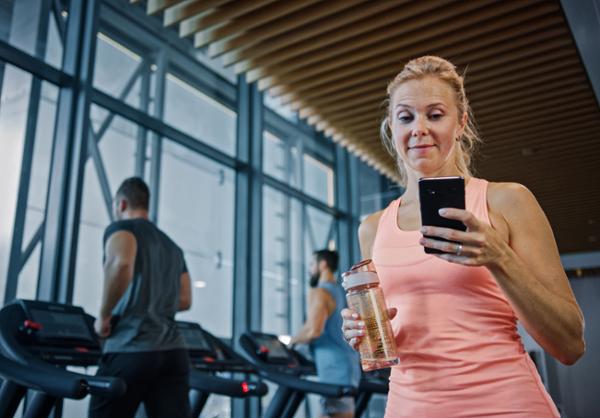
Operators committed to delivering on COVID-safe operating procedures / shutterstock/Dusan Petkovic
UK Active reporting July 2020 - February 2022
https://www.leisureopportunities.co.uk/images/2022/304391_391113.jpg
We go behind the scenes of the biggest ever collaboration on COVID safety data. Lizzie Broughton tells the story
HCM magazine
Raphael Cuomo explores the powerful link between addiction, health and behaviour change
HCM magazine
For every member with a tripod and a big following, there are others irritated at the way equipment is being hogged or wary they’ll be in the background on someone’s Insta feed. Do influencers offer valuable, free marketing or are they just a nuisance? Kath Hudson finds out how operators are responding
HCM magazine
HCM People

Stephen Price

Founder, SP&Co Group
Working in public health over the last few years has lit up parts of my brain again
HCM magazine
Small improvements to sleep, diet and physical activity have major benefits for the heart, according to new research from the University of Sydney
HCM magazine
Strength training is evolving, driven by changing consumer preferences. Julie Cramer talks to innovators about how their products are meeting this demand
HCM promotional features
Sponsored
Greg Bradley looks at the shift towards strength training in gyms and advises on how operators can create the ultimate training environment
HCM promotional features
Sponsored
David Lloyd is stepping up its commitment to women’s health as it continues to explore what fit-for-purpose looks like for the female population
HCM promotional features
Sponsored
Third Space partnered with IndigoFitness to deliver a bespoke training space for its new club at The Whiteley
HCM promotional features
Sponsored
Find out how your gym can tap into the corporate wellness boom
HCM promotional features
Sponsored
SnowDome Fitness has added 50 per cent more space with cutting-edge Technogym solutions
HCM promotional features
Sponsored
Starpool supports Olympic champion Marcell Jacobs, says Riccardo Turri
HCM promotional features
Sponsored
EGYM has opened a new HQ in Paternoster Square, London and revealed a range of new launches
HCM promotional features
Sponsored
Pulse Fitness has created a new health club delivering an elevated wellness experience
HCM promotional features
Promotion
Performance Health Systems, manufacturer of Power Plate, has a new CEO, with an ambitious vision for the company
HCM promotional features
Latest News
People taking GLP-1 weight loss medications such as Ozempic, Wegovy, Mounjaro and Zepbound may be ...
Latest News
Low-cost gym operator, PureGym, is trialling recovery zones at two of its UK sites, democratising ...
Latest News
In a milestone moment, mental health has become a core part of CIMSPA’s occupational professional ...
Latest News
US high-value, low-price chain, Eos Fitness, has announced plans to pilot reformer Pilates in three ...
Latest News
Preventive healthcare company Neko Health has added body composition analysis to its full-body health scan ...
Latest News
Chequan Lewis is the new CEO of Crunch Fitness, taking over from Jim Rowley, who ...
Latest News
Sea Lanes Canary Wharf has officially opened. The 50-metre, six-lane pool, which uses the natural ...
Latest News
London-based high-performance fitness club, ONE LDN, is raising funds for a multi-site expansion across London, ...
Opinion
promotion
Strength training has moved from the margins to the mainstream.
Opinion: Building smarter strength spaces for today’s operators
Featured supplier news
Featured supplier news: Supporting long-term health: why whole body vibration belongs in clinical settings
As healthcare continues to shift towards prevention, there’s a growing focus on helping people stay active, independent and feeling good for longer.
Featured supplier news
Featured supplier news: Reaching the people most gyms miss: Bedford Gym & Swim Campaign delivers 410 new members
One of the biggest mistakes the fitness industry still makes is advertising almost exclusively to people who already look and live like gym members.
Company profiles
Company profile: Les Mills UK
Every week, millions of people get fit in 21,000 clubs, across 100 countries with the ...
Company profiles
Company profile: Gladstone Software
Gladstone’s software is built to streamline operations, reduce admin burden, and boost engagement. Operators can ...
Supplier Showcases
Supplier Showcase - Future-proofing
Catalogue Gallery
Click on a catalogue to view it online
Featured press releases
Swim England press release: Swim England launches new Learn to Swim Growth Plan to support aquatic programme expansion
Swim England has strengthened its sector-leading Business Solutions offer with the launch of its Learn to Swim Growth Plan, designed to help aquatic providers unlock sustainable programme growth.
Featured press releases
CoverMe Ltd press release: CoverMe and Jobs In. Fitness partner to create end-to-end talent solution
CoverMe, the UK’s leading fitness workforce management and recruitment platform, has partnered with Jobs In. Fitness, the specialist executive search and advisory firm for the fitness and wellbeing sector, to give operators a single route to talent at every level – from frontline staffing to C-suite.
Directory
Water experiences and hydrotherapy solutions
Aquaform s.r.l.: Water experiences and hydrotherapy solutions
Lockers
Crown Sports Lockers: Lockers
Hot tubs
MSpa International Ltd: Hot tubs
Spa and beauty equipment
Living Earth Crafts: Spa and beauty equipment
Industrial washing machines
Miele Company Limited: Industrial washing machines
Fitness tracking platform
SpiviTech: Fitness tracking platform
Property & Tenders
Stratford, East London.
Lee Valley Regional Park Authority
Property & Tenders
Y Felinheli, LL56 4QN
Newmark
Property & Tenders
Diary dates
21-24 Sep 2026
The Langham Huntington Pasadena , Pasadena, United States
Diary dates
06-08 Oct 2026
Messe Stuttgart, Stuttgart, Germany
Diary dates
22-22 Oct 2026
QEII Conference Centre, London,
Diary dates
26-29 Oct 2027
Koelnmesse Exhibition Centre, Cologne, Germany
Diary dates

features

Insight: Safe and essential

The pandemic brought about our sector’s biggest ever collaboration on COVID safety data. Lizzie Broughton tells the story

Published in Health Club Management 2022 issue 4
Research was able to prove that group exercise classes were safe / shutterstock/Gorodenkoff
We adapted the methodology to understand the volume of group exercise class attendees to mitigate fears that classes presented a higher risk environment

This month, UK Active published its full report on COVID-19 safety data from the health and fitness sector in the UK, representing data gathered in relation to 240 million visits, making it the biggest data set in Europe.

UK Active’s safety data reporting was launched nearly two years ago, when the UK was in the middle of its first national lockdown. As the trade body for the sector, UK Active has always championed the importance of having easily accessible physical facilities for exercise for all.

In the first stages of the pandemic, early indications from Sport England’s consumer polling – with Savanta ComRes – suggested that while activity levels overall were staying constant over the lockdown, there were gaps in activity levels opening up between certain demographic groups – effectively, inequalities were growing.

As we moved towards the initial reopening of facilities in July 2020 we were confident that Fit Togehter, the safety frameworks and operating procedures created by UK Active in partnership with operator members, would keep consumers safe when facilities reopened, ensuring more people could remain active and healthy and in turn, improve our nation’s resilience against the virus.

Gyms, leisure centres and fitness facilities all put in a huge amount of work to ensure their facilities met the new standards required. As the reopening of facilities approached on 25 July (in England), UK Active recognised the growing need to demonstrate as a sector the safety of our collective facilities. Amid a landscape of uncertainty and ever-changing restrictions over the next two years, weekly data reporting became a mainstay of the UK Active Research Institute’s work, and our evidence underpinned our public campaigning and lobbying efforts with the simple message that health and fitness facilities were ‘safe and essential’.

Proving health clubs are low-risk
At a time when the spotlight fell across all sectors in determining what restrictions were necessary to reduce the spread of the virus, we looked to develop a reporting mechanism that would enable us to gather on behalf of the sector the data that was needed to demonstrate that gyms and leisure centres were low-risk spaces.

There were some key factors to consider. Firstly, the ease and simplicity of both our data collection and processing. At a time where operators were already under huge pressures due to the additional complications of operating under COVID-19 restrictions, the data we were requesting needed to be quick and simple for them to gather, and not add an extra administrative burden.

Likewise, for the team at the UK Active Research Institute to be able to produce collated weekly stats quickly and efficiently – so we always had the most up-to-date information possible – we needed a methodology that would enable us to easily convert raw data from about 2,000 sites into a set of consistent metrics each week that could be aggregated.

We determined that the key metrics we would gather from each operator each week would be: total visits, confirmed COVID-19 cases from users and staff, and Environmental Health Officer visits across different regions. Using these, we produced a data template which was circulated to the entire UK Active membership. From the initial weekend of reopening in England (24–25 July 2020), the response was incredibly positive, with operators proactively submitting their data on time across all nations. As the weeks progressed, the operation became more streamlined, with the Research Institute adding additional processes in place to automate the procedure as much as possible.

The collated data was shared on a weekly basis with UK Active members for their own internal purposes, but was also used on a much wider basis by UK Active and its members to demonstrate on an ongoing basis the low risk within facilities.

Week-on-week comparisions
Data was analysed as a COVID-19 case rate per 100,000 visits to enable easy week-on-week comparison. This was presented against the UK overall case rate per 100,000 population for the same time, not for direct comparison, but to see if the trends being seen nationwide were reflected in the data we were collecting.

We were able to use the data with each of the home nation governments to provide the reassurance that the mitigations that were in place within facilities were working.

Through regular pubic statements showing the latest stats, we were able to demonstrate that even against a backdrop of rising cases within the general population, COVID-19 case rates remained extremely low throughout. The peak week saw 2,042 sites submit data. The highest weekly reported visits figure reached 5.4 million. Across the two years, the COVID-19 case rate per 100,000 visits was 1.080. Over the course of the whole project, we collected data on more than 240 million visits to facilities.

The speed of data collection and the ongoing dialogue we had with members also enabled us to adapt the methodology to respond to any new requirements. This included asking for additional information on geographical areas classified as high risk, understanding the volume of group exercise class attendees to mitigate fears that these classes presented a higher risk environment, and looking at the quantity of staff required to self-isolate and the impact this was having on business operations.

The speed at which we were able to gather this extra data meant we could respond to new concerns or risks as soon as they emerged, with high-quality evidence from a sector-wide data set available always within a week.

In early 2022, as it became apparent that nearly all COVID-19 restrictions would soon be lifted, the data reporting exercise drew to a natural conclusion. With the threat of closure that had been present over the last two years removed, and the end of mandatory self-isolation, there was no longer a pressing need for weekly data. Coupled with the removal of free lateral flow testing, which would be likely to compromise the accuracy of the data, the final week of reporting took place in February 2022.

By this point the project had served its purpose and fulfilled the original mission – to support the sector by demonstrating the safety of facilities and the effectiveness of the operating procedures that were in place.

None of this would have been possible without the ongoing support of our members, who were unwavering in their commitment to supplying their data to us, week in, week out. This level of collaboration and commitment from the sector enabled us to produce high-quality evidence which was far greater than the sum of its parts.

Having seen the power of this collaboration over the course of the pandemic, the next step now is to build on this and maintain the momentum generated. This model is a great example of the sector unifying through data to influence positive change both publicly and politically. We must continue to work together, fostering an open approach to data sharing in order to generate the insight required to continue to support, protect, inform and help the sector to grow.

Lizzie Broughton is strategic lead for insight at UK Active. Download Safe and Essential at www.HCMmag.com/SafeEssential

Operators committed to delivering on COVID-safe operating procedures / shutterstock/Dusan Petkovic
UK Active reporting July 2020 - February 2022
https://www.leisureopportunities.co.uk/images/2022/304391_391113.jpg
We go behind the scenes of the biggest ever collaboration on COVID safety data. Lizzie Broughton tells the story
Latest News
People taking GLP-1 weight loss medications such as Ozempic, Wegovy, Mounjaro and Zepbound may be ...
Latest News
Low-cost gym operator, PureGym, is trialling recovery zones at two of its UK sites, democratising ...
Latest News
In a milestone moment, mental health has become a core part of CIMSPA’s occupational professional ...
Latest News
US high-value, low-price chain, Eos Fitness, has announced plans to pilot reformer Pilates in three ...
Latest News
Preventive healthcare company Neko Health has added body composition analysis to its full-body health scan ...
Latest News
Chequan Lewis is the new CEO of Crunch Fitness, taking over from Jim Rowley, who ...
Latest News
Sea Lanes Canary Wharf has officially opened. The 50-metre, six-lane pool, which uses the natural ...
Latest News
London-based high-performance fitness club, ONE LDN, is raising funds for a multi-site expansion across London, ...
Latest News
A new brain clinic has opened in London, which uses non-invasive brain stimulation to treat ...
Latest News
Good Boost’s digital exercise programmes are helping adults with MSK at a lower cost than ...
Latest News
With Prime Minister, Keir Starmer, announcing his resignation this morning and Andy Burnham as a ...
Opinion
promotion
Strength training has moved from the margins to the mainstream.
Opinion: Building smarter strength spaces for today’s operators
Featured supplier news
Featured supplier news: Supporting long-term health: why whole body vibration belongs in clinical settings
As healthcare continues to shift towards prevention, there’s a growing focus on helping people stay active, independent and feeling good for longer.
Featured supplier news
Featured supplier news: Reaching the people most gyms miss: Bedford Gym & Swim Campaign delivers 410 new members
One of the biggest mistakes the fitness industry still makes is advertising almost exclusively to people who already look and live like gym members.
Company profiles
Company profile: Les Mills UK
Every week, millions of people get fit in 21,000 clubs, across 100 countries with the ...
Company profiles
Company profile: Gladstone Software
Gladstone’s software is built to streamline operations, reduce admin burden, and boost engagement. Operators can ...
Supplier Showcases
Supplier Showcase - Future-proofing
Catalogue Gallery
Click on a catalogue to view it online
Featured press releases
Swim England press release: Swim England launches new Learn to Swim Growth Plan to support aquatic programme expansion
Swim England has strengthened its sector-leading Business Solutions offer with the launch of its Learn to Swim Growth Plan, designed to help aquatic providers unlock sustainable programme growth.
Featured press releases
CoverMe Ltd press release: CoverMe and Jobs In. Fitness partner to create end-to-end talent solution
CoverMe, the UK’s leading fitness workforce management and recruitment platform, has partnered with Jobs In. Fitness, the specialist executive search and advisory firm for the fitness and wellbeing sector, to give operators a single route to talent at every level – from frontline staffing to C-suite.
Directory
Water experiences and hydrotherapy solutions
Aquaform s.r.l.: Water experiences and hydrotherapy solutions
Lockers
Crown Sports Lockers: Lockers
Hot tubs
MSpa International Ltd: Hot tubs
Spa and beauty equipment
Living Earth Crafts: Spa and beauty equipment
Industrial washing machines

Miele Company Limited: Industrial washing machines

Fitness tracking platform
SpiviTech: Fitness tracking platform
Property & Tenders
Stratford, East London.
Lee Valley Regional Park Authority
Property & Tenders
Y Felinheli, LL56 4QN
Newmark
Property & Tenders
Diary dates
21-24 Sep 2026
The Langham Huntington Pasadena , Pasadena, United States
Diary dates
06-08 Oct 2026
Messe Stuttgart, Stuttgart, Germany
Diary dates
22-22 Oct 2026
QEII Conference Centre, London,
Diary dates
26-29 Oct 2027
Koelnmesse Exhibition Centre, Cologne, Germany
Diary dates
Search news, features & products:
Find a supplier:
Partner sites