














GET HCM
magazine
Sign up for the FREE digital edition of HCM magazine and also get the HCM ezine and breaking news email alerts.
Not right now, thanksclose this window I've already subscribed!
The Leisure Media Company Ltd
Follow Health Club Management on Twitter Like Health Club Management on Facebook Join the discussion with Health Club Management on LinkedIn
FITNESS, HEALTH, WELLNESS

features

Insight: Consumer engagement

Dr Matthew Wade and Georgie Poole talk us through research from UK Active and Savanta that gives a deeper understanding of what motivates consumers

Published in Health Club Management 2024 issue 6
UK Active is working with Savanta to deliver consumer insight data / photo: Shutterstock / Jacob Lund
The results show the holistic benefits of physical activity, such as improved confidence and better sleep levels

A new research project is exploring UK consumers’ relationship with gyms, swimming pools and leisure centres.

The work is being undertaken via a regularly-updated consumer engagement study conducted by research outfit Savanta (www.savanta.com) and commissioned by industry association, UK Active, with the first set of results published in a report called On the road to Vision 2030.

The aim is to observe the behaviours, experiences and feelings of consumers, using their responses to generate insight that can be deployed by the sector to better understand which types of engagement they respond to when it comes to joining, visiting and enjoying facilities.

On the road to Vision 2030 is based on 16 months’ of data taken across five waves of polling and so far, more than 10,000 existing, former, and potential fitness and leisure consumers have been involved.

As the sample grows, an ever more nuanced picture will be painted about what consumers want to see from our sector, so we can better understand the role facilities play within communities.

About the sample
Participants comprise a nationally representative sample of people from across the UK, with data segmented into three specific focus groups.
The first group are current members and people with active memberships and have taken part in an activity within a facility within the last three months.

The second group are people who’ve previously been a member of a gym or leisure facility but do not currently have a membership, while the third group are those that have never been a member.

This breakdown was chosen to ensure the feelings and behaviours of those who are engaging with, have engaged with or have never engaged with our sector, are reflected in the insights collected. This sample means we can compare responses between those that do and do not interact with our sector, informing decisions on how non-members can be supported and engaged.

Initial findings
This first report explores topics including current physical activity levels, membership status and some of the main barriers and motivations users and non-users have when taking part in activities in facilities. It also examines what can be done to encourage retention and participation.

The full report also touches on what health means to consumers and perceptions around how the sector is supporting people with long-term health conditions.

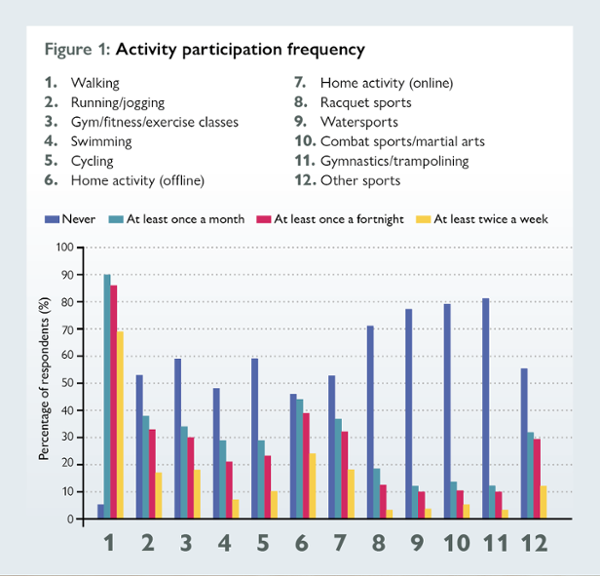
Across the sample, each individual was asked what activities they take part in and how often they do them (see Figure 1).

From January 2024, walking was the most popular activity, with 69 per cent of the sample walking at least twice a week, 86 per cent at least every two weeks and 90 per cent monthly.

Gym attendance, including exercise classes, attracted 18 per cent of the sample to participate twice a week, 30 per cent at least every two weeks and 34 per cent at least every month, with 59 per cent of the sample never undertaking these activities.

Running attracted 17 per cent twice weekly, 33 per cent every two weeks and 38 per cent monthly, while 53 per cent said they never run.

Swimming attracted 7 per cent of the sample twice a week and 21 per cent every fortnight, with 29 per cent going at least once a month, while 48 per cent of people in the sample never swim.

Online home exercise attracted 18 per cent twice a week, 32 per cent every two weeks and 37 per cent monthly, with around 53 per cent never working out at home.

Offline home activity engaged 24 per cent twice a week, 39 per cent every two weeks and 44 per cent every month, with 46 per cent never exercising offline at home.

The overlap between exercising in the gym and at home was not recorded.

What motivates people?
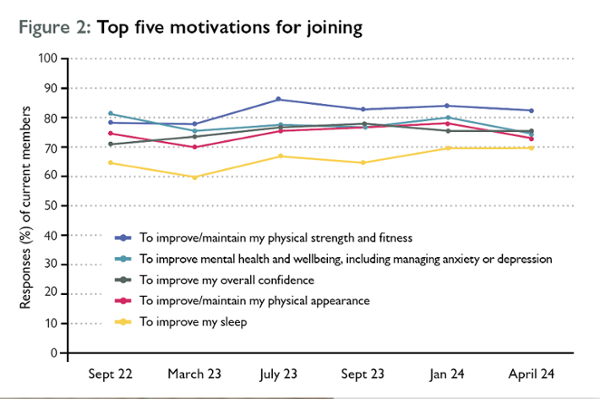
To understand why consumers choose to become members of facilities, current members were asked what motivates them to attend (Figure 2). The researchers gave a wide range of options for respondents to choose from, however, five main motivations emerged:

82% To improve/maintain my physical strength and fitness

79% To improve my mental health and wellbeing, including managing anxiety or depression

75% To improve my overall confidence

75% To improve/maintain my physical appearance

67% To improve my sleep

These results show the holistic benefits of physical activity, with responses such as improving confidence and bettering sleep levels indicating that users are attending facilities to benefit their mental, not just physical wellbeing.

Interestingly, while these motivations have remained consistent across each of the survey waves, their weighted value has adjusted slightly.

For example, in September 2022 – potentially due to the impact of the pandemic – ‘improving mental health’ was the most popular reason given at 81 per cent, a score it hit again in January 2024. However, ‘improving and maintaining physical strength and fitness’ has seen its score increase from 79 per cent to 83 per cent over that time-frame, taking the lead since March 2023.

The benefits of physical activity for mental health and wellbeing are increasingly recognised and it’s reassuring to see that this is a highly motivating factor for consumers.

All motivations are tracked quarterly with the results enabling decision-makers to better understand how operators can tap into these to attract new members, as well as ensuring value for those already engaged in our sector.

What are the main barriers?
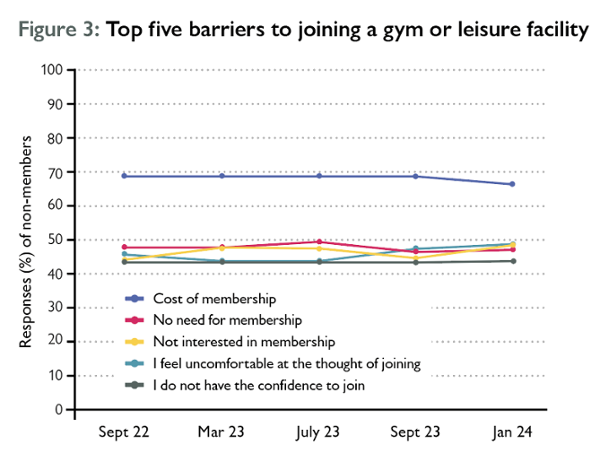
Alongside looking at motivations for attending, it’s important to analyse the main barriers consumers face when they consider participating. These questions were asked of former members and those who have never been members (see Figure 3).

The research team found that cost is the main perceived barrier, with this being the most selected reason consistently across each of the time points surveyed. With the rising cost of living and consumers facing choices for their disposable income, researchers are watching to see how the results of this question change over time.

Interestingly, the data from January 2024 shows the barrier relating to cost declining by a couple of percentage points and during the planned waves of polling it will be essential to see if this continues on a downward trend.

Other barriers for non- and former members included the feeling that there was ‘no need for a membership’, ‘not being interested in a membership’, a ‘lack of confidence’ and ‘feeling uncomfortable in a gym or leisure facility’. This initial report outlines some of the ways these barriers can be overcome.

Tracking these barriers across each of the quarterly waves will be essential to understanding what currently holds people back from engaging with the sector.

Long-term health conditions
Across the physical activity sector in the UK there’s a clear awareness that focusing on health is a positive way our sector can demonstrate the role facilities are playing in supporting the national health crisis. In January 2024, extra questions were added to the Savanta survey to enable researchers to better understand consumers perceptions and understandings of health, as well as their knowledge of programmes within facilities that could support them.

In January 2024, respondents with a health condition were asked whether they knew of programmes at their local gym or leisure facility that could help them manage their condition – 17 per cent of respondents with a condition were aware of these but 68 per cent were unaware and 15 per cent said they didn’t know.

While there’s a greater awareness among those who are members of a facility and have a health condition (in comparison to non-members), there’s also work to be done to ensure that both members and non-members with health conditions are aware of services being delivered at facilities near where they live that could provide the support they need.

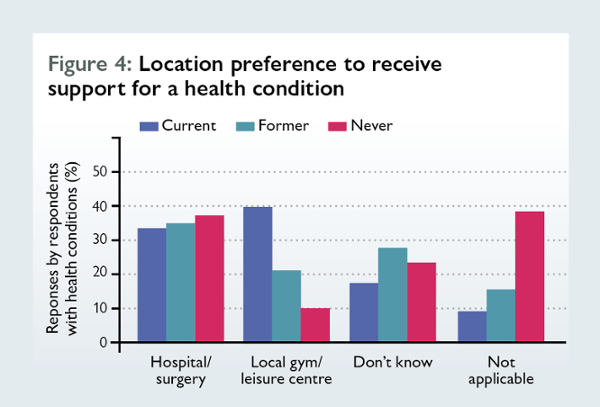
In order to understand the preference of those with a health condition when it comes to where they would like to receive support, a further question was included, which asked: “Would you prefer to receive support for your condition at a hospital/surgery, or at your local gym or leisure centre?”

Overall, 35 per cent chose hospital and 21 per cent a local gym or leisure centre (Figure 4).

When these results were broken down by membership status, receiving support at a gym or leisure centre was favoured by 40 per cent of current gym members, suggesting that current members are more aware of the benefits gyms and leisure centres are providing for those with long-term conditions and feel comfortable accessing support in these spaces.

This is the first wave of this questioning and the consequent iterations of the quarterly polling will help us to build on these findings and understand how perceptions grow and develop.

Conclusions
This first report from Savanta and UK Active lays the foundations for understanding consumers’ current attitudes towards the UK’s physical activity sector and as quarterly data is collected, it will provide a deeper understanding of what matters to people when it comes to their health and fitness, as well as the choices they make in relation to using facilities.

As the sector continues to play a significant role as part of the national health agenda, this consumer engagement polling will support the building of market intelligence that can be used by operators and suppliers within the sector, as well as providing useful material for political engagement. The findings will also help to inform UK Active’s work areas and support the organisation’s Vision 2030 mission to get five million more people active by 2030.

Dr Matthew Wade is head of research and development at UK Active. Georgie Poole is senior head of marketing, events and engagement at UK Active

More: HCMmag.com/savanta

/ Source: Savanta/UK Active
Responses provided by respondents with health condition, split by membership status. January 2024 / Source: Savanta/UK Active.
48 per cent of people in the sample never swim / Shutterstock / Jacob Lund
Quarterly data will provide a deeper understanding of what matters to people / Shutterstock/KOTOIMAGES
https://www.leisureopportunities.co.uk/images/2024/548682_783123.jpg
UK Active has initiated a new research project with Savanta to dive deeper into what truly motivates today’s consumers
HCM magazine
Strength training is evolving, driven by changing consumer preferences. Julie Cramer talks to innovators about how their products are meeting this demand
HCM magazine
Collaborations with the medical profession and greater aspirations around wellbeing are creating a need for more experts in our sector. It’s time to reboot our thinking around the workforce
HCM magazine
HCM People

Stephen Price

Founder, SP&Co Group
Working in public health over the last few years has lit up parts of my brain again
HCM magazine
If the health service is to survive, we must recognise that it is a disease service – and that wellbeing rests with us, says the activity advocate and healthy ageing champion. He talks to Kate Cracknell
HCM magazine
For every member with a tripod and a big following, there are others irritated at the way equipment is being hogged or wary they’ll be in the background on someone’s Insta feed. Do influencers offer valuable, free marketing or are they just a nuisance? Kath Hudson finds out how operators are responding
HCM promotional features
Sponsored
Starpool supports Olympic champion Marcell Jacobs, says Riccardo Turri
HCM promotional features
Sponsored
SnowDome Fitness has added 50 per cent more space with cutting-edge Technogym solutions
HCM promotional features
Sponsored
David Lloyd is stepping up its commitment to women’s health as it continues to explore what fit-for-purpose looks like for the female population
HCM promotional features
Sponsored
Third Space partnered with IndigoFitness to deliver a bespoke training space for its new club at The Whiteley
HCM promotional features
Sponsored
Greg Bradley looks at the shift towards strength training in gyms and advises on how operators can create the ultimate training environment
HCM promotional features
Sponsored
Find out how your gym can tap into the corporate wellness boom
HCM promotional features
Sponsored
EGYM has opened a new HQ in Paternoster Square, London and revealed a range of new launches
HCM promotional features
Promotion
BLK BOX has been reimagining elite performance spaces for more than a decade. Founder and former athlete, Greg Bradley, tells us what it takes
HCM promotional features
Sponsored
The industry is embracing consumer-facing tech. Now it’s time to streamline back-of-house systems with Orbit4, says Daniel Jones
HCM promotional features
Latest News
PureGym Group has announced that group chief financial officer, Alex Wood, is taking over the ...
Latest News
Independent operator, Fitness Worx Gyms, is introducing private blood testing as a service to members. ...
Latest News
International industry lobbying associations are calling for physical activity and strength training to be deeply ...
Latest News
Global group exercise specialist, Les Mills, is inviting operators to sign up to its Workout ...
Latest News
Global luxury hospitality brand, Six Senses, has partnered with longevity healthcare provider, HUM2N, to launch ...
Latest News
Premium London health club, KX Chelsea, is gearing up to unveil its most significant redevelopment ...
Latest News
Researchers in the US have identified an antibody which could greatly reduce the loss of ...
Latest News
Peloton has made the strategic acquisition of Pilates start-up, Skōp, to support the expansion of ...
Opinion
promotion
Strength training has moved from the margins to the mainstream.
Opinion: Building smarter strength spaces for today’s operators
Featured supplier news
Featured supplier news: Supporting long-term health: why whole body vibration belongs in clinical settings
As healthcare continues to shift towards prevention, there’s a growing focus on helping people stay active, independent and feeling good for longer.
Featured supplier news
Featured supplier news: Elevate 2026 to mark 10-year anniversary with biggest ever waterfront drinks reception
Elevate is set to celebrate its 10th anniversary in style this June, with organisers confirming the event’s largest-ever drinks reception as registrations continue to run more than 10% ahead of last year.
Company profiles
Company profile: Power Plate
Power Plate's range of products include whole body vibration platforms, targeted vibration products and the ...
Company profiles
Company profile: Sporty Group AS
With more than 90 fitness centres across the country and more than 130.000 members, Sporty ...
Supplier Showcases
Supplier Showcase - Future-proofing
Catalogue Gallery
Click on a catalogue to view it online
Featured press releases
Everyone Active press release: Everyone Active celebrates Summer Solstice and International Yoga Day with wellness events across UK
A nationwide celebration for the upcoming Summer Solstice and International Yoga Day will take place at Everyone Active facilities across the country on Friday, 19 June 2026.
Featured press releases
Zynk Design press release: Gym lighting design: how to specify lighting that motivates members
Gym lighting design is one of the most underrated tools an operator has, and one of the most commonly mishandled.
Directory
Spa and beauty equipment
Living Earth Crafts: Spa and beauty equipment
Lockers
Crown Sports Lockers: Lockers
Fitness tracking platform
SpiviTech: Fitness tracking platform
Industrial washing machines
Miele Company Limited: Industrial washing machines
Water experiences and hydrotherapy solutions
Aquaform s.r.l.: Water experiences and hydrotherapy solutions
Hot tubs
MSpa International Ltd: Hot tubs
Property & Tenders
Stratford, East London.
Lee Valley Regional Park Authority
Property & Tenders
Y Felinheli, LL56 4QN
Newmark
Property & Tenders
Diary dates
22-23 Jun 2026
WX Wakefield , Wakefield, United Kingdom
Diary dates
21-24 Sep 2026
The Langham Huntington Pasadena , Pasadena, United States
Diary dates
06-08 Oct 2026
Messe Stuttgart, Stuttgart, Germany
Diary dates
22-22 Oct 2026
QEII Conference Centre, London,
Diary dates
26-29 Oct 2027
Koelnmesse Exhibition Centre, Cologne, Germany
Diary dates

features

Insight: Consumer engagement

Dr Matthew Wade and Georgie Poole talk us through research from UK Active and Savanta that gives a deeper understanding of what motivates consumers

Published in Health Club Management 2024 issue 6
UK Active is working with Savanta to deliver consumer insight data / photo: Shutterstock / Jacob Lund
The results show the holistic benefits of physical activity, such as improved confidence and better sleep levels

A new research project is exploring UK consumers’ relationship with gyms, swimming pools and leisure centres.

The work is being undertaken via a regularly-updated consumer engagement study conducted by research outfit Savanta (www.savanta.com) and commissioned by industry association, UK Active, with the first set of results published in a report called On the road to Vision 2030.

The aim is to observe the behaviours, experiences and feelings of consumers, using their responses to generate insight that can be deployed by the sector to better understand which types of engagement they respond to when it comes to joining, visiting and enjoying facilities.

On the road to Vision 2030 is based on 16 months’ of data taken across five waves of polling and so far, more than 10,000 existing, former, and potential fitness and leisure consumers have been involved.

As the sample grows, an ever more nuanced picture will be painted about what consumers want to see from our sector, so we can better understand the role facilities play within communities.

About the sample
Participants comprise a nationally representative sample of people from across the UK, with data segmented into three specific focus groups.
The first group are current members and people with active memberships and have taken part in an activity within a facility within the last three months.

The second group are people who’ve previously been a member of a gym or leisure facility but do not currently have a membership, while the third group are those that have never been a member.

This breakdown was chosen to ensure the feelings and behaviours of those who are engaging with, have engaged with or have never engaged with our sector, are reflected in the insights collected. This sample means we can compare responses between those that do and do not interact with our sector, informing decisions on how non-members can be supported and engaged.

Initial findings
This first report explores topics including current physical activity levels, membership status and some of the main barriers and motivations users and non-users have when taking part in activities in facilities. It also examines what can be done to encourage retention and participation.

The full report also touches on what health means to consumers and perceptions around how the sector is supporting people with long-term health conditions.

Across the sample, each individual was asked what activities they take part in and how often they do them (see Figure 1).

From January 2024, walking was the most popular activity, with 69 per cent of the sample walking at least twice a week, 86 per cent at least every two weeks and 90 per cent monthly.

Gym attendance, including exercise classes, attracted 18 per cent of the sample to participate twice a week, 30 per cent at least every two weeks and 34 per cent at least every month, with 59 per cent of the sample never undertaking these activities.

Running attracted 17 per cent twice weekly, 33 per cent every two weeks and 38 per cent monthly, while 53 per cent said they never run.

Swimming attracted 7 per cent of the sample twice a week and 21 per cent every fortnight, with 29 per cent going at least once a month, while 48 per cent of people in the sample never swim.

Online home exercise attracted 18 per cent twice a week, 32 per cent every two weeks and 37 per cent monthly, with around 53 per cent never working out at home.

Offline home activity engaged 24 per cent twice a week, 39 per cent every two weeks and 44 per cent every month, with 46 per cent never exercising offline at home.

The overlap between exercising in the gym and at home was not recorded.

What motivates people?
To understand why consumers choose to become members of facilities, current members were asked what motivates them to attend (Figure 2). The researchers gave a wide range of options for respondents to choose from, however, five main motivations emerged:

82% To improve/maintain my physical strength and fitness

79% To improve my mental health and wellbeing, including managing anxiety or depression

75% To improve my overall confidence

75% To improve/maintain my physical appearance

67% To improve my sleep

These results show the holistic benefits of physical activity, with responses such as improving confidence and bettering sleep levels indicating that users are attending facilities to benefit their mental, not just physical wellbeing.

Interestingly, while these motivations have remained consistent across each of the survey waves, their weighted value has adjusted slightly.

For example, in September 2022 – potentially due to the impact of the pandemic – ‘improving mental health’ was the most popular reason given at 81 per cent, a score it hit again in January 2024. However, ‘improving and maintaining physical strength and fitness’ has seen its score increase from 79 per cent to 83 per cent over that time-frame, taking the lead since March 2023.

The benefits of physical activity for mental health and wellbeing are increasingly recognised and it’s reassuring to see that this is a highly motivating factor for consumers.

All motivations are tracked quarterly with the results enabling decision-makers to better understand how operators can tap into these to attract new members, as well as ensuring value for those already engaged in our sector.

What are the main barriers?
Alongside looking at motivations for attending, it’s important to analyse the main barriers consumers face when they consider participating. These questions were asked of former members and those who have never been members (see Figure 3).

The research team found that cost is the main perceived barrier, with this being the most selected reason consistently across each of the time points surveyed. With the rising cost of living and consumers facing choices for their disposable income, researchers are watching to see how the results of this question change over time.

Interestingly, the data from January 2024 shows the barrier relating to cost declining by a couple of percentage points and during the planned waves of polling it will be essential to see if this continues on a downward trend.

Other barriers for non- and former members included the feeling that there was ‘no need for a membership’, ‘not being interested in a membership’, a ‘lack of confidence’ and ‘feeling uncomfortable in a gym or leisure facility’. This initial report outlines some of the ways these barriers can be overcome.

Tracking these barriers across each of the quarterly waves will be essential to understanding what currently holds people back from engaging with the sector.

Long-term health conditions
Across the physical activity sector in the UK there’s a clear awareness that focusing on health is a positive way our sector can demonstrate the role facilities are playing in supporting the national health crisis. In January 2024, extra questions were added to the Savanta survey to enable researchers to better understand consumers perceptions and understandings of health, as well as their knowledge of programmes within facilities that could support them.

In January 2024, respondents with a health condition were asked whether they knew of programmes at their local gym or leisure facility that could help them manage their condition – 17 per cent of respondents with a condition were aware of these but 68 per cent were unaware and 15 per cent said they didn’t know.

While there’s a greater awareness among those who are members of a facility and have a health condition (in comparison to non-members), there’s also work to be done to ensure that both members and non-members with health conditions are aware of services being delivered at facilities near where they live that could provide the support they need.

In order to understand the preference of those with a health condition when it comes to where they would like to receive support, a further question was included, which asked: “Would you prefer to receive support for your condition at a hospital/surgery, or at your local gym or leisure centre?”

Overall, 35 per cent chose hospital and 21 per cent a local gym or leisure centre (Figure 4).

When these results were broken down by membership status, receiving support at a gym or leisure centre was favoured by 40 per cent of current gym members, suggesting that current members are more aware of the benefits gyms and leisure centres are providing for those with long-term conditions and feel comfortable accessing support in these spaces.

This is the first wave of this questioning and the consequent iterations of the quarterly polling will help us to build on these findings and understand how perceptions grow and develop.

Conclusions
This first report from Savanta and UK Active lays the foundations for understanding consumers’ current attitudes towards the UK’s physical activity sector and as quarterly data is collected, it will provide a deeper understanding of what matters to people when it comes to their health and fitness, as well as the choices they make in relation to using facilities.

As the sector continues to play a significant role as part of the national health agenda, this consumer engagement polling will support the building of market intelligence that can be used by operators and suppliers within the sector, as well as providing useful material for political engagement. The findings will also help to inform UK Active’s work areas and support the organisation’s Vision 2030 mission to get five million more people active by 2030.

Dr Matthew Wade is head of research and development at UK Active. Georgie Poole is senior head of marketing, events and engagement at UK Active

More: HCMmag.com/savanta
/ Source: Savanta/UK Active
Responses provided by respondents with health condition, split by membership status. January 2024 / Source: Savanta/UK Active.
48 per cent of people in the sample never swim / Shutterstock / Jacob Lund
Quarterly data will provide a deeper understanding of what matters to people / Shutterstock/KOTOIMAGES
https://www.leisureopportunities.co.uk/images/2024/548682_783123.jpg
UK Active has initiated a new research project with Savanta to dive deeper into what truly motivates today’s consumers

Latest News
PureGym Group has announced that group chief financial officer, Alex Wood, is taking over the ...
Latest News
Independent operator, Fitness Worx Gyms, is introducing private blood testing as a service to members. ...
Latest News
International industry lobbying associations are calling for physical activity and strength training to be deeply ...
Latest News
Global group exercise specialist, Les Mills, is inviting operators to sign up to its Workout ...
Latest News
Global luxury hospitality brand, Six Senses, has partnered with longevity healthcare provider, HUM2N, to launch ...
Latest News
Premium London health club, KX Chelsea, is gearing up to unveil its most significant redevelopment ...
Latest News
Researchers in the US have identified an antibody which could greatly reduce the loss of ...
Latest News
Peloton has made the strategic acquisition of Pilates start-up, Skōp, to support the expansion of ...
Latest News
Crunch Fitness has announced the launch of Crunch Reform Pilates – its own reformer concept ...
Latest News
The 20th State of the Industry Report from LeisureDB has revealed a resilient, expanding and ...
Latest News
Purpose Brands has announced its entry into the Italian market, having sold the franchise rights ...
Opinion
promotion
Strength training has moved from the margins to the mainstream.
Opinion: Building smarter strength spaces for today’s operators
Featured supplier news
Featured supplier news: Supporting long-term health: why whole body vibration belongs in clinical settings
As healthcare continues to shift towards prevention, there’s a growing focus on helping people stay active, independent and feeling good for longer.
Featured supplier news
Featured supplier news: Elevate 2026 to mark 10-year anniversary with biggest ever waterfront drinks reception
Elevate is set to celebrate its 10th anniversary in style this June, with organisers confirming the event’s largest-ever drinks reception as registrations continue to run more than 10% ahead of last year.
Company profiles
Company profile: Power Plate
Power Plate's range of products include whole body vibration platforms, targeted vibration products and the ...
Company profiles
Company profile: Sporty Group AS
With more than 90 fitness centres across the country and more than 130.000 members, Sporty ...
Supplier Showcases
Supplier Showcase - Future-proofing
Catalogue Gallery
Click on a catalogue to view it online
Featured press releases
Everyone Active press release: Everyone Active celebrates Summer Solstice and International Yoga Day with wellness events across UK
A nationwide celebration for the upcoming Summer Solstice and International Yoga Day will take place at Everyone Active facilities across the country on Friday, 19 June 2026.
Featured press releases
Zynk Design press release: Gym lighting design: how to specify lighting that motivates members
Gym lighting design is one of the most underrated tools an operator has, and one of the most commonly mishandled.
Directory
Spa and beauty equipment
Living Earth Crafts: Spa and beauty equipment
Lockers
Crown Sports Lockers: Lockers
Fitness tracking platform
SpiviTech: Fitness tracking platform
Industrial washing machines
Miele Company Limited: Industrial washing machines
Water experiences and hydrotherapy solutions
Aquaform s.r.l.: Water experiences and hydrotherapy solutions
Hot tubs
MSpa International Ltd: Hot tubs
Property & Tenders
Stratford, East London.
Lee Valley Regional Park Authority
Property & Tenders
Y Felinheli, LL56 4QN
Newmark
Property & Tenders
Diary dates
22-23 Jun 2026
WX Wakefield , Wakefield, United Kingdom
Diary dates
21-24 Sep 2026
The Langham Huntington Pasadena , Pasadena, United States
Diary dates
06-08 Oct 2026
Messe Stuttgart, Stuttgart, Germany
Diary dates
22-22 Oct 2026
QEII Conference Centre, London,
Diary dates
26-29 Oct 2027
Koelnmesse Exhibition Centre, Cologne, Germany
Diary dates
Search news, features & products:
Find a supplier:
The Leisure Media Company Ltd
Partner sites