
































features
HCM Forum: safety management procedures, GLP-1 medication and targeted public investment
Fuel the debate about issues and opportunities across the industry. We’d love to hear from you. Write to [email protected]




Congratulations to PureGym for its initiative in partnering with the British Heart Foundation to enable all its in-club automated external defibrillators (AEDs) to be connected to The Circuit (www.hcmmag.com/PGdefib). While it’s true there’s no UK legislation requiring the fitting of AEDs in health clubs, the European Standard for Fitness Clubs (EN17229) requires an AED to be ‘accessible’. This can mean, for example, within a short distance of the club in a shopping centre, or town centre where an AED is in place.
The requirements of the European Standard for Fitness Clubs automatically apply fully in the UK to just about every fitness facility and conformity inspections are currently being carried out through the FITcert Scheme (www.HCMmag.com/FITcert).
Operators such as The Gym Group and David Lloyd who are already certified through FITcert also have AEDs installed in their clubs.
Through FITcert they also prove they have excellent detection, alerting and intervention procedures in place in the event of a life-threatening medical emergency, such as a sudden cardiac arrest.
Operators should be reviewing their safety management and operational policy and procedures to ensure they meet the requirements of the standard. It’s not only best practice – with all the benefits this brings in the eyes of the law – it’s also the right thing to do for members, equipping staff to act positively in an emergency and signalling real care for the wellbeing of staff and customers.
More: www.fitcert.eu
Install a defibrillator: www.hcmmag.com/defibrillator

Responding to your editor’s letter about the challenges and opportunities presented by GLP-1 weight loss drugs (HCM issue 6 2024 www.hcmmag.com/GLP-1threat), The Health and Fitness Association, like so many in the medical and fitness sectors, recognises the potential for GLP-1 drugs for weight loss – both for individuals and in terms of improving overall public health.
But, the devil is in the details. That’s why we’ve been at the leading edge of advocacy to US government officials about what we view as a responsible and practical way forward.
The association has been supporting legislation, raising its voice in hearings and testimony, and building support and raising awareness within the industry.
In particular, we support extending Medicare coverage – federally-funded healthcare for older Americans – for these drugs because they can help address chronic conditions such as diabetes and cardiovascular disease, in addition to obesity.
Our message to US government officials has been clear: the expansion of Medicare coverage for GLP-1 drugs is not an isolated solution, but is part of a broader, integrated approach to health and wellness. This move makes sense because the US Medicare programme – mainly through its supplemental coverage which serves millions of seniors – offers them reduced or no-cost physical activity programmes.
The health and fitness industry plays a crucial role in partnering with healthcare providers, fostering healthy habits and guiding exercise and resistance training to offset the side effects of GLP-1 medications and maximise the positive benefits.
These medications are an innovative and positive tool in the toolbox, but as we know from so many other trends, a comprehensive approach that includes exercise is best. Industry groups and sector leaders should continue to raise awareness about the importance of their role as part of the solution.

In the early 20th century, the International Olympic Committee (IOC) refused to publish medals tables, considering them vulgar and a goad to competitive nationalism rather than the cooperative internationalism that the Games were meant to nurture. It heartily disapproved of the US press which invented them as part of its coverage of the 1908 London Games as a way of selling papers and tracking the US’s sporting ascent and Britain’s decline.
The IOC has since made its peace with the medals table and at each Games it is offered – especially for those at the top – as a measure of national prowess and power.
How then to read Team GB’s performance at Paris 2024, seventh in the table with 14 golds and 65 medals in total? By the first two criteria, this marks a decline from the highs of London 2012 (29 golds and third in the table) and Rio 2016 (27 golds and second in the table), though that this should appear disappointing is a measure of the transformation of UK elite sport since the Olympic nadir of Atlanta 1996 where the UK won just one gold medal and finished 36th in the rankings.
That said, the total number of medals won is about the same as recent Olympics and, given the small margins of elite competition, the UK could easily have finished higher up the table.
In this light, Paris 2024 is confirmation that the UK has, given its population size, sporting cultures and wealth – the main determinants of Olympic success – performed at least as well as it should; not overperforming like Australia (18 golds with a smaller population) but better than Italy or Germany or Canada.
Given where the UK ends up in most tables of international comparison these days, this is no mean feat.
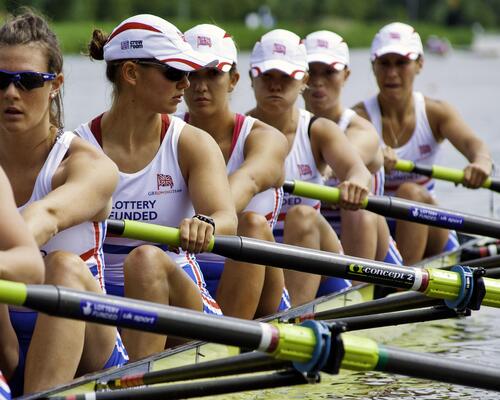
The key reason for this is that for more than a quarter of a century the Treasury and the National Lottery have, though UK Sport, been directing about £100m a year to elite sport, with a ruthless allocation process focusing funds on potential medallists.
Of course, innovative cultures of coaching and development have also been pioneered in key sports such as cycling, but the money is the most important thing.
Since the Olympics abandoned amateurism in 1992, success is all but impossible without access to high-level facilities, coaching and funding. Given that very few sports have a commercial form that can sustain a serious pool of elite athletes in full-time training (and the US model of college sport is not replicable here), state sinecures – as in many other nations – are the bedrock of British success.
Has it been a good investment? Certainly, there has been a lot of excitement, entertainment, joy and pride; all of which is good. While the anti-migrant riots that raged alongside the Games have been fuelled by an ugly racist component, Team GB has been a celebration of our diversity. However, other longer-term public benefits are harder to discern.
Certainly levels of participation in sport and everyday physical activity – a central rationale for investing in elite sport – have not significantly risen alongside our Olympic successes.
This was always a quixotic hope. Olympians are exceptional rather than the norm, their motivations and practices quite different from much of the population. No amount of sport on television, and no amount of gold medal ceremonies, have been able to arrest the long-term decline in young people’s activity rates, the obesity crisis, or the sedentary nature of most of our lives.
Given that, if we want to take a positive message away from Paris 2024, it is that targeted public investment works. Yes, it matters how and where it’s spent, but whatever the patterns of causation, there is absolutely no chance of transforming the activity rate, and the mental and physical health of the nation, without spending a lot more money, especially in poorer areas.
Sport England, and its equivalents in Scotland, Wales and Northern Ireland, which are responsible for developing grassroots sport, are working with a budget of about £250m for the whole country; a figure so small, in terms of public expenditure, that it would otherwise only buy a single large hospital or a handful of fighter jets.
Local authorities responsible for leisure centres and community sport have been devastated by 14 years of austerity and are closing swimming pools, selling off green spaces and spending less than half what they did on recreation a decade and a half ago.
In any reasonable model of public accounting, a sustained investment in the nation’s playing fields, sporting facilities, school sports, community programmes and, above all, staffing – in the billions rather than millions – and a similar level of investment in making walking and cycling the norm for urban transport, would be an immediate priority with huge and obvious health and economic benefits.
At a fraction of the cost, it would deliver better and more egalitarian outcomes than the £11bn we spend on the roads every year and – given the scale of sickness at work – deliver a greater boost to the nation’s productivity.
The UK’s Olympic athletic model may not get us off the sofa, but if we were to adopt its ambition, focus and scale up the funding, it might: and that would be an Olympic legacy without parallel.