

































features
Digital: Digital Futures evolution
Dave Gerrish examines the results of the sector’s Digital Futures programme



Digital Futures – now in its fifth year – is a programme from UK Active in partnership with Sport England that examines digital maturity and effectiveness in the fitness, leisure and sport sector.
The evolution of digital transformation in the sector has accelerated rapidly in recent years, reshaping how individuals engage with physical activity and wellbeing services. From early innovations such as online booking systems and wearable fitness trackers to the integration of AI-powered software to enhance operations, coaching and immersive virtual experiences, technology has become an essential enabler of inclusive, personalised, data-driven experiences.
This digital momentum continues to be championed by many leading organisations and companies, as well as by initiatives such as Digital Futures, which supports operators in navigating digital maturity and embedding technology strategically into their operations.
By providing a framework for digital benchmarking and fostering a culture of innovation, Digital Futures is playing a supportive role in equipping the sector to meet evolving consumer expectations and driving long-term sustainability.
Last year (2024) marked a pivotal moment for the Digital Futures programme with the publication of the results of the 2024 consultation, which was completed by 117 fitness, leisure and sports organisations.
Since the programme began in 2021, 295 organisations have completed the consultation, representing more than 10,000 facilities across the UK which serve an estimated 5.5 million members. 2024 also saw the addition of second and third survey options measuring enterprise architecture for digitally mature organisations.
This 2024 review represented the completion of the first phase of the initial overarching project – ‘Test and Learn’.
The phase two review concluded in March 2025 and involved nine months of intensive user research, workshops and collaboration with the Digital Futures Advisory Group, which is made up of strategic partners, EGYM, Gladstone and Technogym and contributing partners Leisure Labs, PerfectGym and Xn Leisure. Operator partners include David Lloyd, Everyone Active, The Gym Group, Parkwood, Places Leisure and Sandwell Leisure Trust. Additionally, there were invited organisations across National Governing Bodies and Active Partnerships.
2024 report consultation findings
This report included data from UK Active’s recently published Consumer Engagement and Insights work to provide a greater level of context behind consumers’ preferences that could have an impact on an operator’s digital development (www.hcmmag.com/UKAinsights).
The average score for digital maturity and effectiveness among the surveyed UK organisations was 51 per cent, an increase of 4 per cent in the 2023 study the previous year.
The Digital Maturity and Effectiveness Index describes this level (40-59 per cent) as being that of a ‘Digital Experimenter’, typically meaning that operators are making great strides forward but are missing the investment, goal alignment and rapid advances needed to yield a strong performance (see Figure 1).
Organisations with six to 10 locations saw a 13 per cent uplift in scores, demonstrating that even with fewer resources, smaller organisations can benefit from greater agility as they lay the foundations for growth.
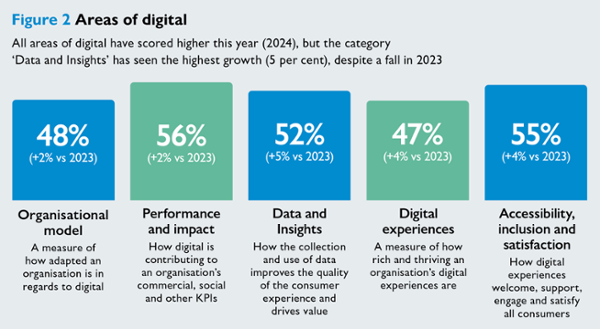
The largest improvement was seen in the area of Data and Insights, which rose by 5 per cent (Figure 2) after a decline in 2023, when operators were grappling with their approaches to managing vast increases in data inflows to help inform their business decisions, due to the increasing impact of AI.
With the 2024 increase, it’s clear that value is being placed on the importance of data and insight capabilities, data standards, data security and appropriate infrastructure. We expect to see further uplift in this category, driven by the growing adoption of AI by operators in the industry.
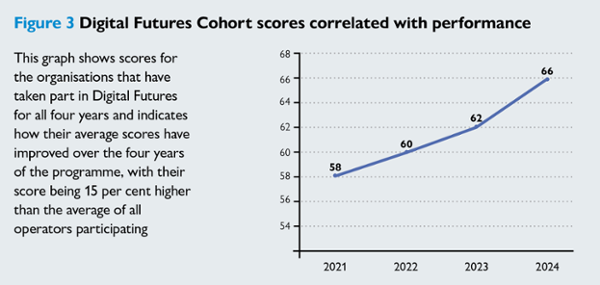
Returners who have participated in more than one year of the Digital Futures programme are know as the Digital Futures Cohort Group. This group scored higher than other participants, with the group of operators that have take part for four years scoring an average of 66 per cent – 15 per cent higher than the sector average (see Fiture 3). This indicates the benefits of sutained digital investment, as continually participating in the programme has helped them to make clear digital improvements and efficiencies.
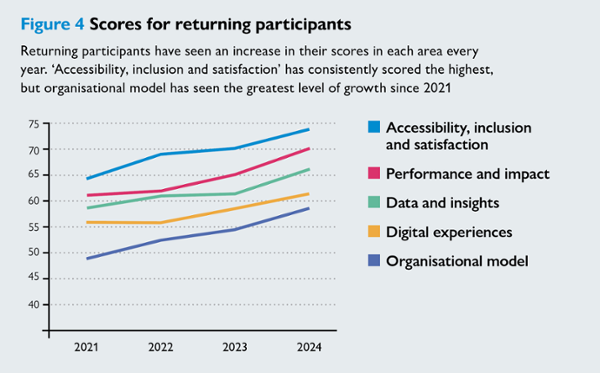
Notably, this group scored highest for Accessibility, Inclusion and Satisfaction in the recent results, while the score for Organisational Model has seen the highest growth since 2021, with a higher percentage growth, suggesting that having a robust, resourced and integrated digital strategy that’s aligned to a business’s overall commercial strategy, has been beneficial for participants in the programme (see Figure 4).
Future digital priorities
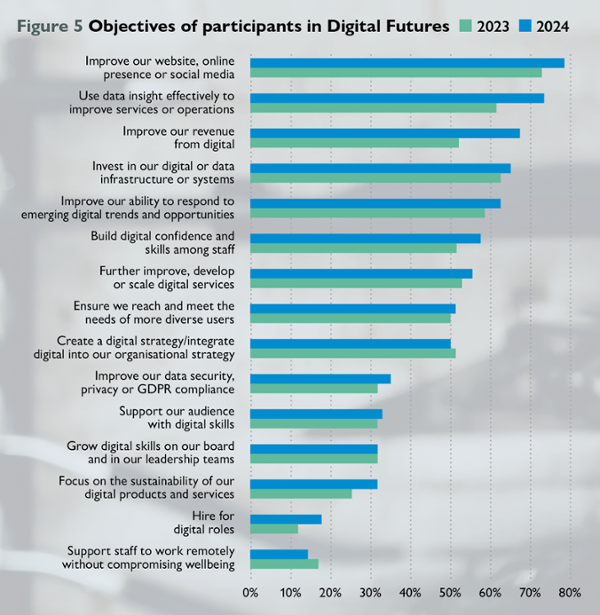
The 2024 report ends by recommending a continued focus on developing a comprehensive digital strategy that’s aligned with an organisation’s overall business goals. In particular, the following areas are shown as trending priorities that exist within many organisations’ strategies and are set to define their ambitions for the next 12 months:
1. Transition to the cloud
Results show that 68 per cent of organisations now use cloud-based Leisure Management Systems (LMS), with 100 per cent considering updates or changes within the next 12 months.
This is a critical area of focus to ensure decision-making is centred on creating positive customer experiences alongside commercial long-term value. Moving from on-site systems to cloud-based and eventually a full SaaS model offers many benefits, such as scalability, cost-efficiency and support for innovation.
Transitioning to the cloud also presents several challenges across technical, operational and cultural aspects that organisations must navigate.
2. Focus on digital strategy
Only 18 per cent of 2024 participants have an up-to-date and ambitious digital strategy. However, since Digital Futures began in 2021, 63 per cent of participating organisations have a comprehensive strategy in place that’s aligned with their business goals. The report outlines how organisations should work towards creating a digital strategy over the next 12 months to help maximise opportunities, such as gathering data and insights to grow their revenue.
3. AI Adoption
The report has shown a small increase in the adoption of AI (3 per cent growth on 2023), but the number of operators wishing to implement AI within their strategies over the next 12 months has increased by 11 per cent. This suggests a growing awareness of how AI can be used successfully within an organisation and its operations, with a clear intention to learn and experiment more.
4. Virtual Experiences
Virtual services, including online classes, have seen a 16 per cent decline according to the 2024 report. This reflects a shift away from the demand surge during the pandemic, however, a blended approach to providing both physical and virtual experiences is a key consideration and reinforces the importance of understanding customers’ needs.
5. Use of Open Data
Sharing data in a standardised format – known as Open Data – ensures digital information is freely available for anyone to access, use and share, allowing organisations within the sector to create applications freely to encourage more inclusive and diverse participation.
Open Data initiatives such as OpenActive continue to deliver value, while also benefitting from greater levels of awareness among operators.
This is especially true of the Digital Futures Cohort Group whose use of Open Data was higher than the sector average, being 12 per cent more for those organisations who have participated in Digital Futures for two years rising to 40 per cent more for those who’ve taken part over four years.
What’s next for Digital Futures?
The Digital Futures programme has now published results over the past four years and concluded a thorough review through extensive operator research and formal design activities with UK Active’s Digital Futures Advisory Group and stakeholders.
The review’s findings focused on the generation of value propositions for specific Digital Future groups, with enhancements to both the Digital Futures dashboard and methods of support to guide participants through their digital transformation journey. It also formulated growth plans to enhance the programme through partnerships.
Dashboard enhancements
On completion of the survey all participants will have access to their own Digital Futures dashboard with enhanced analytics enabling them to view results, benchmark against other parts of the sector and track progress year-on-year through partnerships with digital service providers.
In recognition of requests made by participating organisations for help understanding how they can use digital to add value, grow memberships and support participation, UK Active is piloting a global-first AI digital transformation agent that will deliver greater personalisation of content to support operators in growing their digital maturity and effectiveness.
Additionally, several themed work strands have been identified to support growth – namely, digital health integration, cybersecurity and the practical application of AI and open data health standards.
Digital Futures – conclusions
The Digital Futures 2024 report demonstrates steady progress by operators in relation to digital adoption within the sector, with organisations seeing tangible benefits from cloud-based systems and data insights.
It shows the sector is poised for continued digital integration, with emphasis shifting towards leveraging data analytics and AI to personalise user experiences and optimise operations.
However, gaps remain in digital strategy and system integration, so addressing these will be crucial to maintaining momentum and achieving growth and stability into the future.
Organisations are advised to develop comprehensive digital strategies that are aligned with their business goals to capitalise fully on these technologies. As consumer expectations evolve, embracing digital innovation will be crucial for the industry to remain competitive and meet the demands of a tech-savvy population.
Dave Gerrish is strategic lead (digital) at UK Active
Use UK Active’s free Digital Maturity and Effectiveness Index Tool: www.hcmmag.com/digitalmaturitytool
Send feedback: www.hcmmag.com/DigitalFuturesfeedback







Private investment company Franchise Equity Partners has acquired Bravo Fit, the Planet Fitness ...

Midtown Athletic Club has launched a new community tennis initiative honouring the legacy ...



Urban Gym Group has entered the Irish market with the acquisition of Iconic ...

Total Fitness has released new research revealing how the expectations and motivations of ...