









Follow Health Club Management on Twitter Like Health Club Management on Facebook Join the discussion with Health Club Management on LinkedIn
FITNESS, HEALTH, WELLNESS

features

Consumer research: Polarising nation

What are customers’ current attitudes towards health and fitness, and what are the implications for our industry? Mike Hill reports on the findings from this year’s Health and Fitness Omnibus Survey

By Mike Hill, Leisure-net Solutions | Published in Health Club Management 2013 issue 3

The national Health and Fitness Omnibus Survey (HAFOS) – the annual barometer of UK consumers’ attitudes towards health, fitness and physical activity – is now in its 10th year. A street-based consumer survey, HAFOS uses a national sample of over 1,200 people, interviewed in five locations throughout England. To date, HAFOS has interviewed well over 15,000 people, making it the largest and longest running annual survey of its kind.

This year’s HAFOS provided some interesting information regarding participation in the aftermath of the London Olympics, as well as insight into consumers’ ongoing reluctance to exercise in spite of understanding the value of physical activity for good health.

Exercise is healthy? That’s a given
After a decade of campaigns at every level, it seems consumers are getting the message about being active. In the 2012 HAFOS report, more than 90 per cent of the population now recognise that regular exercise/activity is important to their health, with only a marginal two per cent saying it’s unimportant. In terms of perceptions of how much activity you need to do and what type, more are starting to recognise the key message that regular amounts of moderate physical activity, even for short periods, can be beneficial to health (see Figure 1).

People are also saying they want to do more exercise: 51 per cent of HAFOS respondents said they either definitely or probably do not exercise as much as they’d like. Only 19 per cent said they definitely do as much as they want, with 20 per cent saying they probably do.

Overall, the percentage of the population claiming they’d like to be more active has remained relatively static over the last 10 years, with 52 per cent of people overall stating yes, they would.

There are, however, interesting differences to be noted between males and females, with more than half (55 per cent) of women saying they would like to be more active, compared to only 47 per cent of males. Even more dramatic is the noticeable decline in those wanting to be more active among the older age groups, with only 22 per cent of those aged 75 and over wishing to do so (see Figure 2).

Don’t abandon old messages
Among HAFOS respondents, the main motivation for being active is – or would be – general improvement or maintenance of health, at 51 per cent. However, the two reasons quoted that relate to weight/body shape follow closely behind, both at 18 per cent (see Figure 3). The sector must not ignore the fact that weight loss/maintenance remains a key motivating factor.

Indeed, other research by Leisure-net suggests that weight loss/maintenance is in fact the main motivation for many existing gym users – this in spite of the fact that people tend to be reticent about admitting they’re concerned more with how they look than how they feel. The importance of the weight loss message is certainly not something the sector should be underestimating, either in its marketing or its retention strategies.

Excuses, excuses…
But however highly people now claim to rate regular exercise/activity in principle, HAFOS revealed that reasons for not converting that into action remain a challenge. A perceived lack of time due to work is still the number one barrier preventing people from being more active. This is followed by cost: although only 13 per cent of respondents named high costs as a barrier, when asked what would encourage them to use leisure centres/health clubs, lower prices were quoted by the most people, at 62 per cent (see Figures 4 & 5).

Other factors that people said would encourage them to use leisure facilities included improved equipment and facilities (42 per cent), better programming (43 per cent), and access to more information (47 per cent). A quarter of respondents said they would like better childcare provision. While some of these elements would require investment in facilities – perhaps difficult in the current economic climate – areas such as programming and information could easily be addressed by a more customer-centric approach: providing information through channels that people can readily access, for example, and making programming/activities more convenient for people to fit into their busy everyday lives.

The London 2012 legacy
Continuing on the participation theme, HAFOS also asked about the London 2012 Olympic Games. An overwhelming 76 per cent of respondents said they thought the event had encouraged people to be more active, with only 15 per cent disagreeing with this statement. However, overall only 22 per cent of respondents said the Games had encouraged them personally to be more active, while only eight per cent of inactive people said that the 2012 Games had encouraged them to get moving.

Among respondents who had been encouraged to be more active, most had taken to running/walking (49 per cent), followed by using a gym/health club (30 per cent). Only nine per cent said they had taken up formal sport. Opportunities to get back into traditional sports after school/university are generally not as readily available as other activities. In addition, while there have been attempts by sports such as hockey and netball in particular to bring adults back into sport, more could be done to make sport attractive and an enjoyable social opportunity for people of all age groups.

Of those who were encouraged by the Olympics to be more active, seven per cent had done no moderate activity in the previous three months. Ten per cent had previously achieved only 1 x 30 minutes of moderate activity a week, and 19 per cent previously did 2 x 30. In total, therefore, 36 per cent of those who were inspired by the Games to be more active had previously not been meeting the recommended minimum levels of weekly physical activity. Nevertheless, the group that saw the biggest uplift was those already achieving 3 x 30 – 24 per cent of those who had been inspired by the Games fell into this category.

Overall, then, the message seems to be that people saw the Games as having a positive impact on everyone else, but not necessarily on themselves. The event also seemed to have more of an impact on those already active and open to doing more, rather than on sedentary people.

Population polarisation
This latest HAFOS shows a degree of improvement compared to previous years, perhaps in part due to the positive impact of London 2012. However, there is a real concern that these changes in activity may not be permanent, and also that the divide between the active and the inactive is becoming ever greater.

Those who are interested in their health – who are participating in an increasingly wide range of activities, as well as getting more active, more often – are distancing themselves more and more from the sedentary population who still struggle to find the motivation and time to do anything but basic physical activity.

Figure 1: Do you agree with the following statements: Strongly agree only
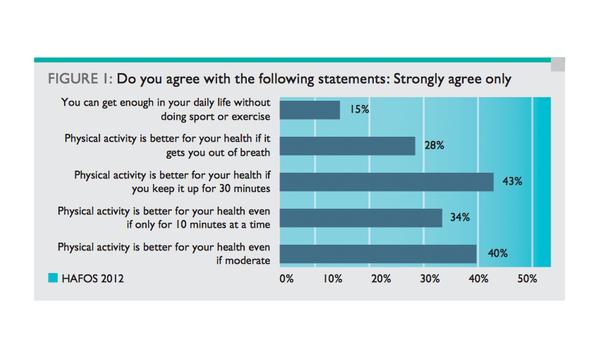
Figure 1
Figure 1

Figure 2: Would you like to do more physical activity/exercise? 52% Yes
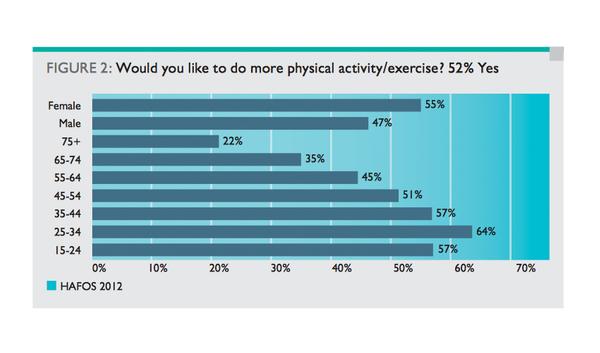
Figure 2
Figure 2

Figure 3: Why would you like to undertake more activity/exercise? (Choose one main reason)
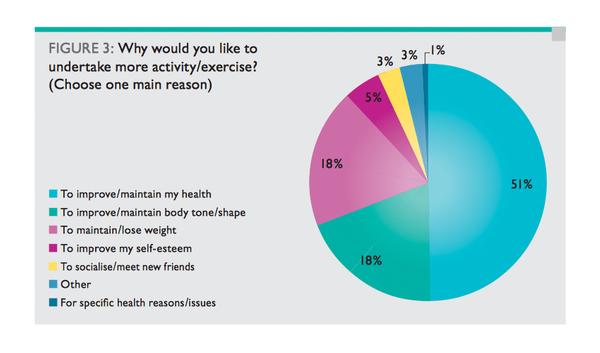
Figure 3
Figure 3

Figure 4: What’s stopping you from doing more?
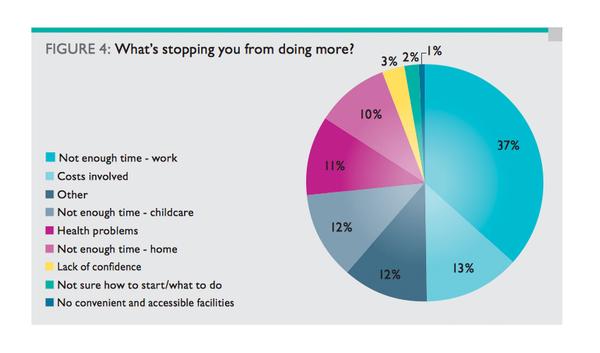
Figure 4
Figure 4

Figure 5: To what extent would the following encourage you to use these leisure centres/facilities? (strongly encourage/encourage)
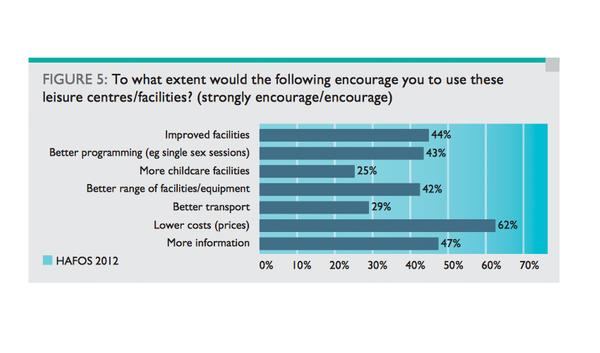
Figure 5
Figure 5

For further information

Mike Hill is managing director of customer insight specialist Leisure-net Solutions, which conducts the annual HAFOS survey. To find out more, to purchase a full report or to find out about other research undertaken by Leisure-net, contact [email protected] or call +44 (0)1603 814233
Sign up here to get HCM's weekly ezine and every issue of HCM magazine free on digital.
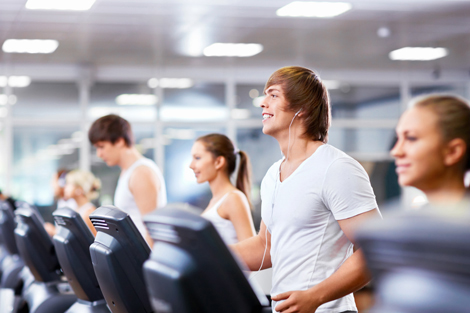
Most understand the benefits of exercise, but many remain inactive
The survey found that 55 per cent of female respondents wanted to be more active, compared to only 47 per cent of males / © all photos on pages: shutterstock.com
Olympic Legacy: 30 per cent of those inspired to be more active went to the gym
https://www.leisureopportunities.co.uk/images/HCM2013_3research.gif
Did the Olympics have any impact on participation levels among the general public? Mike Hill reports on the latest HAFOS findings
Leisure-net Solutions,HAFOS, research, participation,Consumer
HCM magazine
Raphael Cuomo explores the powerful link between addiction, health and behaviour change
HCM magazine
Collaborations with the medical profession and greater aspirations around wellbeing are creating a need for more experts in our sector. It’s time to reboot our thinking around the workforce
HCM magazine
If the health service is to survive, we must recognise that it is a disease service – and that wellbeing rests with us, says the activity advocate and healthy ageing champion. He talks to Kate Cracknell
HCM magazine
As the entrepreneur who started Wexer, Fresh Fitness, Fitness DK and Repeat, as well as being a former elite athlete, Rasmus Ingerslev’s life looked perfect from the outside, but onthe inside it was a different story. He talks to Kath Hudson about healing old wounds
HCM magazine
HCM People

Stephen Price

Founder, SP&Co Group
Working in public health over the last few years has lit up parts of my brain again
HCM promotional features
Sponsored
Greg Bradley looks at the shift towards strength training in gyms and advises on how operators can create the ultimate training environment
HCM promotional features
Sponsored
David Lloyd is stepping up its commitment to women’s health as it continues to explore what fit-for-purpose looks like for the female population
HCM promotional features
Sponsored
SnowDome Fitness has added 50 per cent more space with cutting-edge Technogym solutions
HCM promotional features
Sponsored
Starpool supports Olympic champion Marcell Jacobs, says Riccardo Turri
HCM promotional features
Sponsored
Find out how your gym can tap into the corporate wellness boom
HCM promotional features
Sponsored
Third Space partnered with IndigoFitness to deliver a bespoke training space for its new club at The Whiteley
HCM promotional features
Sponsored
EGYM has opened a new HQ in Paternoster Square, London and revealed a range of new launches
HCM promotional features
Sponsored
Active IQ is calling for greater accountability in online fitness advice with the launch of a new trustmark
HCM promotional features
Promotion
BLK BOX has been reimagining elite performance spaces for more than a decade. Founder and former athlete, Greg Bradley, tells us what it takes
HCM promotional features
Latest News
People taking GLP-1 weight loss medications such as Ozempic, Wegovy, Mounjaro and Zepbound may be ...
Latest News
Low-cost gym operator, PureGym, is trialling recovery zones at two of its UK sites, democratising ...
Latest News
In a milestone moment, mental health has become a core part of CIMSPA’s occupational professional ...
Latest News
US high-value, low-price chain, Eos Fitness, has announced plans to pilot reformer Pilates in three ...
Latest News
Preventive healthcare company Neko Health has added body composition analysis to its full-body health scan ...
Latest News
Chequan Lewis is the new CEO of Crunch Fitness, taking over from Jim Rowley, who ...
Latest News
Sea Lanes Canary Wharf has officially opened. The 50-metre, six-lane pool, which uses the natural ...
Latest News
London-based high-performance fitness club, ONE LDN, is raising funds for a multi-site expansion across London, ...
Opinion
promotion
Strength training has moved from the margins to the mainstream.
Opinion: Building smarter strength spaces for today’s operators
Featured supplier news
Featured supplier news: Reaching the people most gyms miss: Bedford Gym & Swim Campaign delivers 410 new members
One of the biggest mistakes the fitness industry still makes is advertising almost exclusively to people who already look and live like gym members.
Featured supplier news
Featured supplier news: Cornerstone Connect helps Active Blackpool tackle health inequalities
Active Blackpool is deploying Cornerstone Connect, a new digital interface allowing disparate information from multiple systems to be aggregated into one dataset, to support its focus on reducing health inequalities and improving healthy life expectancy.
Company profiles
Company profile: Connect
Connect is a UK-based technology company redefining how the fitness and wellness industry builds digital ...
Company profiles
Company profile: WellnessSpace Brands
WellnessSpace Brands provides innovative wellness solutions like HydroMassage, CryoLounge+, and RelaxSpace Pods— designed for convenient, ...
Supplier Showcases
Supplier Showcase - Future-proofing
Catalogue Gallery
Click on a catalogue to view it online
Featured press releases
Swim England press release: Swim England launches new Learn to Swim Growth Plan to support aquatic programme expansion
Swim England has strengthened its sector-leading Business Solutions offer with the launch of its Learn to Swim Growth Plan, designed to help aquatic providers unlock sustainable programme growth.
Featured press releases
CoverMe Ltd press release: CoverMe and Jobs In. Fitness partner to create end-to-end talent solution
CoverMe, the UK’s leading fitness workforce management and recruitment platform, has partnered with Jobs In. Fitness, the specialist executive search and advisory firm for the fitness and wellbeing sector, to give operators a single route to talent at every level – from frontline staffing to C-suite.
Directory
Lockers
Crown Sports Lockers: Lockers
Fitness tracking platform
SpiviTech: Fitness tracking platform
Hot tubs
MSpa International Ltd: Hot tubs
Spa and beauty equipment
Oakworks Inc: Spa and beauty equipment
Water experiences and hydrotherapy solutions
Aquaform s.r.l.: Water experiences and hydrotherapy solutions
Industrial washing machines
Miele Company Limited: Industrial washing machines
Property & Tenders
Stratford, East London.
Lee Valley Regional Park Authority
Property & Tenders
Y Felinheli, LL56 4QN
Newmark
Property & Tenders
Diary dates
21-24 Sep 2026
The Langham Huntington Pasadena , Pasadena, United States
Diary dates
06-08 Oct 2026
Messe Stuttgart, Stuttgart, Germany
Diary dates
22-22 Oct 2026
QEII Conference Centre, London,
Diary dates
26-29 Oct 2027
Koelnmesse Exhibition Centre, Cologne, Germany
Diary dates

features

Consumer research: Polarising nation

What are customers’ current attitudes towards health and fitness, and what are the implications for our industry? Mike Hill reports on the findings from this year’s Health and Fitness Omnibus Survey

By Mike Hill, Leisure-net Solutions | Published in Health Club Management 2013 issue 3

The national Health and Fitness Omnibus Survey (HAFOS) – the annual barometer of UK consumers’ attitudes towards health, fitness and physical activity – is now in its 10th year. A street-based consumer survey, HAFOS uses a national sample of over 1,200 people, interviewed in five locations throughout England. To date, HAFOS has interviewed well over 15,000 people, making it the largest and longest running annual survey of its kind.

This year’s HAFOS provided some interesting information regarding participation in the aftermath of the London Olympics, as well as insight into consumers’ ongoing reluctance to exercise in spite of understanding the value of physical activity for good health.

Exercise is healthy? That’s a given
After a decade of campaigns at every level, it seems consumers are getting the message about being active. In the 2012 HAFOS report, more than 90 per cent of the population now recognise that regular exercise/activity is important to their health, with only a marginal two per cent saying it’s unimportant. In terms of perceptions of how much activity you need to do and what type, more are starting to recognise the key message that regular amounts of moderate physical activity, even for short periods, can be beneficial to health (see Figure 1).

People are also saying they want to do more exercise: 51 per cent of HAFOS respondents said they either definitely or probably do not exercise as much as they’d like. Only 19 per cent said they definitely do as much as they want, with 20 per cent saying they probably do.

Overall, the percentage of the population claiming they’d like to be more active has remained relatively static over the last 10 years, with 52 per cent of people overall stating yes, they would.

There are, however, interesting differences to be noted between males and females, with more than half (55 per cent) of women saying they would like to be more active, compared to only 47 per cent of males. Even more dramatic is the noticeable decline in those wanting to be more active among the older age groups, with only 22 per cent of those aged 75 and over wishing to do so (see Figure 2).

Don’t abandon old messages
Among HAFOS respondents, the main motivation for being active is – or would be – general improvement or maintenance of health, at 51 per cent. However, the two reasons quoted that relate to weight/body shape follow closely behind, both at 18 per cent (see Figure 3). The sector must not ignore the fact that weight loss/maintenance remains a key motivating factor.

Indeed, other research by Leisure-net suggests that weight loss/maintenance is in fact the main motivation for many existing gym users – this in spite of the fact that people tend to be reticent about admitting they’re concerned more with how they look than how they feel. The importance of the weight loss message is certainly not something the sector should be underestimating, either in its marketing or its retention strategies.

Excuses, excuses…
But however highly people now claim to rate regular exercise/activity in principle, HAFOS revealed that reasons for not converting that into action remain a challenge. A perceived lack of time due to work is still the number one barrier preventing people from being more active. This is followed by cost: although only 13 per cent of respondents named high costs as a barrier, when asked what would encourage them to use leisure centres/health clubs, lower prices were quoted by the most people, at 62 per cent (see Figures 4 & 5).

Other factors that people said would encourage them to use leisure facilities included improved equipment and facilities (42 per cent), better programming (43 per cent), and access to more information (47 per cent). A quarter of respondents said they would like better childcare provision. While some of these elements would require investment in facilities – perhaps difficult in the current economic climate – areas such as programming and information could easily be addressed by a more customer-centric approach: providing information through channels that people can readily access, for example, and making programming/activities more convenient for people to fit into their busy everyday lives.

The London 2012 legacy
Continuing on the participation theme, HAFOS also asked about the London 2012 Olympic Games. An overwhelming 76 per cent of respondents said they thought the event had encouraged people to be more active, with only 15 per cent disagreeing with this statement. However, overall only 22 per cent of respondents said the Games had encouraged them personally to be more active, while only eight per cent of inactive people said that the 2012 Games had encouraged them to get moving.

Among respondents who had been encouraged to be more active, most had taken to running/walking (49 per cent), followed by using a gym/health club (30 per cent). Only nine per cent said they had taken up formal sport. Opportunities to get back into traditional sports after school/university are generally not as readily available as other activities. In addition, while there have been attempts by sports such as hockey and netball in particular to bring adults back into sport, more could be done to make sport attractive and an enjoyable social opportunity for people of all age groups.

Of those who were encouraged by the Olympics to be more active, seven per cent had done no moderate activity in the previous three months. Ten per cent had previously achieved only 1 x 30 minutes of moderate activity a week, and 19 per cent previously did 2 x 30. In total, therefore, 36 per cent of those who were inspired by the Games to be more active had previously not been meeting the recommended minimum levels of weekly physical activity. Nevertheless, the group that saw the biggest uplift was those already achieving 3 x 30 – 24 per cent of those who had been inspired by the Games fell into this category.

Overall, then, the message seems to be that people saw the Games as having a positive impact on everyone else, but not necessarily on themselves. The event also seemed to have more of an impact on those already active and open to doing more, rather than on sedentary people.

Population polarisation
This latest HAFOS shows a degree of improvement compared to previous years, perhaps in part due to the positive impact of London 2012. However, there is a real concern that these changes in activity may not be permanent, and also that the divide between the active and the inactive is becoming ever greater.

Those who are interested in their health – who are participating in an increasingly wide range of activities, as well as getting more active, more often – are distancing themselves more and more from the sedentary population who still struggle to find the motivation and time to do anything but basic physical activity.

Figure 1: Do you agree with the following statements: Strongly agree only

Figure 1
Figure 1

Figure 2: Would you like to do more physical activity/exercise? 52% Yes

Figure 2
Figure 2

Figure 3: Why would you like to undertake more activity/exercise? (Choose one main reason)

Figure 3
Figure 3

Figure 4: What’s stopping you from doing more?

Figure 4
Figure 4

Figure 5: To what extent would the following encourage you to use these leisure centres/facilities? (strongly encourage/encourage)

Figure 5
Figure 5

For further information

Mike Hill is managing director of customer insight specialist Leisure-net Solutions, which conducts the annual HAFOS survey. To find out more, to purchase a full report or to find out about other research undertaken by Leisure-net, contact [email protected] or call +44 (0)1603 814233

Sign up here to get HCM's weekly ezine and every issue of HCM magazine free on digital.
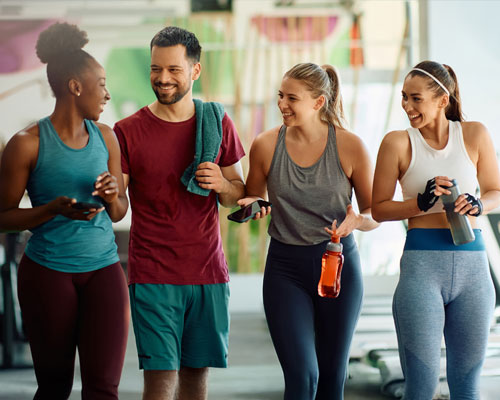
Most understand the benefits of exercise, but many remain inactive
The survey found that 55 per cent of female respondents wanted to be more active, compared to only 47 per cent of males / © all photos on pages: shutterstock.com
Olympic Legacy: 30 per cent of those inspired to be more active went to the gym
https://www.leisureopportunities.co.uk/images/HCM2013_3research.gif
Did the Olympics have any impact on participation levels among the general public? Mike Hill reports on the latest HAFOS findings
Leisure-net Solutions,HAFOS, research, participation,Consumer
Latest News
People taking GLP-1 weight loss medications such as Ozempic, Wegovy, Mounjaro and Zepbound may be ...
Latest News
Low-cost gym operator, PureGym, is trialling recovery zones at two of its UK sites, democratising ...
Latest News
In a milestone moment, mental health has become a core part of CIMSPA’s occupational professional ...
Latest News
US high-value, low-price chain, Eos Fitness, has announced plans to pilot reformer Pilates in three ...
Latest News
Preventive healthcare company Neko Health has added body composition analysis to its full-body health scan ...
Latest News
Chequan Lewis is the new CEO of Crunch Fitness, taking over from Jim Rowley, who ...
Latest News
Sea Lanes Canary Wharf has officially opened. The 50-metre, six-lane pool, which uses the natural ...
Latest News
London-based high-performance fitness club, ONE LDN, is raising funds for a multi-site expansion across London, ...
Latest News
A new brain clinic has opened in London, which uses non-invasive brain stimulation to treat ...
Latest News
Good Boost’s digital exercise programmes are helping adults with MSK at a lower cost than ...
Latest News
With Prime Minister, Keir Starmer, announcing his resignation this morning and Andy Burnham as a ...
Opinion
promotion
Strength training has moved from the margins to the mainstream.
Opinion: Building smarter strength spaces for today’s operators
Featured supplier news
Featured supplier news: Reaching the people most gyms miss: Bedford Gym & Swim Campaign delivers 410 new members
One of the biggest mistakes the fitness industry still makes is advertising almost exclusively to people who already look and live like gym members.
Featured supplier news
Featured supplier news: Cornerstone Connect helps Active Blackpool tackle health inequalities
Active Blackpool is deploying Cornerstone Connect, a new digital interface allowing disparate information from multiple systems to be aggregated into one dataset, to support its focus on reducing health inequalities and improving healthy life expectancy.
Company profiles
Company profile: Connect
Connect is a UK-based technology company redefining how the fitness and wellness industry builds digital ...
Company profiles
Company profile: WellnessSpace Brands
WellnessSpace Brands provides innovative wellness solutions like HydroMassage, CryoLounge+, and RelaxSpace Pods— designed for convenient, ...
Supplier Showcases
Supplier Showcase - Future-proofing
Catalogue Gallery
Click on a catalogue to view it online
Featured press releases
Swim England press release: Swim England launches new Learn to Swim Growth Plan to support aquatic programme expansion
Swim England has strengthened its sector-leading Business Solutions offer with the launch of its Learn to Swim Growth Plan, designed to help aquatic providers unlock sustainable programme growth.
Featured press releases
CoverMe Ltd press release: CoverMe and Jobs In. Fitness partner to create end-to-end talent solution
CoverMe, the UK’s leading fitness workforce management and recruitment platform, has partnered with Jobs In. Fitness, the specialist executive search and advisory firm for the fitness and wellbeing sector, to give operators a single route to talent at every level – from frontline staffing to C-suite.
Directory
Lockers
Crown Sports Lockers: Lockers
Fitness tracking platform
SpiviTech: Fitness tracking platform
Hot tubs
MSpa International Ltd: Hot tubs
Spa and beauty equipment
Oakworks Inc: Spa and beauty equipment
Water experiences and hydrotherapy solutions
Aquaform s.r.l.: Water experiences and hydrotherapy solutions
Industrial washing machines
Miele Company Limited: Industrial washing machines
Property & Tenders
Stratford, East London.
Lee Valley Regional Park Authority
Property & Tenders
Y Felinheli, LL56 4QN
Newmark
Property & Tenders
Diary dates
21-24 Sep 2026
The Langham Huntington Pasadena , Pasadena, United States
Diary dates
06-08 Oct 2026
Messe Stuttgart, Stuttgart, Germany
Diary dates
22-22 Oct 2026
QEII Conference Centre, London,
Diary dates
26-29 Oct 2027
Koelnmesse Exhibition Centre, Cologne, Germany
Diary dates
Search news, features & products:
Find a supplier:
Partner sites