



















The Leisure Media Company Ltd
Follow Health Club Management on Twitter Like Health Club Management on Facebook Join the discussion with Health Club Management on LinkedIn
FITNESS, HEALTH, WELLNESS

features

Tech: Digital Futures: progress report

Consumer expectations are rising all the time, but nowhere more than in relation to digital. UK Active’s Dave Gerrish explains how the industry is shaping up

Published in Health Club Management 2024 issue 1
Consumers expect frictionless digital experiences / photo: Shutterstock / GaudiLab
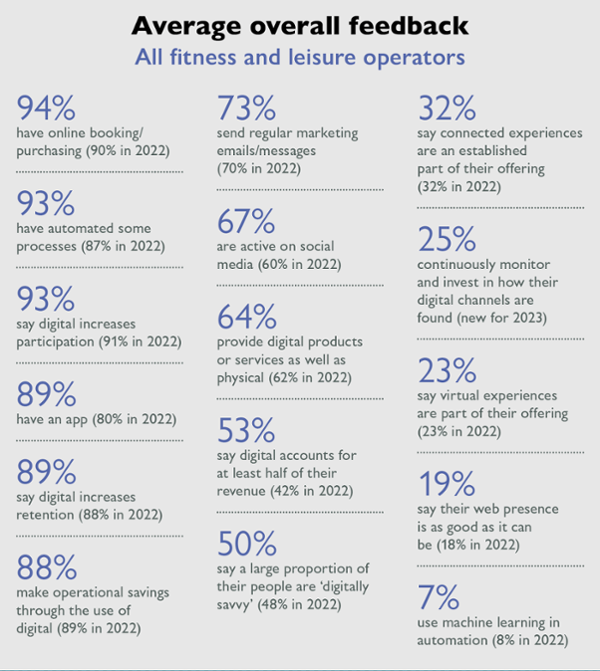
64% of operators have a digital strategy, but only 20% have a digital strategy that’s ‘up to date, complete, ambitious and supported by a roadmap’

Organisations across the UK health and fitness and leisure sectors are at different levels of maturity when it comes to digital transformation and although they’re making strides, improvements can still be made to enable them to reach a wider audience and reduce inequalities by enabling better access.

UK Active has worked with Sport England, the British Chamber of Commerce and a raft of other partners to publish the results of its most recent consultation on digital in its report Digital Futures 2023: The third annual review of the digital maturity and effectiveness of the UK’s fitness, leisure and sports sector. This report provides the fullest picture yet of the sector’s digital status.

About the study
The Digital Futures research programme began in 2021 and participation has doubled each year since, with this year’s sample representing 2,200 sites across the UK serving an estimated 5.5 million customers a year – up from 1,800 last year.

The 2023 consultation was completed by 204 fitness, leisure and sports organisations and saw a 14 per cent increase in the number of private operators taking part, when compared to 2022. Partners included National Governing Bodies for sports and the Active Partnership Network in the UK.

Of the 136 UK operators who took part, 62 per cent were public sector, 26 per cent private and 12 per cent universities. Within the public sector tranche, 55 per cent were trusts and 45 per cent local authorities.

The sample was composed of 76 per cent English, 6 per cent Scottish, 5 per cent Welsh and 1 per cent Northern Irish respondents, while 12 per cent were nationwide operators. 51 per cent had 1-5 sites, 16 per cent had 6-10 sites, 14 per cent had 11-50 sites, 5 per cent had 51+ sites and 13 per cent were NGBs and Active Partnerships.

This year also saw global territories used as a benchmark following a recommendation by PureGym – a member of the Digital Futures Advisory Group – working with AUSactive, EuropeActive, Sport:80 and the GameDay app.

Digital Futures 2023 provides a measure of how well organisations are embracing digital, and highlights the main areas for improvement to digital strategies. It also draws on data from UK Active’s consumer insights work to provide context behind consumers’ preferences that could have an impact on an operator’s digital journey.

The scoring system
A digital maturity and effectiveness score was established based on multiple choice responses from an online survey.

Questions asked in 2023 were identical to those asked in 2022, with the addition of two about emerging technologies and environmental impact.

Organisations were asked 40 questions to establish how they engage with digital. These covered five areas – organisational model, performance and impact, data and insights, digital experience and accessibility, inclusion and satisfaction.

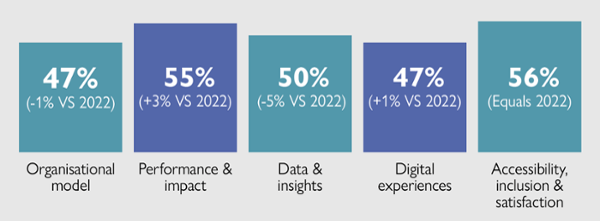
The overall scores (health and fitness operators plus other participants) in these five areas in 2023 showed small changes on the previous year, with scores down 1 per cent in the area of organisational model and digital strategy, up 3 per cent on performance and impact, down 5 per cent on data and insights, up 1 per cent for digital experiences and the same year-on-year for accessibility, inclusion and satisfaction (see table 1).

The 5 per cent decline in the score for ‘data and insights’ suggests that with the constant influx of new technologies such as AI, and the increasing volume of data organisations are collecting, some feel they’re falling behind, even if they’ve been progressing in other areas of digital.

Digital Futures categories
The most established category of operators – called the Digital Futures Cohort – is made up of organisations that have taken part in the consultation for two or three years (58 of the organisations that took part in 2021 also participated in 2022, while 28 have completed all three years. See Table 2).

Members of this group continuously outperform the rest of the overall sample. For example, they scored 65 per cent for ‘performance and impact’, which is 10 per cent above the sector as a whole.

Furthermore, 64 per cent say digital accounts for at least half their revenue (compared to 47 per cent of the sector overall) and 97 per cent say they make operational savings through the use of digital (compared to 84 per cent of the sector overall).

Those participating in both 2022 and 2023 increased their score by 4 per cent on average.

Banding operators by performance
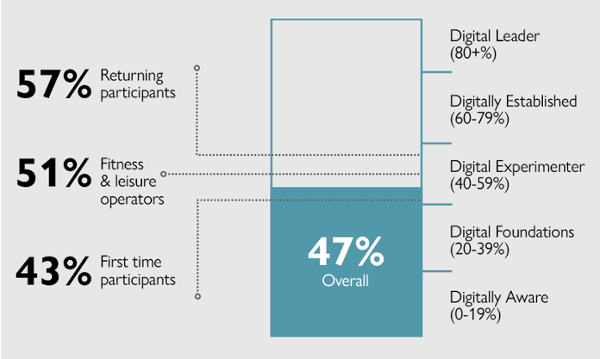
The two- and three-year participants in the Digital Futures Cohort are categorised as either Digital Leaders (if they score 80+) or Digitally Established (if they score 60-79) and together they achieved a digital maturity score of 57 per cent this year (against 53 per cent in 2022).

Five operators reached Digital Leader status – the pinnacle of the digital maturity and effectiveness index – by scoring 80 per cent or more. This compares with three in 2022 and just one in 2021. The highest score was 87.

Being a Digital Leader typically means tech is already driving business performance and setting the benchmark for peers and other companies in the market to follow. However, becoming a Digital Leader isn’t within the scope of all organisations.

One national operator who took part in the survey actually acknowledged it would never reach Digital Leader status, as the complexities of its service offering were preventing it from gaining a higher score. Nevertheless, it still gained from the process, as the programme highlighted that it needed to work on its data strategy.

The index describes those scoring 60-79 per cent as Digitally Established, meaning they’re harnessing digital more than most peers, but have opportunities for greater automation and innovation.

In the next band down, those scoring 40-59 per cent are called ‘Digital Experimenters’, typically meaning they’re making great strides forward, but missing the investment, goal-alignment and rapid advances to yield a really strong performance. Organisations in this bracket scored an average of 51 per cent.

First timers sit in the Digital Foundations (20-39) and Digitally Aware (0-19) categories, scoring 43 per cent on average and when comparing their score with those who’ve participated in all three years, it’s clear this drives progress. The lowest score was 29.

Scores by type and location
Private operators scored highest on average, with 65 per cent attaining the Digitally Established level, trusts scoring 56 per cent, local authorities 54 per cent and universities 53 per cent.

Private operators also scored higher than public operators and universities for most digital categories, but universities scored highest for Data and Insights and matched private operators for Performance and Impact.

As with previous years, organisations with more physical sites scored higher too. Those with 51+ sites scored 64 per cent, 11-50 sites 52 per cent, 6-10 sites 49 per cent and 1-5 sites 45 per cent.

The overall results
The average score for the entire sample this year was 47 per cent across all areas of assessment and each of the organisations that took part also received scores in the individual categories.

This score was four percentage points lower than the previous year, but this doesn’t necessarily mean a drop in digital maturity for the sector as a whole. There have been new participants from inside and outside fitness and leisure and a slightly higher participation from smaller organisations, which tend to score lower.

In addition, the greater the knowledge of digital, the more accurate (and sometimes lower) the score.

The scores for the whole sample for the question ‘Do you have a digital strategy?’ was up 36 per cent on 2022 to 64 per cent, suggesting there’s a more concerted effort to build a digital focus into overarching strategies, although only 20 per cent said they have a digital strategy that’s “up to date, complete, ambitious and supported by a road map.”

This number rose to 43 per cent in the higher-level Digital Futures cohort.

When asked, ‘How does digital influence participation or engagement growth?’ scores were also up by 32 per cent on last year, indicating that investing and using digital processes is having a tangible impact when it comes to reaching and engaging with more members.

However, when asked, ‘What do you do with data you collect from audiences?’ The average score was down by 9 per cent (5 per cent among health and fitness operators), suggesting, as mentioned, that more needs to be done to support operators in using data effectively and the conclusions of the research also highlighted this as a major development area.

Old software
Old systems are still failing some in the sector, with 90 per cent of operators saying at least some of the systems they have hold them back (compared to 84 per cent in 2022).

Legacy systems that don’t integrate seamlessly present a cost and logistical challenge, particularly when multiple systems are required to provide the best experiences and operators are still finding leisure management systems challenging to work with.

There’s a cost and resource impact in changing systems but those who are upgrading to cloud-based versions can better meet consumer needs.

2023 saw the launch of a Digital Futures microsite, which enables software suppliers to support customers in embracing digital transformation, while also allowing operators to see year-on-year views of results with recommendations and resources.

The recommendations
Looking back at the development of the Digital Futures initiative, we see that in 2021, collaboration and simplification were the two key areas of focus – collaboration was about organisations working more closely together with each other, with platform providers and with other third-party providers, such as local authorities, NGBs and Active Partnerships.

Simplification was about reducing complexities, such as the volume of different membership types and products, disparities across different local authorities and multiple versions of platforms.

In 2022, the focus turned to digital maturity and effectiveness, through the introduction of recommendations to deliver organisational excellence and exceptional customer experience.

Three themes emerge in 2023 – data use, inclusion and personalisation.

It’s clear large parts of the sector need more support – even those with higher levels of digital maturity – in the area of data use, where scores have gone down and there’s a significant opportunity to improve inclusivity in ways that would benefit consumers and operators.

Operators need to do more to deliver on inclusion and accessibility to ensure digital transformation doesn’t exclude segments of the population and there’s a need for shared case studies to demonstrate how this can benefit everyone – particularly through the application of personalisation, which can have such a powerful impact on outcomes and engagement.

These themes can only be integrated into an operator’s overall strategy if they’re clearly identified, supported and resourced, but there are huge wins to be had for the sector if this can be implemented, including delivering a competitive advantage, enhancing customer engagement, driving efficiency, fostering agility and promoting data-driven decision-making.

Further reading and insight
Digital Futures 2023 offers tips and guidance to help operators and suppliers establish tailored solutions to ensure the advantages of digital can be felt across all organisations. You can download it at www.hcmmag.com/DF23.

Dave Gerrish is strategic lead – digital at UK Active [email protected]

Digital futures Headline themes

2021 Collaboration and simplification

2022 Digital maturity and effectiveness

2023 Data use, inclusion and personalisation

Steps to improving your organisational model

1. Develop a robust digital strategy

2. Ensure digital is baked into processes organisation-wide

3. Work to improve digital literacy throughout the organisation

4. Invest in systems improvements

5. Implement customer research ahead of development

Who’s backing Digital Futures?
Advisory

• EGym

• Gladstone

• Les Mills

• Myzone

• Technogym

• Xplor

Operators

• Anytime Fitness

• David Lloyd Leisure

• Everyone Actice

• Parkwood

• PureGym

Suppliers

• Endurance Zone

• Keepme

• Leisure Labs

• Perfect Gym

• Xn

• Zoom Media

photo: UK ACTIVE

The UK Active report has been endorsed and supported by the British Chamber of Commerce.

Check your digital score here: digitalfutures.ukactive.com/preview


67% of operators use social media, creating channels for members to use / photo: Shutterstock / RZ Images
/ photo: Shutterstock / PH888
50% of operators say their people are ‘digitally savvy’ / photo: Shutterstock / Chay_Tee
Table 1: All Digital Futures participants – highest scoring digital areas / SOURCE: Digital Futures 2023
Table 2: Whole Digital Futures sample, scores by category / SOURCE: Digital Futures 2023
/ SOURCE: Digital Futures 2023
https://www.leisureopportunities.co.uk/images/2024/465547_720589.jpg
New research into the digitisation of the health club sector has found both examples of best practice and room for improvement, as Dave Gerrish explains
HCM magazine
HCM People

Jamie Clements

The Breath Coach
I experienced a blissful feeling of joy I hadn’t felt since I was a kid
HCM magazine
Collaborations with the medical profession and greater aspirations around wellbeing are creating a need for more experts in our sector. It’s time to reboot our thinking around the workforce
HCM magazine
For every member with a tripod and a big following, there are others irritated at the way equipment is being hogged or wary they’ll be in the background on someone’s Insta feed. Do influencers offer valuable, free marketing or are they just a nuisance? Kath Hudson finds out how operators are responding
HCM magazine
Raphael Cuomo explores the powerful link between addiction, health and behaviour change
HCM magazine
Strength training is evolving, driven by changing consumer preferences. Julie Cramer talks to innovators about how their products are meeting this demand
HCM promotional features
Sponsored
Greg Bradley looks at the shift towards strength training in gyms and advises on how operators can create the ultimate training environment
HCM promotional features
Sponsored
SnowDome Fitness has added 50 per cent more space with cutting-edge Technogym solutions
HCM promotional features
Sponsored
Find out how your gym can tap into the corporate wellness boom
HCM promotional features
Sponsored
David Lloyd is stepping up its commitment to women’s health as it continues to explore what fit-for-purpose looks like for the female population
HCM promotional features
Sponsored
Starpool supports Olympic champion Marcell Jacobs, says Riccardo Turri
HCM promotional features
Sponsored
Third Space partnered with IndigoFitness to deliver a bespoke training space for its new club at The Whiteley
HCM promotional features
Sponsored
EGYM has opened a new HQ in Paternoster Square, London and revealed a range of new launches
HCM promotional features
Sponsored
Pulse Fitness has created a new health club delivering an elevated wellness experience
HCM promotional features
Promotion
Performance Health Systems, manufacturer of Power Plate, has a new CEO, with an ambitious vision for the company
HCM promotional features
Latest News
Independent operator, Fitness Worx Gyms, is introducing private blood testing as a service to members. ...
Latest News
International industry lobbying associations are calling for physical activity and strength training to be deeply ...
Latest News
Global group exercise specialist, Les Mills, is inviting operators to sign up to its Workout ...
Latest News
Global luxury hospitality brand, Six Senses, has partnered with longevity healthcare provider, HUM2N, to launch ...
Latest News
Premium London health club, KX Chelsea, is gearing up to unveil its most significant redevelopment ...
Latest News
Researchers in the US have identified an antibody which could greatly reduce the loss of ...
Latest News
Peloton has made the strategic acquisition of Pilates start-up, Skōp, to support the expansion of ...
Latest News
Crunch Fitness has announced the launch of Crunch Reform Pilates – its own reformer concept ...
Opinion
promotion
Strength training has moved from the margins to the mainstream.
Opinion: Building smarter strength spaces for today’s operators
Featured supplier news
Featured supplier news: Reaching the people most gyms miss: Bedford Gym & Swim Campaign delivers 410 new members
One of the biggest mistakes the fitness industry still makes is advertising almost exclusively to people who already look and live like gym members.
Featured supplier news
Featured supplier news: CoverMe extends matching service to personal training, rewriting how members and personal trainers connect
CoverMe, the global leader in fitness workforce management, today launches CoverMe PT, an on-demand personal training platform that connects the right personal trainer to the right client in under 10 seconds.
Company profiles
Company profile: Sporty Group AS
With more than 90 fitness centres across the country and more than 130.000 members, Sporty ...
Company profiles
Company profile: JK Group UK and Ireland Plc
JK Group's products are designed and manufactured at our global headquarters in Germany, with a ...
Supplier Showcases
Supplier Showcase - From nightclub to health club
Supplier Showcases
Supplier Showcase - Future-proofing
Catalogue Gallery
Click on a catalogue to view it online
Featured press releases
Alliance Leisure Services (Design, Build and Fund) press release: Trowbridge pupils create lasting legacy at time capsule event
Pupils from schools across Trowbridge have come together to bury a time capsule at the site of the town’s new leisure centre, capturing a snapshot of life in 2026 for future generations.
Featured press releases
BLK BOX press release: Inside the build: Aberdeen Sports Village
When Aberdeen Sports Village set out to upgrade its gym offering, the goal was to create a more motivating, versatile and high-performing training environment for its diverse member base.
Directory
Hot tubs
MSpa International Ltd: Hot tubs
Spa and beauty equipment
Oakworks Inc: Spa and beauty equipment
Industrial washing machines
Miele Company Limited: Industrial washing machines
Fitness tracking platform
SpiviTech: Fitness tracking platform
Lockers
Crown Sports Lockers: Lockers
Water experiences and hydrotherapy solutions
Aquaform s.r.l.: Water experiences and hydrotherapy solutions
Property & Tenders
Stratford, East London.
Lee Valley Regional Park Authority
Property & Tenders
Y Felinheli, LL56 4QN
Newmark
Property & Tenders
Diary dates
22-23 Jun 2026
WX Wakefield , Wakefield, United Kingdom
Diary dates
21-24 Sep 2026
The Langham Huntington Pasadena , Pasadena, United States
Diary dates
06-08 Oct 2026
Messe Stuttgart, Stuttgart, Germany
Diary dates
22-22 Oct 2026
QEII Conference Centre, London,
Diary dates
26-29 Oct 2027
Koelnmesse Exhibition Centre, Cologne, Germany
Diary dates

features

Tech: Digital Futures: progress report

Consumer expectations are rising all the time, but nowhere more than in relation to digital. UK Active’s Dave Gerrish explains how the industry is shaping up

Published in Health Club Management 2024 issue 1
Consumers expect frictionless digital experiences / photo: Shutterstock / GaudiLab
64% of operators have a digital strategy, but only 20% have a digital strategy that’s ‘up to date, complete, ambitious and supported by a roadmap’

Organisations across the UK health and fitness and leisure sectors are at different levels of maturity when it comes to digital transformation and although they’re making strides, improvements can still be made to enable them to reach a wider audience and reduce inequalities by enabling better access.

UK Active has worked with Sport England, the British Chamber of Commerce and a raft of other partners to publish the results of its most recent consultation on digital in its report Digital Futures 2023: The third annual review of the digital maturity and effectiveness of the UK’s fitness, leisure and sports sector. This report provides the fullest picture yet of the sector’s digital status.

About the study
The Digital Futures research programme began in 2021 and participation has doubled each year since, with this year’s sample representing 2,200 sites across the UK serving an estimated 5.5 million customers a year – up from 1,800 last year.

The 2023 consultation was completed by 204 fitness, leisure and sports organisations and saw a 14 per cent increase in the number of private operators taking part, when compared to 2022. Partners included National Governing Bodies for sports and the Active Partnership Network in the UK.

Of the 136 UK operators who took part, 62 per cent were public sector, 26 per cent private and 12 per cent universities. Within the public sector tranche, 55 per cent were trusts and 45 per cent local authorities.

The sample was composed of 76 per cent English, 6 per cent Scottish, 5 per cent Welsh and 1 per cent Northern Irish respondents, while 12 per cent were nationwide operators. 51 per cent had 1-5 sites, 16 per cent had 6-10 sites, 14 per cent had 11-50 sites, 5 per cent had 51+ sites and 13 per cent were NGBs and Active Partnerships.

This year also saw global territories used as a benchmark following a recommendation by PureGym – a member of the Digital Futures Advisory Group – working with AUSactive, EuropeActive, Sport:80 and the GameDay app.

Digital Futures 2023 provides a measure of how well organisations are embracing digital, and highlights the main areas for improvement to digital strategies. It also draws on data from UK Active’s consumer insights work to provide context behind consumers’ preferences that could have an impact on an operator’s digital journey.

The scoring system
A digital maturity and effectiveness score was established based on multiple choice responses from an online survey.

Questions asked in 2023 were identical to those asked in 2022, with the addition of two about emerging technologies and environmental impact.

Organisations were asked 40 questions to establish how they engage with digital. These covered five areas – organisational model, performance and impact, data and insights, digital experience and accessibility, inclusion and satisfaction.

The overall scores (health and fitness operators plus other participants) in these five areas in 2023 showed small changes on the previous year, with scores down 1 per cent in the area of organisational model and digital strategy, up 3 per cent on performance and impact, down 5 per cent on data and insights, up 1 per cent for digital experiences and the same year-on-year for accessibility, inclusion and satisfaction (see table 1).

The 5 per cent decline in the score for ‘data and insights’ suggests that with the constant influx of new technologies such as AI, and the increasing volume of data organisations are collecting, some feel they’re falling behind, even if they’ve been progressing in other areas of digital.

Digital Futures categories
The most established category of operators – called the Digital Futures Cohort – is made up of organisations that have taken part in the consultation for two or three years (58 of the organisations that took part in 2021 also participated in 2022, while 28 have completed all three years. See Table 2).

Members of this group continuously outperform the rest of the overall sample. For example, they scored 65 per cent for ‘performance and impact’, which is 10 per cent above the sector as a whole.

Furthermore, 64 per cent say digital accounts for at least half their revenue (compared to 47 per cent of the sector overall) and 97 per cent say they make operational savings through the use of digital (compared to 84 per cent of the sector overall).

Those participating in both 2022 and 2023 increased their score by 4 per cent on average.

Banding operators by performance
The two- and three-year participants in the Digital Futures Cohort are categorised as either Digital Leaders (if they score 80+) or Digitally Established (if they score 60-79) and together they achieved a digital maturity score of 57 per cent this year (against 53 per cent in 2022).

Five operators reached Digital Leader status – the pinnacle of the digital maturity and effectiveness index – by scoring 80 per cent or more. This compares with three in 2022 and just one in 2021. The highest score was 87.

Being a Digital Leader typically means tech is already driving business performance and setting the benchmark for peers and other companies in the market to follow. However, becoming a Digital Leader isn’t within the scope of all organisations.

One national operator who took part in the survey actually acknowledged it would never reach Digital Leader status, as the complexities of its service offering were preventing it from gaining a higher score. Nevertheless, it still gained from the process, as the programme highlighted that it needed to work on its data strategy.

The index describes those scoring 60-79 per cent as Digitally Established, meaning they’re harnessing digital more than most peers, but have opportunities for greater automation and innovation.

In the next band down, those scoring 40-59 per cent are called ‘Digital Experimenters’, typically meaning they’re making great strides forward, but missing the investment, goal-alignment and rapid advances to yield a really strong performance. Organisations in this bracket scored an average of 51 per cent.

First timers sit in the Digital Foundations (20-39) and Digitally Aware (0-19) categories, scoring 43 per cent on average and when comparing their score with those who’ve participated in all three years, it’s clear this drives progress. The lowest score was 29.

Scores by type and location
Private operators scored highest on average, with 65 per cent attaining the Digitally Established level, trusts scoring 56 per cent, local authorities 54 per cent and universities 53 per cent.

Private operators also scored higher than public operators and universities for most digital categories, but universities scored highest for Data and Insights and matched private operators for Performance and Impact.

As with previous years, organisations with more physical sites scored higher too. Those with 51+ sites scored 64 per cent, 11-50 sites 52 per cent, 6-10 sites 49 per cent and 1-5 sites 45 per cent.

The overall results
The average score for the entire sample this year was 47 per cent across all areas of assessment and each of the organisations that took part also received scores in the individual categories.

This score was four percentage points lower than the previous year, but this doesn’t necessarily mean a drop in digital maturity for the sector as a whole. There have been new participants from inside and outside fitness and leisure and a slightly higher participation from smaller organisations, which tend to score lower.

In addition, the greater the knowledge of digital, the more accurate (and sometimes lower) the score.

The scores for the whole sample for the question ‘Do you have a digital strategy?’ was up 36 per cent on 2022 to 64 per cent, suggesting there’s a more concerted effort to build a digital focus into overarching strategies, although only 20 per cent said they have a digital strategy that’s “up to date, complete, ambitious and supported by a road map.”

This number rose to 43 per cent in the higher-level Digital Futures cohort.

When asked, ‘How does digital influence participation or engagement growth?’ scores were also up by 32 per cent on last year, indicating that investing and using digital processes is having a tangible impact when it comes to reaching and engaging with more members.

However, when asked, ‘What do you do with data you collect from audiences?’ The average score was down by 9 per cent (5 per cent among health and fitness operators), suggesting, as mentioned, that more needs to be done to support operators in using data effectively and the conclusions of the research also highlighted this as a major development area.

Old software
Old systems are still failing some in the sector, with 90 per cent of operators saying at least some of the systems they have hold them back (compared to 84 per cent in 2022).

Legacy systems that don’t integrate seamlessly present a cost and logistical challenge, particularly when multiple systems are required to provide the best experiences and operators are still finding leisure management systems challenging to work with.

There’s a cost and resource impact in changing systems but those who are upgrading to cloud-based versions can better meet consumer needs.

2023 saw the launch of a Digital Futures microsite, which enables software suppliers to support customers in embracing digital transformation, while also allowing operators to see year-on-year views of results with recommendations and resources.

The recommendations
Looking back at the development of the Digital Futures initiative, we see that in 2021, collaboration and simplification were the two key areas of focus – collaboration was about organisations working more closely together with each other, with platform providers and with other third-party providers, such as local authorities, NGBs and Active Partnerships.

Simplification was about reducing complexities, such as the volume of different membership types and products, disparities across different local authorities and multiple versions of platforms.

In 2022, the focus turned to digital maturity and effectiveness, through the introduction of recommendations to deliver organisational excellence and exceptional customer experience.

Three themes emerge in 2023 – data use, inclusion and personalisation.

It’s clear large parts of the sector need more support – even those with higher levels of digital maturity – in the area of data use, where scores have gone down and there’s a significant opportunity to improve inclusivity in ways that would benefit consumers and operators.

Operators need to do more to deliver on inclusion and accessibility to ensure digital transformation doesn’t exclude segments of the population and there’s a need for shared case studies to demonstrate how this can benefit everyone – particularly through the application of personalisation, which can have such a powerful impact on outcomes and engagement.

These themes can only be integrated into an operator’s overall strategy if they’re clearly identified, supported and resourced, but there are huge wins to be had for the sector if this can be implemented, including delivering a competitive advantage, enhancing customer engagement, driving efficiency, fostering agility and promoting data-driven decision-making.

Further reading and insight
Digital Futures 2023 offers tips and guidance to help operators and suppliers establish tailored solutions to ensure the advantages of digital can be felt across all organisations. You can download it at www.hcmmag.com/DF23.

Dave Gerrish is strategic lead – digital at UK Active [email protected]

Digital futures Headline themes

2021 Collaboration and simplification

2022 Digital maturity and effectiveness

2023 Data use, inclusion and personalisation

Steps to improving your organisational model

1. Develop a robust digital strategy

2. Ensure digital is baked into processes organisation-wide

3. Work to improve digital literacy throughout the organisation

4. Invest in systems improvements

5. Implement customer research ahead of development

Who’s backing Digital Futures?
Advisory

• EGym

• Gladstone

• Les Mills

• Myzone

• Technogym

• Xplor

Operators

• Anytime Fitness

• David Lloyd Leisure

• Everyone Actice

• Parkwood

• PureGym

Suppliers

• Endurance Zone

• Keepme

• Leisure Labs

• Perfect Gym

• Xn

• Zoom Media

photo: UK ACTIVE

The UK Active report has been endorsed and supported by the British Chamber of Commerce.

Check your digital score here: digitalfutures.ukactive.com/preview

67% of operators use social media, creating channels for members to use / photo: Shutterstock / RZ Images
/ photo: Shutterstock / PH888
50% of operators say their people are ‘digitally savvy’ / photo: Shutterstock / Chay_Tee
Table 1: All Digital Futures participants – highest scoring digital areas / SOURCE: Digital Futures 2023
Table 2: Whole Digital Futures sample, scores by category / SOURCE: Digital Futures 2023
/ SOURCE: Digital Futures 2023
https://www.leisureopportunities.co.uk/images/2024/465547_720589.jpg
New research into the digitisation of the health club sector has found both examples of best practice and room for improvement, as Dave Gerrish explains
Latest News
Independent operator, Fitness Worx Gyms, is introducing private blood testing as a service to members. ...
Latest News
International industry lobbying associations are calling for physical activity and strength training to be deeply ...
Latest News
Global group exercise specialist, Les Mills, is inviting operators to sign up to its Workout ...
Latest News
Global luxury hospitality brand, Six Senses, has partnered with longevity healthcare provider, HUM2N, to launch ...
Latest News
Premium London health club, KX Chelsea, is gearing up to unveil its most significant redevelopment ...
Latest News
Researchers in the US have identified an antibody which could greatly reduce the loss of ...
Latest News
Peloton has made the strategic acquisition of Pilates start-up, Skōp, to support the expansion of ...
Latest News
Crunch Fitness has announced the launch of Crunch Reform Pilates – its own reformer concept ...
Latest News
The 20th State of the Industry Report from LeisureDB has revealed a resilient, expanding and ...
Latest News
Purpose Brands has announced its entry into the Italian market, having sold the franchise rights ...
Latest News
Fitness First UK is integrating red light therapy into its yoga and Pilates classes through ...
Opinion
promotion
Strength training has moved from the margins to the mainstream.
Opinion: Building smarter strength spaces for today’s operators
Featured supplier news
Featured supplier news: Reaching the people most gyms miss: Bedford Gym & Swim Campaign delivers 410 new members
One of the biggest mistakes the fitness industry still makes is advertising almost exclusively to people who already look and live like gym members.
Featured supplier news
Featured supplier news: CoverMe extends matching service to personal training, rewriting how members and personal trainers connect
CoverMe, the global leader in fitness workforce management, today launches CoverMe PT, an on-demand personal training platform that connects the right personal trainer to the right client in under 10 seconds.
Company profiles
Company profile: Sporty Group AS
With more than 90 fitness centres across the country and more than 130.000 members, Sporty ...
Company profiles
Company profile: JK Group UK and Ireland Plc
JK Group's products are designed and manufactured at our global headquarters in Germany, with a ...
Supplier Showcases
Supplier Showcase - From nightclub to health club
Supplier Showcases
Supplier Showcase - Future-proofing
Catalogue Gallery
Click on a catalogue to view it online

Featured press releases
Alliance Leisure Services (Design, Build and Fund) press release: Trowbridge pupils create lasting legacy at time capsule event
Pupils from schools across Trowbridge have come together to bury a time capsule at the site of the town’s new leisure centre, capturing a snapshot of life in 2026 for future generations.

Featured press releases
BLK BOX press release: Inside the build: Aberdeen Sports Village
When Aberdeen Sports Village set out to upgrade its gym offering, the goal was to create a more motivating, versatile and high-performing training environment for its diverse member base.
Directory
Hot tubs
MSpa International Ltd: Hot tubs
Spa and beauty equipment
Oakworks Inc: Spa and beauty equipment
Industrial washing machines
Miele Company Limited: Industrial washing machines
Fitness tracking platform
SpiviTech: Fitness tracking platform
Lockers
Crown Sports Lockers: Lockers
Water experiences and hydrotherapy solutions
Aquaform s.r.l.: Water experiences and hydrotherapy solutions
Property & Tenders
Stratford, East London.
Lee Valley Regional Park Authority
Property & Tenders
Y Felinheli, LL56 4QN
Newmark
Property & Tenders
Diary dates
22-23 Jun 2026
WX Wakefield , Wakefield, United Kingdom
Diary dates
21-24 Sep 2026
The Langham Huntington Pasadena , Pasadena, United States
Diary dates
06-08 Oct 2026
Messe Stuttgart, Stuttgart, Germany
Diary dates
22-22 Oct 2026
QEII Conference Centre, London,
Diary dates
26-29 Oct 2027
Koelnmesse Exhibition Centre, Cologne, Germany
Diary dates
Search news, features & products:
Find a supplier:
The Leisure Media Company Ltd
Partner sites