

























features
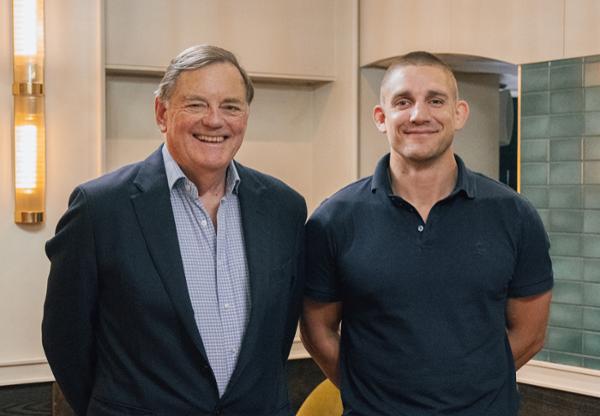
Profile: Peter Roberts & Max Cotton
VOR uses AI and automation to unlock human potential. Kate Cracknell speaks to the investor and the inventor


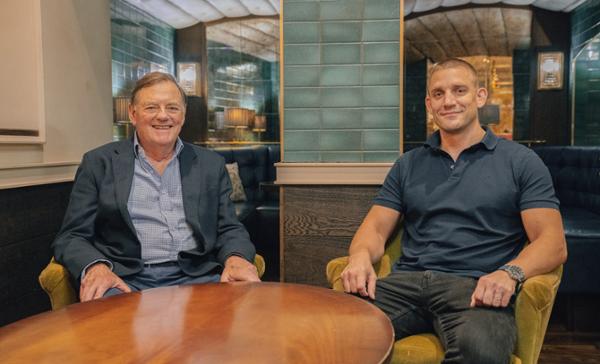
Peter, let’s start with your CV…
Peter Roberts: It all started in the 1990s, when I came on-board as non-executive director for John Treharne’s Dragons Health Clubs. I got a feel for what was happening in the sector – this was the early days of people realising they needed to exercise more – and I really enjoyed it.
I’d just sold my hotel business [Golden Tulip Hotels] and was looking for something to do when someone mentioned low-cost gyms. There was nothing like it in the UK at that point, but it was already happening in the US, Germany and Scandinavia.
The only thing that worried me was why nobody had done it in the UK – but then, the UK market was quite entrenched in its ways back then, with annual contracts and so on.
I became very enthused with the idea and in 2009 launched PureGym, the year after John Treharne launched The Gym Group. We tried four different types of location for PureGym – business, residential, retail and commuter route – to see which would work. To our surprise they all did. That was our first inkling that we were on to something pretty special. We had a very supportive board and shareholders and after year four went to opening 30–40 gyms a year.
When we first set out, we thought we’d be doing well if we reached 200 gyms. Obviously that’s been blown out of the water under Humphrey Cobbold’s tutelage, with the business exceeding all my expectations [PureGym now has around 600 locations).
I exited PureGym at the end of 2017 when we sold to US private equity firm, Leonard Green & Partners, but I’ve still been involved in the fitness sector via appointments and investments in a number of other businesses.
Tell us about those other businesses.
Peter Roberts: Some former senior PureGym colleagues and I founded Gymfinity Kids in 2018, offering gymnastics and ninja classes to young children. I remain chair of that business.
I’m also an investor and mentor for BLOK London, which is a very interesting business with a specialist niche of its own. It has done very well and is on the path to expansion. I’m director of Another Round/VOR, which I’ve been involved with since it was a start-up, advising on the issues around building a business.
I was previously on the board of sports apparel brand Castore. I’d done something in this sector before and it’s very hard, but Castore was started by two brothers with a real twinkle in their eye regarding what they wanted to do, so I brought a few investors together to raise the initial funding. It has grown phenomenally since then.
I became chair of Coordinate Sport recently, which provides much-needed software to help clubs and organisations manage coaching schemes, classes and clubs for children across a wide range of activities. It’s early days but looks promising.
I’m also doing quite a lot outside the fitness sector now, from flexible office spaces to music businesses – Audoo tracks real-time plays in public spaces to ensure smaller bands get the royalties they’re due – to working with Shalini Khemka CBE to support young entrepreneurs.
What drew you to invest in Another Round/VOR?
Peter Roberts: Ideas are important, but people are normally my top reason for going into a business: the passion, energy and commitment of the team. I also look for businesses that differentiate – that do something no-one else does, but that’s really needed.
With my PureGym background, I knew quite a lot about personal training and the potential for trainers to coach their clients better. It seemed to me that Another Round was going to break new ground in this respect, using AI to improve the offering for the exerciser and to make life a lot easier and more efficient for the personal trainers themselves.
It was a start-up when I came onboard and was B2C back then, offering trainer-led online coaching. Now it’s predominantly B2B and is now operating under the brand VOR, having pivoted.
It’s taken time to work through the technology, but we have some very good, very bright people and I believe we’re on the crest of a wave now.
Max, why did you create Another Round?
Max Cotton: This was never tech for tech’s sake. We had an organic problem.
As a personal trainer, you can spend a lot of time designing bespoke programmes around the specific needs of each client. As you get busier you might also start churning out very similar programmes for different clients with a few tweaks here and there. But you can still have a lot of quiet time. In fact, you can have quiet months where income is tight.
Another Round set out to address all of this, allowing PTs to scale up and service more clients without compromising the quality or the personalisation of the product.
Crucially, this was never about replacing human trainers with a faceless AI PT. Quite the opposite: by taking care of the programming, Another Round aims to enable the trainer to focus their time on the human touch, supporting clients and keeping them accountable.
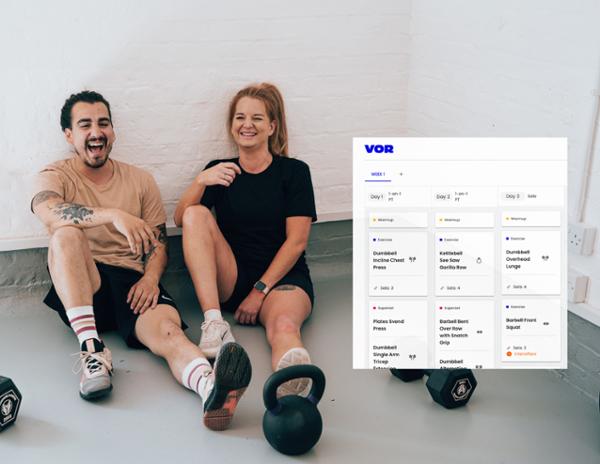
The app allows trainers to quickly create and send personalised programmes to their clients, with our proprietary AI ensuring workouts are safe and effective for each client. Suddenly, in addition to in-person sessions, one trainer can work with 50–100 people online. It can make PT affordable for people and provides the trainer with additional revenue. It also allows for the scaling of PT.
It started a year before the pandemic, which meant that going into lockdown, I had three businesses: I was a personal trainer, I ran a workplace wellness venture called PE for Grown-Ups and I had Another Round as a side hustle – the online coaching business.
When lockdown came, three went down to one: Another Round. Yet I had an advantage over other PTs in that I’d done it for a year and had a customer base. The business did well.
As we came out of the last lockdown, I realised this was what I wanted to do; I’d always enjoyed personal training, but I wanted to run a business. I began to scale Another Round in mid-2021, with Peter coming on board in 2022. The reviews on our website and on Trustpilot say it all: we created something that met a need and serviced it very successfully.
But your main focus is now VOR?
Max Cotton: Some gym chains had seen Peter’s involvement and reached out to discuss potential collaboration. My wife and co-founder suggested selling our technology to them. I wasn’t sure at first, but they led me to realise that all the issues we had set out to address – the challenges of delivering high-quality coaching at scale – were the same challenges health clubs face.
We asked the operators that had approached us if they’d be interested in a white label version of our technology and they said yes. Peter and some of my VC contacts also advised B2B as the strongest model in the prevailing climate. And so we pivoted from B2C to B2B, supported by our CTO Jesse Shanahan.
We had to work through a lot of updates to create a universal piece of kit; it had always been a platform designed around our needs as Another Round, which we would have built up over time. However, we secured funding to get us through to April 2024, we got the tech and the branding fully ready and we launched in June this year.
As a B2B platform, we now focus on supporting the enhanced delivery of in-person PT; as with Another Round, VOR isn’t there to replace trainers. We believe having a person there makes the experience better in every way.
What will happen to Another Round?
Max Cotton: Over the last few years, Another Round has given us a lot of feedback and knowledge and established us as experts in online coaching.
It also helped us raise funding, as many users became angel investors: we raised £40,000 in 24 hours and went on to raise almost a whole investment round through this network. These individuals are also still on-hand to offer their expertise as lawyers, financial experts, HR experts and so on.
Another Round isn’t going anywhere, but we’ll keep it quite small: a handful of trainers and capped at around 500 members.
How does VOR work?
Max Cotton: We recognised that building and hosting apps is not our strong suit – our strengths are AI, automation and fitness – so VOR isn’t an app. It’s an AI engine that we’ve designed to plug in to other technology, making gyms’ own ‘workout builders’ smarter.
In fact, ‘white label’ doesn’t really do our technology justice. This isn’t some large language model plug-in – we’ve built our AI from the ground up.
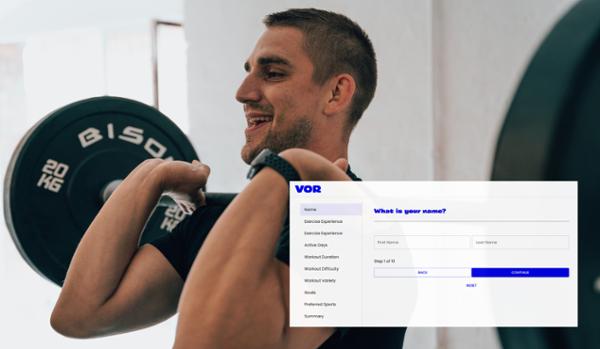
Every programme is based on a series of questions about the exerciser: their preferences, health conditions, injuries, goals and so on. Some of these questions are multiple choice, so people can pick more than one option and arrange them in order of importance.
Based on this information, VOR can generate millions of programme outputs. Clubs are also able to add their own questions.
Our engine is also customisable, able to adapt to gyms’ training styles, the ways they use certain pieces of equipment, their layouts and so on. It means programmes can replicate a club’s specific style.
It takes under a second for VOR to design a simple programme or a couple of seconds to create something more complex, with the option to design single workouts through to 16-week programmes.
Trainers have the option to edit programmes if they wish; if they do, VOR will track those changes to continue to improve its programming.
It’s great for new trainers who might otherwise spend hours trying to design overly complex programmes. It’s also great for busy PTs, reducing trainer bias – the tendency to always fall back on their favourite exercises – by using hundreds of different exercises. Put simply, it’s there to help trainers do their job better.
By taking care of the programming, VOR upskills PTs to coach whoever comes through the door, whether they have health conditions, are looking for sports-specific training or, post-physio, still need to be careful of their injuries as they build back up. It unlocks the human potential clubs by enhancing what PTs are capable of.
Have any operators taken it on yet?
Max Cotton: We’re in conversation with a number of operators and are about to sign with one, with the first few deals likely to come from outside the UK.
The standard of personal training is decent in the UK, however, places such as a club we’re speaking to in eastern Europe are still emerging from a bodybuilding mindset. People there now want a more functional style of training, but PTs are stuck in their ways and not equipped to deliver it. We will need to support not only with our tech, but also through education.
Any plans to evolve the offering?
Max Cotton: We’ll continue to refine our automations, working with our partners to understand what data they take in from their members at the front end; if you’re asking someone to share information, you should absolutely be using that to improve your service to them.
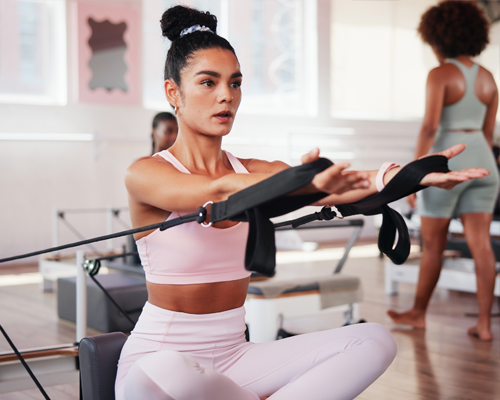
The algorithm can also be applied to anything from Zumba to Reformer Pilates to physiotherapy. The PT model took us a couple of years to build, but we’ve already created a circuit class model and plan to expand on this with a series of group exercise products. We just need to know what ‘great’ looks like for any given club.
What potential do you see for VOR?
Max Cotton: I want to use VOR to demonstrate how the best use case for AI isn’t to replace trainers, but to enhance what they’re capable of.
In spite of this person-first vision, we’re also looking to create a trainer-less option. However, this will be a quick-fire solution with nowhere near the same level of hyper-personalisation. We see it as a funnel into personal training, giving people just a taster of having a programme and leaving them wanting more.
Will you tackle other markets?
Max Cotton: We’d ultimately like VOR to transcend fitness and embrace healthcare too. I’m excited by the opportunities to build in parameters for conditions such as hypertension, Type 2 diabetes, obesity, rheumatoid arthritis and so on, as well as to support pre- and postnatal women. In some cases, trainers will also need specialist qualifications.
Peter Roberts: Before we move into the group exercise and healthcare markets with VOR, we’ll first embed the PT product, with the aim of dominating the market niche we know best.
We’re in a strong position commercially; it would be hard for anyone else to come in now and quickly copy what Max and his team have built, given the amount of development work that’s been done.
We’re ready to deliver and have something I believe a lot of people will want. The door is now open.